Understanding Industrial Hygiene
Gain a better understanding of what Industrial Hygiene (IH) is, its importance, basic principles, regulatory standards, and the best practices for conducting exposure assessments.
Gain a better understanding of what Industrial Hygiene (IH) is, its importance, basic principles, regulatory standards, and the best practices for conducting exposure assessments.
Published 28 Apr 2026
Article by
7 min read
Industrial hygiene, also known as occupational hygiene, deals with the process of identifying, evaluating, and controlling real or potential workplace environmental stressors or risks that can impact the well-being of workers and community members. It is primarily concerned with preserving good health across the workplace by anticipating hazards that could affect workers.
The United Nations estimates that 2.78 million workers die from occupational accidents and work-related diseases, while 374 million workers suffer from non-fatal work incidents. Implementing proper industrial hygiene strategies can effectively control workplace hazards and improve working conditions. This practice helps protect employees from various types of injuries and diseases, such as nonfatal illnesses, respiratory conditions, skin diseases, poisoning, hearing loss, and repetitive stress injuries, among others.
One common way of practicing industrial hygiene is by mandating the use of Personal Protective Equipment (PPE) to improve working conditions, provide respiratory protection, and prevent or eliminate workers’ exposure to hazards. Another is complying with industry safety regulations, especially for high-risk fields like manufacturing and construction, to ensure workers receive the appropriate training and working conditions.
Stay ahead of regulations and maintain a safe workplace with a digitized compliance tool.
Occupational Health and Safety (OHS) refers to the process of dealing with the effects of hazard exposure such as damage to human health, prescribing medicines for treatment and prevention, and conducting pre-employment, along with periodic, medical examinations. Ultimately, OHS aims to assess potential occupational diseases so that continuous healthcare assistance can be provided to workers.
On the other hand, industrial hygiene aims to reduce or remove work hazard exposure by implementing a series of controls and programs toward keeping the workplace hygienic, free from environmental stressors, and hygienic.
Industrial hygienists perform risk assessments to anticipate health and safety concerns so that they can create and implement solutions and plans for prevention. Before conducting assessments, it’s a must to understand first: “What are the core principles of industrial hygiene?”. Here are its 5 principles:
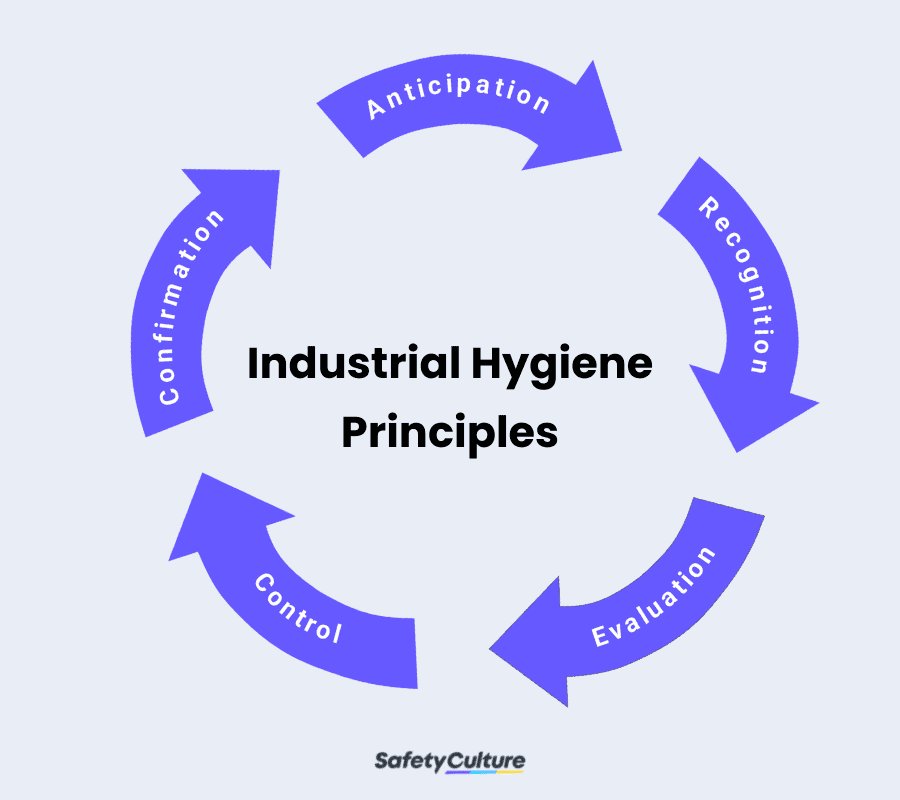
Industrial Hygiene Principles
This step entails a thorough documentation of the workplace design, operations, processes, specific work tasks, materials, and worker population. One notable example of anticipating industrial hygiene hazards is the use of Safety Data Sheets (SDS) as required under the Hazard Communication Standard (HCS) of the U.S. Occupational Safety and Health Administration (OSHA).
SDSs include important information on the properties of each chemical, the various hazards, protective measures, and safety precautions for proper handling, storing, and transporting of the chemical. Employers must ensure SDSs are readily available to all workers to serve as their guide on how to handle hazardous chemicals in the workplace.
This step also covers the importance of identifying any potential exposure issues caused by workplace hazards. In this phase, using a hazard identification checklist would be useful.
Having a system of surveying each worker about how they get their work done is a key part of recognizing hazards. Employers must consider the layout of the workplace as employees working close to each other, also called simultaneous operations, can affect their hazard exposures.
This is where the exposure assessment comes in. Strictly done by qualified professionals such as industrial hygienists, the process involves evaluating the exposure risk and determining the who, what, where, when, and how, based on the work environment and industrial hygiene instruments necessary.
According to OSHA, there are 3 main ways on how to reduce employee exposure to occupational hazards:
Engineering controls – These aim to reduce or remove the hazard at its source or isolate the worker from the hazard itself. Such controls include confining work operations, installing general and local ventilation systems, eliminating toxic chemicals, and replacing them with non-toxic ones.
Work practice controls – Such practices alter the way tasks are performed to mandate safe work practices and ask workers to follow the proper procedures to minimize exposures. Some examples include implementing workplace housekeeping practices and providing good supervision guidelines.
Administrative controls – Setting production and task schedules is key to controlling employees’ hazard exposure. For instance, employers may schedule high-exposure productions during a period when only a few employees are present.
Once measures and controls have been established, the last step is to check the performance of what was implemented. Proactive confirmation also involves investigating issues, both present and potential, and employing corrective actions that complement your industrial hygiene program initiatives.
Under the OSH Act of 1970, some examples of OSHA standards involve requiring employers to:
Prevent employees’ exposure to infectious diseases and harmful chemicals
Ensure the safety of those working in confined spaces
Provide fall protection, ample training for dangerous jobs, and safety equipment such as PPE
Build from scratch or choose from our collection of free, ready-to-download, and customizable templates.
A comprehensive industrial hygiene exposure assessment program is designed to gauge exposure profiles and assess the acceptability of workplace exposure to environmental agents. As prescribed by the American Industrial Hygiene Association (AIHA), the basic steps of this systematic exposure assessment and control process include the following:
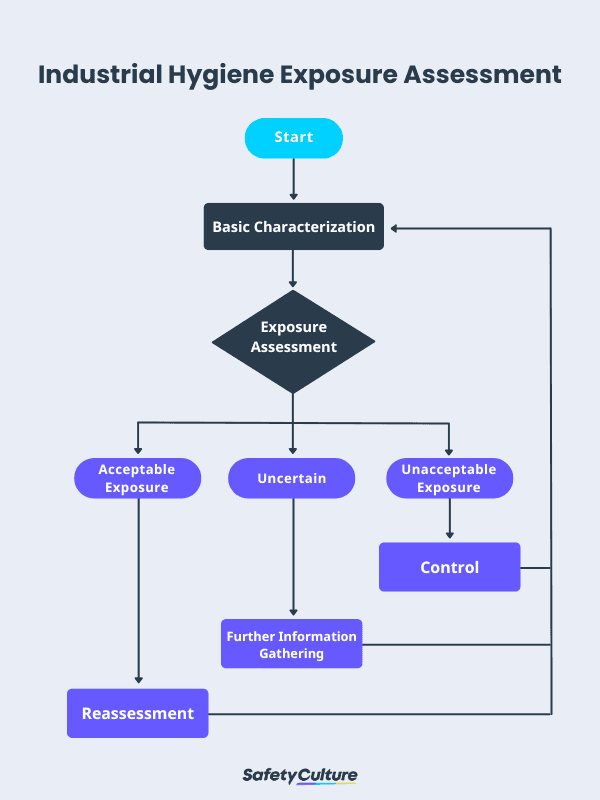
Industrial Hygiene Exposure Assessment
Make sure to gather the necessary details to characterize the project site or facility, process, operations, workforce, and environmental agents. For this step, it’s highly crucial to conduct documentation that is well-organized. In most cases, this characterization is done as part of the job safety analysis, which is also known as the job hazard analysis.
Conducting qualitative exposure assessments paves the way to screening exposure risks and letting employers set priorities on the type of program to be implemented.
This process also defines the groups of similarly-exposed workers through the Similar Exposure Groups (SEGs). After this, their exposure profiles will be described, and judgments on these profiles will depend on the: (1) estimated exposure level, (2) gravity of health effects, and (3) level of certainty associated with the available data.
Further, industrial hygiene risks may be classified as:
Unacceptable – This requires implementing engineering and/or administrative controls. Additionally, strictly mandating the use of PPE until controls are effectively carried out is recommended.
Acceptable – Even if there’s no action required, routine monitoring may be necessary for judgment validation purposes. Doing this is also a key step in ensuring that exposures remain acceptable.
Uncertain – This means that there’s a need to acquire additional information to determine the acceptability of the exposure.
Mainly applied for uncertain exposure judgments, collecting supporting information on health effects helps in resolving such uncertainties with increased confidence. Hence, exposure monitoring can also be conducted as needed.
Once priority measures have been confirmed, establish strategies most especially for unacceptable and uncertain exposures. While organizations should ensure that this step doesn’t necessarily happen often, having principles and programs in place is important to take the proper precautions or steps to protect worker health.
As part of an employer’s responsibility to promote a culture of safety and quality, conducting thorough periodic reviews of exposures is a must. This is where identifying the frequency of routine monitoring comes in, and whether certain exposures remain acceptable and tolerable. Continuous monitoring is highly recommended, most especially if changes in processes or operations happen regularly.
Make sure to fully document SEGs, the workers’ exposure profiles, exposure judgments, monitoring results, and hazard control measures. Further, be transparent to your employees about the results of exposure assessments. Occupational health managers may use these data to gauge whether recommended practices are being followed and monitored well, and help gauge the accuracy and integrity of the results.
Empower your team with SafetyCulture to perform checks, train staff, report issues, and automate tasks with our digital platform.
Getting everyone on board with organizational initiatives toward industrial hygiene starts with training the workers involved. Using digital tools like a Learning Management System (LMS) with standardized courses for industrial hygiene can make it easier to align employees with the right safety knowledge.
SafetyCulture is a mobile-first operations platform adopted across industries such as manufacturing, mining, construction, retail, and hospitality. It’s designed to equip leaders and working teams with the knowledge and tools to do their best work—to the safest and highest standard. Efficiently manage and streamline health and safety processes across the organization, including incident management, safety audits and inspections, risk assessment, waste management, and more, using a comprehensive manufacturing software solution.
Save time and reduce costs
Stay on top of risks and incidents
Boost productivity and efficiency
Enhance communication and collaboration
Discover improvement opportunities
Make data-driven business decisions