Mastering Project Delivery
Explore the essentials of project delivery, from planning to completion, and discover effective approaches to drive successful results.

Explore the essentials of project delivery, from planning to completion, and discover effective approaches to drive successful results.
Published 27 Apr 2026
Article by
6 min read
Project delivery is a structured framework used to move a project from concept to completion, whether it's constructing high rises or deploying a software update. It coordinates stakeholders, technical standards, and rigorous procedures. This ensures every phase - from planning to implementation - results in a final product that meets all safety, quality, and compliance requirements.
Implementing a structured project management system is not just about paperwork. This prevents catastrophes by ensuring teams are organized, aligned, and accountable from start to finish. The Denver International Airport baggage system failure was an example of a project delivery failure that resulted in delays and billions in cost overruns.
Operating from a defined playbook triggers a success chain. Clear roles and seamless coordination provide total control over costs and risks, allowing teams to focus on quality. Continuous monitoring creates an improvement loop that makes every future project leaner and more reliable.
Cultivate a culture of excellence with our digital solutions that enhance efficiency, agility, and continuous improvement across all operations.
The framework seems simple, with only four specific phases. But its power lies in scalability. It can be tailored based on project size, industry requirements, and operational complexity.
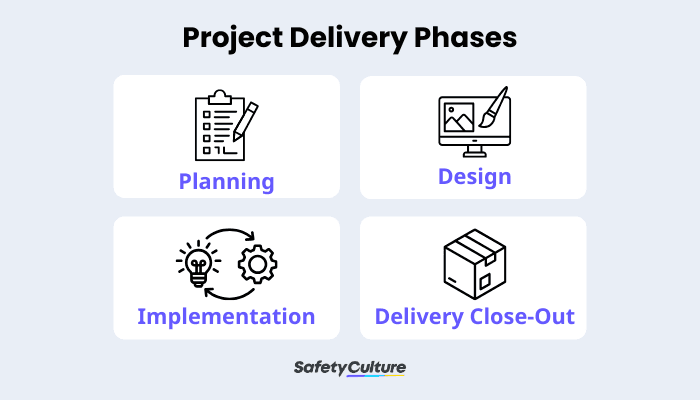
Setting the foundation through careful project planning ensures everyone starts with a clear direction. This minimizes uncertainty, reduces risks, and prevents costly changes. A comprehensive plan includes the following:
Scope definition and project objectives
Stakeholder identification and alignment
Budget estimation and resource planning
Risk identification and mitigation planning
Timeline development (e.g., schedules, milestones)
In this phase, project requirements are translated into detailed plans, specifications, or prototypes that guide execution. Well-developed designs ensure feasibility, reducing errors during implementations. These are some essential components:
Concept development and validation
Technical specifications and documentation
Stakeholder feedback and regulatory alignment
This is where the actual work happens. Teams execute the plans, build deliverables, and manage day-to-day operations. Efficient coordination and monitoring are critical in this phase to stay on track. Focus on these to help teams stay on track:
Workflow management
Communication across teams
Ongoing risk management and issue resolution
The last phase finalizes the project, ensuring deliverables are completed, approved, and handed over to the client or end user. Proper closeout should include the following:
Final inspections and quality checks
Client acceptance and sign-off
Documentation and reporting
Financial closure and contract completion
Handover of deliverables
Build from scratch or choose from our collection of free, ready-to-download, and customizable templates.
Success in project delivery thrives on collaboration. When multiple stakeholders contribute their expertise to achieve a shared goal, their team becomes a unified powerhouse. Here are the core roles:
Project Owner: the individual or organization funding the project. They define objectives, approve budgets, and make key decisions.
Designers (e.g., architects, engineers, or creatives): responsible for translating requirements into plans and specifications. They ensure functionality, compliance, and feasibility while collaborating with stakeholders to refine designs and address technical issues.
Contractor: responsible for executing the work based on the approved designs. They manage labor, materials, and equipment, ensuring the implementation meets quality standards, timelines, and contractual obligations.
Project Manager: oversees the entire project lifecycle. They coordinate teams, schedules, and resources, monitor progress, manage risks, and ensure communication among stakeholders. By doing all these, the project manager keeps the entire endeavor on track and within scope.
Choosing the right method shapes how responsibilities are assigned, risks are managed, and timelines are met. Each approach is different, offering distinct advantages. Get to know the most common:
Method | Definition | Advantage | Best For |
DDB | Design-Bid-Build is a traditional method where design and implementation are separate contracts. Contractors need to bid again after the design is completed. | Clear scope and competitive pricing | Straightforward, well-defined projects, like public infrastructure (e.g., government school buildings or offices) |
DB | Design-Build means a single entity handles both design and construction under one contract. | Faster delivery and streamlined communication | Speed and efficiency, needed for commercial buildings or warehouses |
CMR | Construction Manager at Risk means a manager is involved early and commits to delivering the project within a guaranteed maximum price (GMP) | Early cost control and expert input | Balancing control and collaboration, such as hospitals or financial institutions |
MP | Multi-Prime is when the owner contracts directly with different suppliers or vendors for different project components. | Greater control and potential cost savings | Maximizing owner control, like in marketing or event production |
IPD | Integrated Project Delivery is a collaborative approach where stakeholders share risks and rewards under a single agreement. | High collaboration and innovation | Highly complex, innovation-driven projects like tech goods or media production |
Projects are minefields of shifting goals, hidden risks, and confusing handovers. Without a clear system, these gaps lead to failures. Aside from following the playbook, take note of these best practices at every stage of the process:
Decide how to build before starting anything. Choosing the right method early ensures the budget, timeline, and team roles match the project’s unique technical and safety requirements.
A clear roadmap eliminates guesswork. A detailed plan defines every task and deadline, ensuring everyone knows their role and the project stays on track from day one.
Get the design right and keep stakeholders in sync. When everyone agrees on the blueprints and goals, costly mid-project changes are prevented. This also ensures the final result meets expectations.
Expect the unexpected. By spotting hazards early and staying adaptable, the team can navigate shifting goals or "hidden mines" without losing momentum or compromising on safety. Everyone should be well-trained in every aspect of project management to uphold this goal.
A structured closeout ensures all documents are signed, quality is verified, and lessons are learned to make the next job even better.
The Australian Open, a premier international tennis tournament, replaced disconnected, paper-based inspections with a centralized system. Real-time reporting and team synchronization helped them gain total control over risks. This disciplined approach ensures they deliver a world-class fan experience while building a loop of continuous improvement for future events.
SafetyCulture is a mobile-first operations platform adopted across industries such as manufacturing, mining, construction, retail, and hospitality. It’s designed to equip leaders and working teams with the knowledge and tools to do their best work—to the safest and highest standard.
Develop fool-proof project plans with easy-to-tailor templates and enable real-time progress tracking with digital checklists. Streamline workflows and ensure quality compliance across all phases through instant reporting and improved inter-departmental communication. Minimized risks to deliver consistent results as promised in the initial blueprint through a unified platform.
✓ Save and reduce costs
✓ Stay on top of risks and incidents
✓ Boost productivity and efficiency
✓ Enhance communication and collaboration
✓ Discover improvement opportunities
✓ Make data-driven business decisions
In this article