An Introduction to Core Drilling
Learn all about core drilling, why it’s performed, the types of core drilling, the risks involved, and safety measures to take to reduce the risk.
Learn all about core drilling, why it’s performed, the types of core drilling, the risks involved, and safety measures to take to reduce the risk.
Published 20 Aug 2024
Article by
6 min read
Core drilling refers to the process of removing a solid, cylindrical sample of material from the ground or structure using a hollow drill. The sample, called a core, helps teams assess the density, chemical composition, strength, and other properties of soil, rock, or concrete. It’s commonly used in mining, construction, and environmental projects for structural testing before proceeding with any building process.
Core drilling traces its roots to the 19th-century gold and mineral rushes. What began as a grueling, labor-intensive process evolved into high-precision engineering that allows for deeper exploration, better structural analysis, and improved excavation safety. These are the modern drilling methodologies, their specific applications, and the specialized equipment required for each:
Used in mining and large-scale civil engineering, hard rock core drilling is a high-endurance technique designed for deep-strata analysis of up to 5,000 feet. It evaluates rock quality, mineral density, and deep geological structures. Common equipment used includes:
Diamond rotary core drill rigs
Surface-mounted hydraulic rigs
Underground jumbo drill rigs
This method is often used in environmental science and urban construction for soil contamination studies, and foundational testing. The equipment used has two barrels to encase unconsolidated materials (e.g., sand, clay, silt) and prevent collapse, since digs can go down to 500 feet. This includes:
Hollow-stem auger rigs
Shelby tube samplers
Rotary wash drilling rigs
Considered the gold standard for precision work in existing structures, core boring uses a hollow-diamond-tipped bit that rotates at high speeds to cut cylindrical holes with minimal vibration. Commercial construction and renovation workers use this to install HVAC, plumbing, and electrical conduits. Examples of equipment that can carry out this drilling method are:
Handheld electric core drills
Hydraulic core drilling machines
Rig-mounted concrete core drill systems
Where speed and sample integrity are paramount, wireline core drilling serves as the industry benchmark for medium to ultra-deep boreholes. It is the preferred method across mining exploration, hydrogeology, and geotechnical sectors for extracting continuous deep rock samples and monitoring groundwater. Commonly used equipment includes:
Wireline diamond drill rigs
Hydraulic top-drive systems
Automated rod handling rigs
The heavy hitter for initial exploration, this method can penetrate hard, rocky soils faster than any other method. It’s used for initial sampling and bulk testing at depths exceeding 500 meters in dense, rocky terrain in mineral exploration and large-scale geotechnical grade control. To achieve the desired results, this equipment and these processes are used:
Reverse circulation rigs
Dual-wall drill pipe systems
Compressor-supported drilling units
There are several methods similar to core drilling, but they aren't interchangeable. Choosing the wrong technique based on soil or data needs compromises sample integrity, project costs, and structural accuracy. As such, it’s important to take note of the key differences, such as:
Drilling Type | Sample Type | Sample Quality & Accuracy | Specific Use | Industry |
Core | Solid, intact core from hard rock and consolidated formations | Very high, intact layers visible | Detailed geological and structural analysis | Mining, geotechnical engineering, structural testing |
Sonic | Continuous, high-quality (less disturbed) from mixed soil, sand, and gravel | Very high, minimal disturbance | High-quality soil and mixed-ground sampling | Environmental and geotechnical projects |
Mud Rotary | Loose cutting mixed with drilling mud from soft to medium soils | Low to moderate, not intact | Fast borehole drilling, especially for water wells | Water well drilling |
Percussion | Broken rock fragments | Low, fragmented samples | Breaking through hard rock | Quarrying and foundation drilling |
Auger | Loose soil | Moderate, can be disturbed | Shallow soil investigation | Construction site testing |
Core drilling sites are high-risk environments. Recognizing these hazards and understanding how they can happen during toolbox talks is critical to preventing catastrophic injury, equipment failure, and costly operational shutdowns.
Entanglement with rotating equipment - Moving parts can catch on clothing or limbs, which can lead to crush injuries and potential amputations.
High-pressure fluids and blowouts - Hose bursts or sudden release of fluid cause impact injuries and loss of borehole control.
Ground instability and borehole collapse - Unstable formations may collapse, trapping tools or cause surface subsidence, especially in fractured rocks or loose soil.
Manual handling and ergonomic strain - Equipment and tools used in this task are heavy. Repetitive lifting and awkward postures can result in musculoskeletal injuries affecting workers’ long-term health.
Noise, dust, and silica exposure - Drilling generates high noise levels and airborne particles. Long-term exposure can cause hearing loss and respiratory illnesses.
Rigorous safety practices are the ultimate defense against mechanical and environmental hazards during core drilling. Consistent application eliminates injury, protects assets, and ensures total control in high-risk drilling environments. Here are a few key practices to consider:
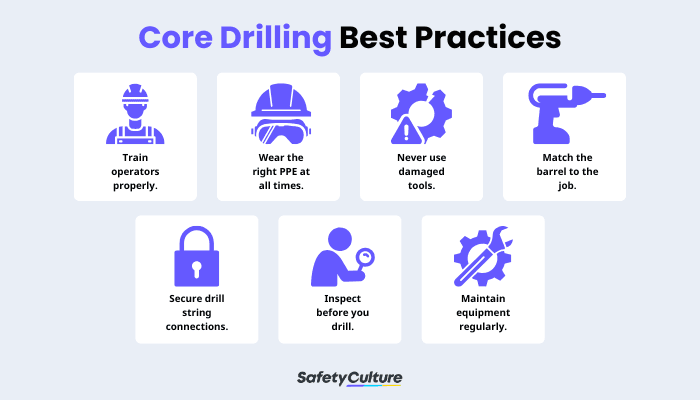
It’s crucial that operators are able to respond fast to hazards, preventing costly and life-threatening mistakes. Ensure personnel are fully trained in equipment handling, hazard recognition, and emergency response to give them the knowledge and skills they need to carry out their tasks safely.
PPE serves as the last line of defense against workplace hazards and is meant to be worn at all times. Putting on proper eye, respiratory, hand, head, and hearing protection before approaching equipment or active drilling areas should be non-negotiable.
Faulty tools can fail under load or pressure, resulting in equipment damage or injuries. Check that all tools are free from cracks, wear, or defects. Unsafe equipment must be replaced immediately.
Incorrect parts increase vibration, increasing the risk of overheating and mechanical failures. Select a core barrel compatible with the drill rig and formation type to prevent strain and ensure safe, accurate recovery.
Loose connections can lead to rod whipping and potential equipment collapse. Tighten and stabilize all drill string components to prevent vibration, misalignment, or dangerous disconnections.
Small issues can become major safety issues during active drilling. Detecting these early is necessary for proactive hazard detection and risk prevention. Perform a final pre-operation check for leaks, loose fittings, alignment issues, and system readiness.
Well-maintained equipment operates predictably, minimizing sudden malfunctions on site. This also extends the machinery’s lifespan to lower operational costs. Follow scheduled servicing and preventive maintenance to reduce long-term risk and avoid unexpected failures.
SafetyCulture is a mobile-first operations platform adopted across industries such as manufacturing, mining, construction, retail, and hospitality. It’s designed to equip leaders and working teams with the knowledge and tools to do their best work—to the safest and highest standard.
Streamline site, machinery, and protective equipment inspections with digital checklists. Ensure that tasks are accomplished in an organized manner, including training and toolbox talks, with core drilling SOPs. Minimize hazards and prepare for emergencies with real-time activity monitoring and reporting. Boost efficiency, safety, and compliance during core drilling activities through a unified platform.
✓ Save and reduce costs
✓ Stay on top of risks and incidents
✓ Boost productivity and efficiency
✓ Enhance communication and collaboration
✓ Discover improvement opportunities
✓ Make data-driven business decisions