How to Get Started in Commercial Construction
Curious about the commercial construction process? This article breaks it down step-by-step, from planning to completion.
Curious about the commercial construction process? This article breaks it down step-by-step, from planning to completion.
Published 28 Apr 2026
Article by
6 min read
Commercial construction is the process of planning, designing, and building of structures used for business or commercial. This type of construction includes office buildings, retail stores, warehouses, medical centers, hotels, and industrial facilities. Projects also vary in scale from small retail shops and office spaces to large complexes like shopping malls and skyscrapers.
Commercial, residential, and industrial construction are three distinct types of building projects. Each serve different purposes and require distinct approaches, as follows:
Generally larger in scale and more complex
Often built with steel, concrete, and composite materials to create durable, functional spaces designed around client needs and business operations
Must follow stricter fire safety and accessibility codes compared to residential builds
Covers homes and living spaces, including single-family houses, apartments, condos, and townhouses
Generally uses wood framing and materials optimized for comfort, insulation, and aesthetics
Have shorter timelines, simpler permit requirements, and are often funded by homeowners
Involves facilities for manufacturing, processing, warehousing, and production, such as factories, power plants, and refineries
Focuses on heavy-duty structures built to support large machinery and strict safety standards to handle hazardous materials
Requires strict compliance with specific building codes to ensure facilities are durable and able to withstand harsh conditions, all while maintaining worker safety
Commercial construction involves a wide range of projects. The following are some of the most frequent commercial construction tasks.
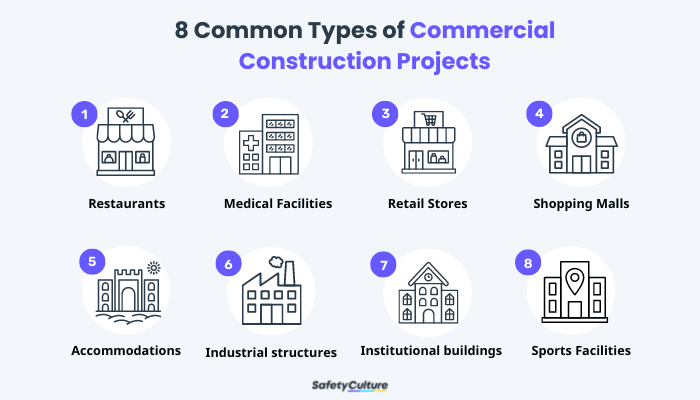
8 Common Types of Commercial Construction Projects | SafetyCulture
Restaurants
Medical Facilities
Retail & Grocery Stores
Shopping Malls
Accommodations such as hotels, apartments, etc.
Industrial structures such as factories, warehouses
Institutional buildings such as high schools, universities
Sports Facilities
Construction projects for businesses can range from small family restaurants to mid-size office structures and large city high-rises. No matter the size, all projects must follow standards such as the International Building Code (IBC) and fire safety rules from the National Fire Protection Association (NFPA).
Here’s a closer look at how these projects differ:
Generally, small-scale construction involves renovations, repairs, or expansions that don’t significantly alter a building’s footprint. Typically, these projects take less time to complete than mid-size or large-scale construction and require less equipment and crew members.
Examples
Installing new windows, doors, or roofs
Interior office renovations or remodelling
HVAC system upgrade or installation
Medium-scale construction entails upgrading, expanding, and starting from the ground up. Projects are more complex than small-scale projects, such as adding a floor to a building. It implies that projects might need several months or even a year to complete.
Examples
Buildings for businesses like mid-size offices, hotels, or medical facilities
Construction of a new wing for an existing structure
Large-scale construction is any project that significantly changes the footprint of a building or creates an entirely new structure. These jobs are much more complex than small or mid-size projects, often taking years to finish. Not only do they take longer, but they also require more specialized equipment and a high level of coordination among various teams.
Examples
Buildings for businesses like large offices, skyscrapers, or shopping malls
Infrastructure projects like airports or bridges
Successful commercial building construction requires several steps. Below is a high-level breakdown of the process:
This stage begins before a project is authorized and any planning begins. The initial design stage usually takes three main steps:
Programming and Feasibility – The planning team defines the project’s goals through a feasibility study or business case. This step determines the building size, layout, and space needs.
Schematic Design – The team then produces initial sketches showcasing space layout, materials, colors, and textures. These plans guide design development and material selection.
Contract Documents –The final drawings and specifications are all found in these files. Bidders use these documents to collaborate on the job.
After the bidding process, the selected contractor forms a project team before ‘breaking ground,’ as the industry says. A typical unit consists of the following members:
Project Manager
Contract Administrator
Field Engineer
Superintendent
Health and Safety Manager
Next, the team reviews the construction site and takes care of environmental issues, such as soil testing. The city authorities will review all construction plans and findings after the site inspection.
After finalizing the strategic plan and budget, the team sources labor, materials, and expertise, including designers, architects, engineers, and other professionals.
This phase involves ordering, purchasing, or renting materials, tools, and services needed for the build. This stage of construction can pose more or fewer challenges depending on the project’s scope, resources available, and start date.
In the procurement phase, these items are typically purchased:
Concrete: Usually procured and delivered within 1 day to 1 week depending on supplier location and batch size; sometimes mixed on site for faster availability.
Steel: Lead times typically range from 2 to 8 weeks depending on fabrication requirements and supplier schedules.
Lumber: Procurement usually takes 1 to 3 weeks depending on wood type and supplier inventory.
Masonry materials: Lead times vary generally between 1 to 4 weeks depending on type and supplier.
Drywall and insulation: Typically procured within 1 to 2 weeks.
Roofing materials: Usually 1 to 3 weeks procurement time.
Paint and finishes: Generally 1 to 2 weeks depending on order size and specialty products.
Construction equipment: Rental or purchase lead times can range from a few days for common equipment to 2-4+ weeks for specialty or custom equipment.
Heavy vehicles: Procurement or rental often takes 1 to 4 weeks.
This is where all planning and coordination come together. Before any construction begins, the project manager, design, and engineering teams have already worked hard to set the project up for success. During construction, control falls to contractors and subcontractors.
Construction managers oversee quality control, safety, and scheduling, ensuring every stage aligns with contract documents, Requests for Information (RFIs), and approved technical submittals.
Meanwhile, architects and engineers review RFIs, submittals, and inspections throughout the build to confirm compliance and maintain quality standards. The contractor should complete the project on time.
Following the completion of construction at the job site, the project enters the closure phase. A project closeout entails deactivating assets, returning equipment rentals, cleaning up the worksite, and allowing subcontractors to head elsewhere.
A post-project review is beneficial to detect incomplete tasks, analyze struggles and consolidate a list of pointers for future improvement. It’s helpful from a project management perspective.
SafetyCulture is a mobile-first operations platform adopted across industries such as manufacturing, mining, construction, retail, and hospitality. It’s designed to equip leaders and working teams with the knowledge and tools to do their best work—to the safest and highest standard.
Streamline processes, eliminate bottlenecks, enhance resource utilization, and build an agile and scalable infrastructure with SafetyCulture. Strive for operational excellence to boost competitive advantage, foster sustainable growth, and deliver long-term value.
Save time and reduce costs
Stay on top of risks and incidents
Boost productivity and efficiency
Enhance communication and collaboration
Discover improvement opportunities
Make data-driven business decisions
In this article