
Understanding Underground Storage Tanks
Learn about the purpose of underground storage tanks and the compliance requirements to properly maintain and dispose of them.

Published 9 Jan 2026
Article by
7 min read
What is an Underground Storage Tank?
Underground Storage Tanks (USTs) are storage systems that include one or more tanks and connected underground piping, with at least 10% of their combined volume located beneath the ground surface. These tanks are often used to store petroleum products like gasoline, chemicals, and other hazardous materials. Their main purpose is to safely store large volumes of product while protecting it from weathering, evaporation, and theft.
Compliance Requirements for Underground Tank Systems
Given that UST systems store petroleum products and potentially hazardous materials, they’re heavily regulated because of the threat they pose on the environment. These systems are strictly regulated by agencies like the U.S. Environmental Protection Agency (EPA) at the federal level, with state programs for effective implementation.
It’s important to follow the compliance requirements for underground tank systems, which include:
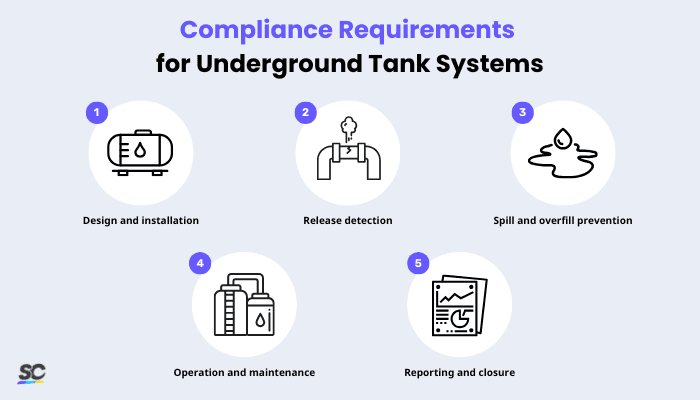
Design and installation
UST systems must meet federal standards for corrosion protection, spill and overfill prevention, and secondary containment for new or upgraded tanks. Tanks and piping must be constructed with approved materials like fiberglass-reinforced plastic or steel with cathodic protection to reduce the risk of leaks.
Release detection
Owners must implement monthly monitoring methods, such as automatic tank gauging,vapor monitoring, or interstitial monitoring for double-walled systems, to identify petroleum releases early. Piping must use continuous monitoring or other regulation-approved methods, with records kept for at least three years.
Spill and overfill prevention
Equipment like automatic shutoff valves, ball float valves, or flow restrictors must be installed to prevent spills during delivery. Spill buckets and containment sumps must also undergo testing required every three years. Overfill prevention requirements apply to all regulated USTs storing petroleum products.
Operation and maintenance
Regular inspections, recordkeeping, and operator training are essential for ongoing compliance. They should include annual checks for corrosion protection and walkthrough inspections. Financial responsibility coverage for cleanup costs is also mandatory, which is why it’s important to properly maintain tanks to prevent spillage.
Create your own underground storage tank checklist
Build from scratch or choose from our collection of free, ready-to-download, and customizable templates.
Reporting and closure
Report suspected releases within 24 hours, and properly close tanks with site assessments to check for contamination. Noncompliance can lead to penalties up to $11,000 per tank per day.
Underground Storage Tanks Laws and Regulations
In addition to operational requirements, there are also laws and regulations that govern those who own and operate USTs. This includes key regulations such as:
Resource Conservation and Recovery Act (RCRA) : Authorizes EPA to regulate USTs storing petroleum or hazardous substances , enacted via 1984 amendments to prevent groundwater contamination from leaks.
Energy Policy Act of 2005 : Added requirements for spill prevention equipment, overfill protection, and corrosion protection upgrades for existing USTs.
40 CFR Part 280 : Set technical standards for design, installation, release detection, operation, maintenance, financial responsibility, and corrective actions.
40 CFR Part 281 : Also known as the State Program Approval , this allows states to enforce equivalent or stricter standards, with EPA oversight; most states implement their own UST programs.
Are All Tanks Required to Follow Federal EPA Regulations?
The following tanks are not subject to the federal EPA regulations:
Tanks holding motor fuel that are 1,100 gallons or less and used for noncommercial purposes on farms or in residential areas
Storage tanks for heating oil used on the property where the tank is located
Tanks that are on the floor or above it in underground areas, such as basements or tunnels
Septic tanks for collecting stormwater and wastewater
Flow-through process tanks
Tanks that hold 110 gallons or less
Emergency spill and overfill tanks
Most oil storage tanks follow federal EPA regulations mainly through the Spill Prevention, Control, and Countermeasure (SPCC) rule. Some state and local authorities may have rules about these kinds of tanks. Find out if your tanks are subject to any regulations from your state or local government’s website.
Improve your EHS Management
Cultivate a safe working environment and streamline compliance with our EHS solutions.
Reasons for Removal of Underground Storage Tanks
While USTs are incredibly useful, it’s sometimes necessary to remove them or make them defunct because of public or environmental safety hazards. Here are a few other reasons why a UST may need to be removed:
Out-of-Use Tanks
Sometimes, a property owner does not use their UST anymore. Perhaps their business no longer requires this type of underground storage tank or a newer tank was installed and renders the old one defunct. Unusable tanks threaten the environment, and best practices and laws suggest removal.
Leaking Tanks
The owner or operator of a UST must act if it leaks. A leaking UST might present a problem of soil and water resource contamination. Additionally, vapors might escape the tank and enter buildings, posing a health risk to occupants. UST removal is often the best way to mitigate these risks.
Replacing a Tank
Some older and less updated USTs may necessitate removal and replacement to bring them into compliance with new regulations. For example, more recent upgrades include double- or triple-walled tanks, which now meet most jurisdictions’ regulatory requirements.
The Underground Storage Tank Abandonment Process
Abandoning a UST can be complicated, as it requires permits, certified professionals, and proper handling of the defunct tank. It’s important to follow key steps to carry out this task properly, including:
Obtain permits
Secure required permits from local or state authorities, such as environmental protection departments, before starting work; this often includes approvals for soil sampling and final abandonment.
Empty the tank
The contractor who works with underground storage tanks must empty the tank of any liquids or residue. Emptied tanks must be injected with inert gas because their contents are usually flammable and poisonous. This process must be overseen and certified by a professional toxicologist. Additionally, the transportation and disposal of these materials may require permits and regulation by government agencies.
Perform site assessment before excavation
Soil testing is essential to ensure no harmful materials are around the UST. A professional geologist or engineer will help with this. If the soil is clean, the removed soil can be used to fill in the hole. If the soil is contaminated, it must be removed using special procedures for hazardous materials. More testing will be needed to determine what else needs to be done to make the area safe again.
Abandon in place or remove
In special cases where it is necessary to stabilize an underground tank,filling it with a cement slurry may be the only option. The method is only allowable when it’s impossible to remove the tank without compromising structural integrity, such as when it lies directly below a building perimeter or retaining wall. In addition to the original UST abandonment permit, an additional special license is necessary if such a case occurs.
Provide testing and closure report
Analyze soil samples for contaminants, perform remediation if needed, and submit a closure report with lab results, manifests, and certifications to obtain a "No Further Action" letter from regulators.
To obtain a “No Further Action Certificate,” it is mandatory that you adhere strictly to the standard procedures and protocols set forth by the environmental agency. Various qualifications and fees are required to file a successful application for a UST abandonment permit; some of these include:
Additional licenses from local regulatory authorities
An excavation executed correctly
Testing for soil contamination performed
Efficient remediation methods implemented
Effectively Maintain and Operate Underground Storage Tanks with SafetyCulture
Why use SafetyCulture?
SafetyCulture is a mobile-first operations platform adopted across industries such as manufacturing, mining, construction, retail, and hospitality. It’s designed to equip leaders and working teams with the knowledge and tools to do their best work—to the safest and highest standard.
Efficiently manage and streamline health and safety processes across the organization, including incident management, safety audits and inspections, risk assessment, waste management, and more, using a comprehensive EHS software solution.
✓ Save time and reduce costs
✓ Stay on top of risks and incidents
✓ Boost productivity and efficiency
✓ Enhance communication and collaboration
✓ Discover improvement opportunities
✓ Make data-driven business decisions
FAQs About Underground Storage Tanks
In this article
- What is an Underground Storage Tank?
- Compliance Requirements for Underground Tank Systems
- Underground Storage Tanks Laws and Regulations
- Are All Tanks Required to Follow Federal EPA Regulations?
- Reasons for Removal of Underground Storage Tanks
- The Underground Storage Tank Abandonment Process
- Effectively Maintain and Operate Underground Storage Tanks with SafetyCulture
- FAQs About Underground Storage Tanks
Related articles
Risk Assessment
Safety

A Comprehensive Guide to Risk-Benefit Analysis
Learn how risk-benefit analysis helps teams evaluate trade-offs, document residual risk, and support safer operational decisions.
Equipment Safety
Retail

Forklift Safety
Learn about the basics on forklift safety, forklift operator requirements, safety hazards and tips, and digital forklift tools.
Safety
Warehouse Safety
Key Strategies for Warehouse Emergency Preparedness and Response
Learn about warehouse emergency preparedness essentials, such as risk management, evacuation planning, and best practices to ensure safety.