Green Building for a Carbon-Neutral Future
Explore green building fundamentals, key features, and emerging trends that shape sustainable construction worldwide.
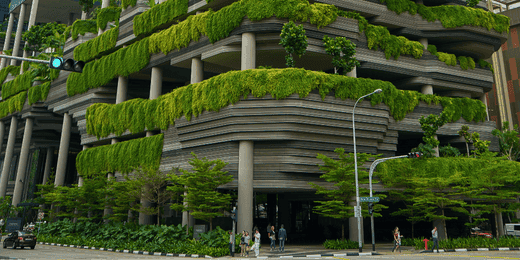
Explore green building fundamentals, key features, and emerging trends that shape sustainable construction worldwide.
Published 5 May 2026
Article by
5 min read
Green building is an innovative construction approach that centers on sustainable practices to minimize a structure’s environmental impact. It involves sustainable materials, efficient energy systems, and other eco-friendly features. Green practices are a growing trend in the construction industry, with more and more builders adopting them in buildings to reduce their carbon footprint.
According to the World Emissions Clock, the built environment was responsible for over 3 gigatons of greenhouse gas (GHG) emissions in 2022. While adopting sustainable construction and high-efficiency energy and water systems is critical to reversing this trend, the advantages of green building extend far beyond environmental stewardship.
For building owners and operators, implementing these standards secures long-term operational resilience and financial gains through:
Lower utility and operational costs
Reduced waste generation
Improved indoor environmental quality
Optimal building performance
Enhanced comfort and well-being of occupants
Increased property values
Green buildings differ depending on local regulations, standards, and climate conditions. However, the most successful projects are based on sustainable site plans that focus on these core pillars:
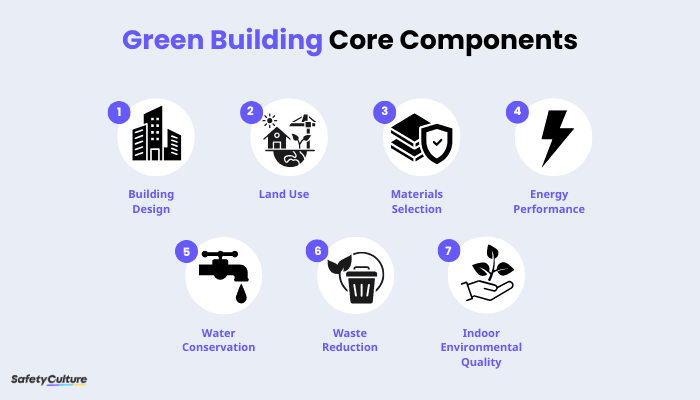
Efficiency must be integrated into the planning from the blueprint stage. The design focuses on the building’s envelope and orientation, ensuring it works with nature rather than against it. For instance, The Edge in Amsterdam uses natural ventilation and strategic window placements to maximize daylight, reducing the electricity needed in the morning.
This component prioritizes site selection, biodiversity, and minimal disruption to protect the ecosystem. It often involves brownfield redevelopment or adding green roofs to manage rainwater and heat. Sydney’s Barangaroo Reserve transformed a concrete shipping terminal into a thriving headland park, restoring the coastline with thousands of native plants.
Choosing recycled, renewable, or low-impact materials from raw material extraction to installation reduces environmental harm. The Bullitt Center in Seattle has achieved 100% Forest Stewardship Council certification for using timber from responsibly managed forests and other materials that do not use toxic chemicals.
By targeting the biggest source of building emissions through LED lighting, high-efficiency HVAC systems, and on-site renewables like solar panels, buildings can become net-zero. California’s Apple Park is powered 100% by renewable energy, an initiative that is part of the company's success in global sustainability.
Freshwater resources are very limited. This component aims to reduce consumption through low-flow fixtures, rainwater harvesting, and greywater recycling. One Central Park in Sydney has a sophisticated water recycling plant that treats wastewater from thousands of apartments, shops, and offices within the precinct.
By cutting waste during construction and shifting to a "circular" system, where materials are reused instead of thrown away, an environmental liability becomes an efficient operation. Crystal Palace Park in the UK is targeting up to 95% recycling and recovery rates for construction and demolition projects, proving it’s possible to repurpose an entire site.
Building management is about protecting the people inside them. By eradicating indoor pollutants and maximizing fresh air and natural light, the structure ensures occupant health, comfort, and productivity. Google Bay View Campus, Pixel Building, and the Bullitt Center have integrated sensors to automate these functions.
Sustainability is now a business imperative. Organizations should be able to prove they have implemented green initiatives with validated performance data. The following are not just badges of honor, but are rigorous technical frameworks that measure the critical components discussed.
Green Building Standard | Jurisdiction | Summary and Rating System |
Leadership in Energy and Environmental Design(LEED) | United States | LEED is a widely used global certification assessing sustainable building design, construction, operations, and performance. Platinum Gold Silver Certified |
Building Research Establishment’s Environmental Assessment Method (BREEAM) | United Kingdom Norway The Netherlands Sweden | BREEAM is a UK-based method that evaluates environmental performance, resource efficiency, and sustainability across the building’s lifecycle. Outstanding Excellent Very Good Good Pass Unclassified |
Green Star | Australia | This Australian rating system measures environmental design, construction practices, and building sustainability performance. 1 Star: Minimum Practice 2 Stars: Average Practice 3 Stars: Good Practice 4 Stars: Best Practice 5 Stars: Australian Excellence 6 Stars: World Leadership |
German Sustainable Building Council (DGNB) | Germany | DGNB is a holistic framework assessing the environmental, economic, and sociocultural performance of sustainable buildings. Platinum Gold Silver Bronze |
Comprehensive Assessment System for Built Environment Efficiency (CASBEE) | Japan | The Japanese system measures building efficiency by balancing environmental quality and resource loads. S: Superior A: Very Good B+: Good B-: Slightly Poor C: Poor |
VERDE | Spain | The Spanish certification focuses on reducing environmental impacts through life-cycle assessment of buildings. 5 Hojas 4 Hojas 3 Hojas 2 Hojas 1 Hoja 0 Hojas |
Pearl Building Rating System (PBRS) | United Arab Emirates | Abu Dhabi’s framework promotes water conservation, energy efficiency, and sustainable development in arid climates. 1 Pearl 2 Pearl 3 Pearl 4 Pearl 5 Pearl |
SafetyCulture is a mobile-first operations platform adopted across industries such as manufacturing, mining, construction, retail, and hospitality. It’s designed to equip leaders and working teams with the knowledge and tools to do their best work—to the safest and highest standard.
Collect complete and accurate data when preparing for certifications like LEED or BREEAM with digital checklists. Track resource consumption in real-time with specialized sensors, especially for energy and water use. Report issues, track trends, and implement corrective actions immediately by utilizing a centralized dashboard for records and communication. Achieve measurable sustainability goals and long-term operational resilience through a unified platform.
✓ Save and reduce costs
✓ Stay on top of risks and incidents
✓ Boost productivity and efficiency
✓ Enhance communication and collaboration
✓ Discover improvement opportunities
✓ Make data-driven business decisions