Training Management: Optimizing Workforce Development
Explore effective training management techniques and learn how to tailor-fit them to your organization for employee development, operational productivity, and business success.

Explore effective training management techniques and learn how to tailor-fit them to your organization for employee development, operational productivity, and business success.
Published 28 Apr 2026
Article by
7 min read
Training management refers to the entire process of managing employee training and development programs, from planning specific modules and methods of delivery, coordinating employees and resources, and executing actual training sessions. Finding a way to streamline these processes helps companies enhance their programs, ensuring these are well-adapted to evolving industries and, more importantly, fully equipping the workforce with the skills and knowledge they need for success.
Employees are the company’s number one asset. Lucrative and thriving businesses understand that their success is due to the efforts put in by their workers. Here are a few reasons why prioritizing employee development is a must-do:
Improves employee performance – Aside from providing employees with a safe working environment, handsome pay, and good benefits, thoroughly preparing them for the job they need to do gives them confidence. All these allow them to perform better and deliver high-quality output.
Enhances employee satisfaction – Providing continuous learning discussions and hands-on training sessions makes employees feel valued and respected because the organization has invested in them. This boosts morale, which, in turn, benefits the business.
Improves risk mitigation and compliance with regulations – When employees fully understand the significance of safety, quality, and sustainability, they know how these play a huge part in their daily responsibilities. With this, hazard identification, risk mitigation, and regulatory compliance are efficiently accomplished.
Cultivate a culture of excellence with our digital solutions that enhance efficiency, agility, and continuous improvement across all operations.
There are numerous elements to consider when planning and executing a training program. Some companies incorporate everything, while others choose a few based on their resources and goals. Here are the essentials:
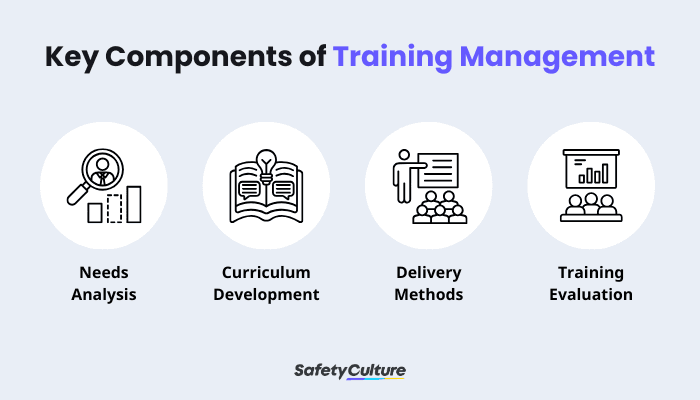
One of the first steps is identifying the specific training needs within an organization. Offering generic courses and return demonstrations to everyone is counterproductive, as some may not need them. To pinpoint skill gaps, you should conduct a needs analysis through the following:
Send out surveys and 360-degree feedback forms.
Interview employees one-on-one.
Assess individual performance using current KPIs (Key Performance Indicators).
A well-structured curriculum covers the necessary topics based on your organization’s needs. Enumerated below are the factors to consider:
Set specific learning objectives, such as collaboration with third-party vendors, understanding non-verbal cues from customers, and taking initiative in the workplace.
Ensure that courses perfectly suit the objectives. Managers may outsource these materials or create them from scratch.
List all materials required, like machinery or devices to learn, printed manuals, and audio-visual presentations.
Consider new industry trends, best practices, and regulations as these impact the curriculum, the operations, and the entire organization.
Schedule a realistic timeline and allocate resources for the entire program.
Aside from creating this outline, you should ascertain that the curriculum is engaging. Remember that successful learning requires full involvement from the participants, and they won’t cooperate in the activities when the lesson feels repetitive or uninspiring.
Face-to-face with practical training is still considered by most as the most effective training delivery method since instructors can evaluate engagement. However, this is not always possible because of constraints on time and resources. Technology has transformed the workplace and has proven to facilitate learning in a more efficient manner.
Here’s a glimpse of the various methods you can explore for carrying out training:
Synchronous – This is the more traditional form of learning, which includes in-person discussions, lectures, equipment simulations, and on-the-job training. This category could also include live Zoom or Skype seminars.
Asynchronous – Also known as self-paced learning, this type allows learners to study a particular topic at their own speed. Managers can send modules, case studies, or scenarios that workers can review during breaks or after work hours.
Blended Learning – As the term implies, this refers to a combination of synchronous and asynchronous modes. It enables collaboration but also provides flexibility.
The only way to know if the curriculum developed is effective is through tracking and assessment. It’s best to implement a system that monitors the program’s progress, evaluates the learners’ retention and on-the-job application, and compares it against the objectives initially laid out.
Consider the tips below to effectively evaluate training initiatives:
Review KPIs (e.g., improvement in performance, reduced errors, faster risk mitigation, and increased customer satisfaction) after the training programs.
Collect feedback from the participants, zooming in on their opinions about the content, the mode of delivery, and even their trainers.
Use tools like the Kirkpatrick Taxonomy Model to evaluate the learner’s reaction to and behavior after the training session. The Phillips ROI Model is also helpful in measuring training costs and results.
Using the assessment results, you can adjust programs to the needs of the organization and the workforce for optimal results.
Effective training management involves strategically designing and delivering training programs that align with business goals, competencies, and talent management efforts. To achieve this, here are a few best practices to integrate in your current strategy:
Align training to business goals- Set clear, specific, measurable training goals that support broader organizational objectives (e.g., productivity, quality, growth).
Get stakeholder buy-in- Secure support and resource commitment from leadership and managers.
Use diverse delivery methods- Blend on-the-job training, e-learning, microlearning, mentoring, and instructor-led sessions.
Ensure content engagement: Use real-world case studies, simulations, gamification, and rich media to keep learners interested.
Involve Subject Matter Experts (SMEs): Leverage internal and external experts to ensure content accuracy and relevance.
Communicate program value- Clearly explain to employees the "why" and "what's in it for me" for participating in the training.
Ensure accessibility- Make training available to all employees, including remote workers and those with different access needs (e.g., mobile-friendly).
Implement follow-up and reinforcement- Provide post-training support, coaching, and job aids to ensure skills are applied on the job.
Iterate and optimize- Use performance data and evaluation results to continuously refine and improve the training curriculum and delivery.
Use a checklist- Implement training checklists to ensure all tasks before, during, and after training programs are completed as planned.
Build from scratch or choose from our collection of free, ready-to-download, and customizable templates.
As mentioned earlier, technology has elevated workplace learning and training. Although it would be hard to replace live coaching and mentoring, automating training delivery does have numerous benefits, including flexibility, accessibility, and cost-efficiency. Here are some options to look into:
Digital Modules- Online learning and training have become so popular that companies continue to use them even after the pandemic. After all, digitized training content is engaging, easily accessible on mobile devices, and readily available for quick review in minutes.
Virtual Reality (VR) and Augmented Reality (AR)- Immersive technologies like VR and AR provide realistic simulations, allowing the workers to learn, feel challenged in a particular situation, and slowly build their confidence, minus the risks.
Training Management Systems- Training management platforms streamline the administrative tasks required in planning and managing training programs. This software has features for standardizing training courses and templates, allocating the appropriate resources, and monitoring the program from start to finish.
SafetyCulture is a mobile-first operations platform adopted across industries such as manufacturing, mining, construction, retail, and hospitality. It’s designed to equip leaders and working teams with the knowledge and tools to do their best work—to the safest and highest standard.
Streamline processes, eliminate bottlenecks, enhance resource utilization, and build an agile and scalable infrastructure with SafetyCulture. Strive for operational excellence to boost competitive advantage, foster sustainable growth, and deliver long-term value.
Save time and reduce costs
Stay on top of risks and incidents
Boost productivity and efficiency
Enhance communication and collaboration
Discover improvement opportunities
Make data-driven business decisions