Implementing Retail Task Management
Assign, track, and prioritize tasks efficiently to ensure consistency, reduce errors, and drive business success with retail task management.
Assign, track, and prioritize tasks efficiently to ensure consistency, reduce errors, and drive business success with retail task management.
Published 28 Apr 2026
Article by
8 min read
Retail task management is the process of organizing, assigning, and tracking a wide range of operational tasks to ensure efficiency, consistency, and compliance. By implementing a well-defined strategy, retailers can streamline workflows, minimize errors, and enhance productivity, leading to a more organized retail environment and improved customer satisfaction.
A well-structured retail task management system ensures that assignments are executed accurately, on time, and in line with the organization’s overall retail management approach. Here are the benefits of retail store task management:
Improved operational efficiency – Retail task management streamlines store operations by automating task assignments, tracking progress, and ensuring accountability. This reduces errors, minimizes delays, and eliminates inefficiencies, enhancing employee productivity.
Real-time visibility and accountability – Managers gain full visibility into task progress through real-time dashboards and automated reporting. This allows them to identify bottlenecks, reassign workloads as needed, and ensure that Critical Business Functions (CBFs) are completed on time, leading to better overall store performance.
Enhanced customer experience – When staff are well-coordinated and operational tasks are efficiently managed, stores become more hygienic, well-stocked, and well-organized. Faster response times, better service, and improved merchandising are benchmarks of a seamless and enjoyable shopping experience, leading 87% of customers to buy more.
Streamline planning, execution, and monitoring of complex retail initiatives across multiple stores and teams.
Every retail assignment plays a crucial role in enhancing efficiency and profitability. Here are the most common examples of retail tasks:
A well-stocked store improves customer satisfaction and boosts revenue. Retail employees regularly check inventory levels and replenish items before they run out. Keeping shelves stocked with popular products prevents lost sales and ensures customers can find what they need.
An efficient checkout process minimizes wait times and enhances the shopping experience. Cashiers and sales associates handle transactions at checkout, ensuring smooth and secure payment processing. This includes scanning items, applying discounts, and managing cash or card payments.
Regular updates help maintain transparency and drive sales. This is why retailers frequently update product pricing and promotional signage to reflect sales, discounts, or price adjustments. Clear and accurate signage prevents confusion and ensures compliance with pricing policies.
Regular inventory checks help retailers track stock levels and prevent theft or discrepancies. Employees use barcode scanners or manual counting methods to verify stock accuracy. Accurate inventory management reduces shrinkage and ensures product availability.
The strategic placement of promotions can significantly impact sales. Retailers create eye-catching promotional displays to highlight seasonal deals and featured products. Well-designed displays attract customers and enhance brand visibility.
Providing excellent customer service is essential in retail. Employees help shoppers find products, answer questions, and offer recommendations. Personalized assistance improves customer satisfaction and increases the likelihood of repeat business.
Employees follow daily checklists to open and close stores efficiently. Opening tasks in retail include setting up registers and restocking shelves, while closing involves cleaning and securing the premises. A structured routine ensures readiness and operational security.
A clean and organized store creates a pleasant shopping environment. Employees regularly tidy up aisles, dust shelves, and remove clutter to maintain store appeal. A well-maintained space enhances customer experience and reflects brand professionalism.
Retail employees and managers must stay vigilant to prevent shoplifting and internal theft. Security measures include surveillance cameras, anti-theft tags, and regular employee monitoring. Effective loss prevention strategies help protect revenue and reduce shrinkage.
With the rise of omnichannel retail, employees process online orders for customer pickup. This involves locating items, packaging them, and ensuring they are ready for collection. Efficient order fulfillment bridges the gap between online and offline shopping.
Employees handle deliveries by unloading shipments, checking invoices, and organizing stockrooms for easy access. Proper stock management prevents delays in restocking shelves. A well-organized stockroom ensures efficiency and prevents misplaced inventory.
Retail managers track sales trends, customer feedback, and employee performance to make informed business decisions. Analyzing key metrics helps identify areas for improvement and training opportunities. Regular performance reviews contribute to a high-functioning retail team.
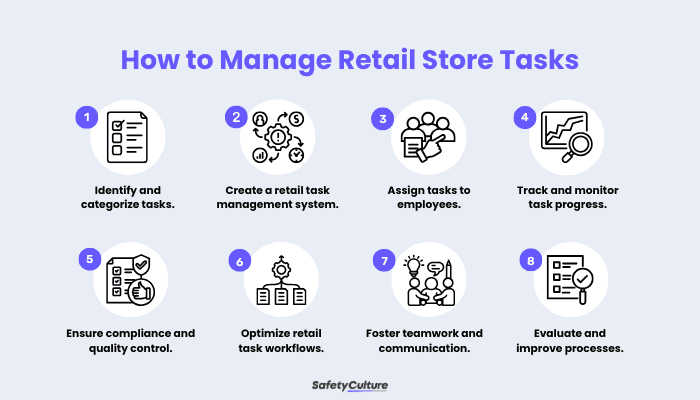
Follow this procedure to manage retail store tasks efficiently:
How to Manage Retail Store Tasks
Organize all necessary activities based on priority, frequency, and department. Common categories include inventory management, customer service, merchandising, and compliance.
Best Practices:
Conduct a task audit to list all routine and seasonal tasks.
Use a prioritization matrix to classify tasks as urgent, high-priority, or low-priority.
Develop a structured task management system to ensure accountability and smooth task execution. This system should define responsibilities, deadlines, and reporting structures.
Best Practices:
Use task management software to assign, track, and monitor progress.
Standardize task documentation with clear instructions and checklists.
Once retail tasks are defined, assign them based on employee roles, skills, and availability. Proper delegation ensures tasks are completed efficiently without overwhelming staff.
Best Practices:
Use a digital task assignment tool to provide employees with real-time updates.
Ensure workload balance by distributing tasks fairly among team members.
Stay on top of task updates to ensure all activities are completed on time and at the expected quality level. Implement real-time tracking to help managers identify and address bottlenecks quickly.
Best Practices:
Use dashboards and performance reports to track completion rates and identify trends.
Conduct daily or weekly check-ins to assess progress and resolve challenges.
Maintain compliance with company policies, industry regulations, and brand standards. Perform regular quality control to ensure that all retail tasks meet the expected standards.
Best Practices:
Implement quality control checklists for employees to verify task completion and accuracy.
Conduct regular audits and perform observations to assess safety, merchandising, and operational compliance.
Automate routine tasks and continuously streamline processes to save time, reduce errors, and enhance efficiency. Task automation improves productivity and allows employees to focus on customer-facing activities.
Best Practices:
Integrate task management software with Point-of-Sale (POS), workforce, and inventory systems for seamless operations.
Regularly review task performance data to refine workflows and eliminate inefficiencies.
Ensure that employees understand their tasks and can seek help when needed through open communication. Encourage collaboration to foster teamwork and improve task execution.
Best Practices:
Use a centralized communication platform for instant updates, task reminders, and feedback.
Hold daily or weekly team meetings to discuss priorities and challenges.
Continuously analyze task performance to refine processes, improve efficiency, and adapt to changing business needs.
Best Practices:
Collect employee and customer feedback to identify improvement areas.
Use Key Performance Indicators (KPIs) such as task completion rates and sales impact to measure success.
Retail businesses often face challenges that impact efficiency, productivity, and compliance. These obstacles can disrupt workflows and lead to operational inefficiencies. Below are the key challenges in retail store task management and how organizations can address them effectively:
Outdated manual processes and disconnected systems make it hard for retail leaders to see what’s happening across their stores, slowing decisions and creating inconsistent execution. Without clear visibility, managers struggle to track progress, leading to missed deadlines, inefficiencies, and frustrated teams.
Hence, store managers must be equipped with mobile-friendly task-tracking apps to oversee store activities remotely. Also, implement retail task management software with real-time tracking, dashboards, and automated notifications.
Discover how much productivity leaks from middle management—and how the right tools can turn wasted hours into progress.
Poor communication between store associates and management can lead to misunderstandings, delays, and duplicated efforts. Task delegation without clarity also causes confusion about responsibilities. So, create a centralized task management system where employees can access assignments, instructions, and deadlines. Automating task delegation using workforce management software also assigns tasks based on employee availability and skill set.
Some employees and managers may resist adopting new digital tools due to unfamiliarity or fear of change, leading to inefficiencies in task execution. To help mitigate this, choose user-friendly digital platforms with intuitive interfaces to reduce the learning curve. Provide comprehensive training programs on how to use task management software effectively.
Without proper analytics, retailers struggle to measure task completion rates, identify inefficiencies, and improve workflows. This lack of insight leads to poor decision-making. However, implementing predictive analytics helps forecast potential bottlenecks and optimize task scheduling. Organizations may also leverage real-time KPI dashboards to track store operations and employee productivity.
SafetyCulture is a mobile-first operations platform adopted across industries such as manufacturing, mining, construction, retail, and hospitality. It’s designed to equip leaders and working teams with the knowledge and tools to do their best work—to the safest and highest standard.
Promote a culture of accountability and transparency within your organization where every member takes ownership of their actions in retail task management. Optimize work order handling, record observations in real time, and harness facility data to boost safety and efficiency in one unified platform.
✓ Save time and reduce costs ✓ Stay on top of risks and incidents ✓ Boost productivity and efficiency ✓ Enhance communication and collaboration ✓ Discover improvement opportunities ✓ Make data-driven business decisions