Enhancing Environmental Management Systems (EMS) with ISO 14001
Understand how ISO 14001 works and how it contributes to your business’s overall environmental impact.

Understand how ISO 14001 works and how it contributes to your business’s overall environmental impact.
Published 23 Jun 2026
Article by
8 min read
ISO 14001 is a set of Environmental Management System (EMS) standards that help companies manage their environmental impact. It’s developed by the International Organization for Standardization (ISO) for businesses of all sizes and industries, setting requirements for establishing, implementing, and maintaining a high-quality EMS. Certification is not required to implement this standard, but having one demonstrates your capability to enforce it correctly and at par with global standards.
ISO 14001 belongs to the ISO 14000 family of EMS standards, with its latest version published in 2026. ISO 14004 complements this standard by laying out guidelines for proper implementation.
Before ISO 14001:2026, however, was ISO 14001:2015. The 2026 revision is not a rebuild of the standard, but rather, it sharpens several requirements that were inconsistently applied under the 2015 standard. This revision still follows the Plan-Do-Check-Act (PDCA) cycle and retains the Harmonized Structure it shares with ISO 9001, ISO 45001, and other management system standards. The ten-clause framework also remains intact. What has changed is the specificity and accountability required within that framework
To be specific, ISO 14001:2026 introduces a new clause on change management, and gives more focus on climate change, biodiversity, and lifecycle thinking, ensuring they are embedded more directly into an organization’s EMS framework. Compared to the 2015 version, this revision also widens the scope of supply chain management and internal audits.
The ISO 14001 standard encompasses environmental systems, auditing mechanisms, communication channels, labels, and operational analyses, among other things. Moreover, it tackles an array of environmental issues ranging from the following:
Pollution and climate change
Biodiversity
Water and sewage systems
Waste management
Soil contamination
Natural resource use and availability
Overall environmental impact of every aspect of a business
ISO 14001 is composed of the following requirements that organizations must follow to implement a high-standard EMS:
Environmental policy: This document expresses the organization’s commitment to upholding its environmental responsibilities in line with its goals and legal obligations.
Environmental objectives: The upper management develops these targets to help them create environmental decisions for the business. It should specify the responsible personnel, timeline, and monitoring mechanisms for every objective.
Environmental risk and opportunities assessment: It identifies and analyzes potential hazards and improvement opportunities associated with the organization’s business activities, in line with the standard’s risk-based approach. An example of this is having an Environmental Health and Safety (EHS) audit or maintaining an ESG risk register to track environmental risks against business objectives.
Environmental evaluation: It examines the environmental effects of the organization’s operations and measures their impacts using a risk rating system. Activities include utilities, waste generation, effluent disposal mechanisms, and air emissions.
Operational control processes: The ISO 14001 standard allows organizations to implement EMS operational controls that suit their business and industry needs, but these need to be documented. For example, in manufacturing, this can include activities such as cooling system inspections or energy consumption audits.
Emergency preparedness and response protocols: Organizations must enforce a plan to prepare for and handle emergency cases while minimizing their environmental impact. Examples of emergencies include chemical spills, power loss, and floods.
List of interested parties, regulatory, and other requirements: This document specifies the parties integral to the organization’s functions and their obligations to those stakeholders. It also outlines strategies to meet said obligations without harming the environment.
Documentation of compliance obligations: This procedure takes note of and reviews the organization’s existing legal obligations, including the changes made throughout the process. Pairing this with an ISO 22301 checklist ensures your emergency response also meets business continuity standards.
Proof of competence: This record proves that the organization’s employees can follow their environmental responsibilities. It includes training, assessment, and upskilling programs.
Communication records: This criterion ensures that internal and external stakeholders are informed of the environmental objectives and their roles in contributing to the cause.
Performance monitoring: Organizations must also keep track of their performance status and how it matches the set objectives. Gauging the effectiveness of the current protocols involve knowing what, when, and how to measure the organization’s environmental performance.
Internal audit programs: Organizations must also report their findings from the environmental audits they conduct internally. It should describe the organization’s environmental performance and note opportunities for improvement.
Management review: Maintaining an effective EMS requires periodic assessments from the top leaders. Recording the results of these reviews is essential to determine if the current strategies are still in line with the ISO 14001 standard.
Nonconformity and corrective actions: ISO 14001 requires organizations to monitor instances where the standards were not followed and describe how they were resolved.
While not a requirement, obtaining an ISO 14001 certification offers numerous advantages to your company.
First, the ISO 14001 standard provides a holistic framework for managing and addressing environmental issues. It enables you to enhance your environmental performance through decreased utility consumption and optimal use of resources.
An ISO-certified EMS also gives your organization a competitive edge. Communicating your environmental efforts builds trust and confidence in your brand, especially for environmentally-conscious stakeholders. These consumers would gladly subscribe to your product or service, given the causes you put forward.
Lastly, getting certified for ISO 14001 shows your readiness to comply with environmental and other relevant legislation and demonstrates your commitment to caring for the environment.
After discussing the scope and requirements, it’s time to learn the process to gain an ISO 14001 certification. This section briefly runs through the certification process to help you get started.
It’s important to note ISO itself doesn’t issue the certificates, so it’s best to look into third-party accreditation bodies for this procedure.
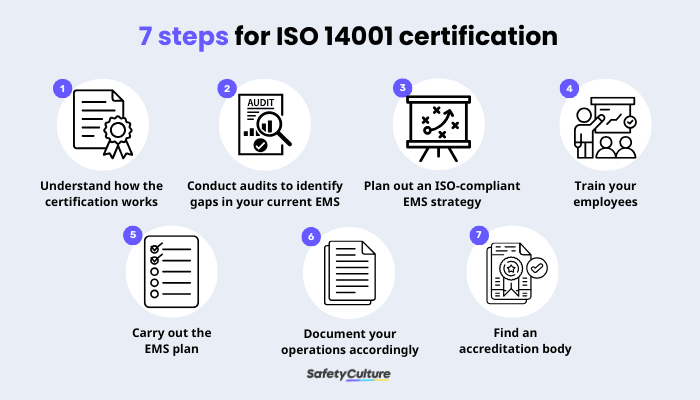
Carrying out ISO’s EMS standards becomes futile without fully understanding what they entail. For this reason, it’s crucial to research and read how ISO 14001 works and how to implement it in your organization effectively. Plenty of online sources and guides are available at your disposal, starting with the ISO website.
The next step is to conduct an internal audit of your EMS operations. This audit imparts valuable insights into your EMS’ strengths and deficiencies compared to the ISO’s standards. The following checklists can help you determine how your current EMS aligns with ISO 14001.
Findings from your preliminary EMS audit become valuable data for the next step: planning. Integrate these results in your EMS compliance and monitoring plan to ensure your operations align with the ISO 14001 requirements. Preparing a plan beforehand sets the pace and guides you in systematically managing environmental issues stemming from your processes.
Before carrying out the plan, you must first train your staff members about the modifications in your EMS procedures and, if needed, provide learning materials about ISO 14001. This procedure equips them with the necessary skills and knowledge to perform their responsibilities and comply with ISO standards.
After developing a plan and training your employees, you are now ready to carry out the ISO-aligned EMS.
Be sure to monitor your progress at set intervals (e.g., weekly, monthly, bi-monthly) and observe any recurring patterns that can hinder you from effectively fulfilling the criteria of ISO 14001.
Documentation is an integral part of the ISO 14001 certification process. It’s critical to record the results of implementing the EMS plan, as it proves that your operations comply with ISO’s EMS standards.
Keeping track and updating your records becomes easier with digital tools. Not only is it better for the environment by replacing paper documents with digital forms, but it also stores your data in a secured online space, so you won’t need to worry about losing any documents.
Once you’re confident with your preparations, it’s time to apply for the certification. You can find legitimate certifying bodies in your country using the International Accreditation Forum CertSearch, a portal from ISO.
Your chosen institution will run an audit to verify if your EMS complies with the criteria set in the ISO 14001 standards. Once your organization satisfies the requirements, the accrediting body will grant you the ISO EMS certification.
SafetyCulture is a workplace operations platform adopted across industries such as manufacturing, mining, construction, retail, and hospitality. It’s designed to equip leaders and working teams with the knowledge and tools to do their best work—to the safest and highest standard.
SafetyCulture complements your organization's efforts to implement and maintain ESG strategies. Through seamless data collection, real-time tracking, and reporting of your progress against sustainability goals, your organization can effectively drive sustainable growth and success.
✓ Save time and reduce costs
✓ Stay on top of risks and incidents
✓ Boost productivity and efficiency
✓ Enhance communication and collaboration
✓ Discover improvement opportunities
✓ Make data-driven business decisions
In this article