How To Write Effective Product Specifications
See what makes a clear, detailed product specification that keeps your team aligned.

See what makes a clear, detailed product specification that keeps your team aligned.
Published 28 Apr 2026
Article by
6 min read
Product specifications, or product specs, are detailed documents that explain what a product does, how it works, and who it’s for. They’re similar to product roadmaps but focus more on the product’s characteristics, requirements, functions, looks, and intended market.
The feature specifications of the product should be stated accurately, be easy to comprehend, and comprehensive enough to support your product, engineering, design, and marketing teams. The more precise the details, the less room there is for confusion during production. Presenting this information in a table or chart can make it easier for teams to find additional information.
Product specs guide every stage of manufacturing—from concept to production. As part of the product management process, they help keep teams aligned and ensure that the product meets customer needs and expectations.
An effective product specification should answer three key questions: why you’re building the product, what specific goal it’s meant to achieve, and what success looks like once it’s delivered.
Beyond defining purpose and goals, product specifications also help:
Clarify what the product is for and why it’s being created
Provide insight into the market and target audience
Guide teams building and programming the product
Keep development on track and in sync
An effective product spec keeps everyone aligned from top to bottom, streamlining development and preventing costly miscommunications.
Cultivate a culture of excellence with our digital solutions that enhance efficiency, agility, and continuous improvement across all operations.
In product development, different specs guide different teams, including manufacturing, quality control, and other stakeholders.
Here’s an overview of these three types:
Functional product specification templates outline what the product does, how it works, and the reasons behind its design choices. It typically includes the following details about the product:
Purpose - Explains why the product is needed and what problem it solves.
Capabilities - Describes what the product can do and its limitations.
Uses - Outlines when and how the product adds value.
Size - Details the product’s dimensions to guide design, compatibility, or installation.
Weight - Details how heavy the product is for handling, transport, or setup purposes.
Materials - Lists what the product is made from and why those materials were chosen.
Other Components - Identifies any additional parts, accessories, or compatible systems required for operation.
Performance product specification templates describe how a product is expected to perform, setting clear metrics for how it should operate in different conditions. These specifications are especially useful for technical or industrial products. They should include:
Speed - Describes how fast the product should run or complete its task in everyday use.
Accuracy - Specifies the level of precision or correctness needed for the product to work reliably.
Reliability - Details how consistently the product should perform over time without failure.
Temperature and Humidity - Describes the ideal temperature and humidity levels for optimal performance.
Vibration - Describes how much motion or impact the product can handle while in operation or transit.
Design product specification templates describe the product’s construction and visual design, focusing on appearance while detailing the elements that complete its look and feel. Here are some of those elements:
Shape - Specifies precise dimensions, weight, and spatial requirements to ensure the product aligns with the final design.
Color - Defines the palette, tones, and finishes used to match the brand and maintain visual consistency.
Texture - Describes surface qualities like smoothness, roughness, or pattern to guide manufacturing and achieve the intended tactile experience.
Dimensions - Lists exact measurements and tolerances for each part to ensure components fit and function as designed.
Finishes - Details any added ornaments, coatings, or polish applied to improve appearance, durability, or usability.
Materials - Identifies the raw materials and their specifications to ensure product quality and regulatory compliance.
Build from scratch or choose from our collection of free, ready-to-download, and customizable templates.
Writing a detailed yet easy-to-follow product specification is essential to ensure internal teams stay on the same page. Poorly written specifications can lead to confusion and unnecessary back-and-forth between teams, wasting time that could be spent getting the actual work done.
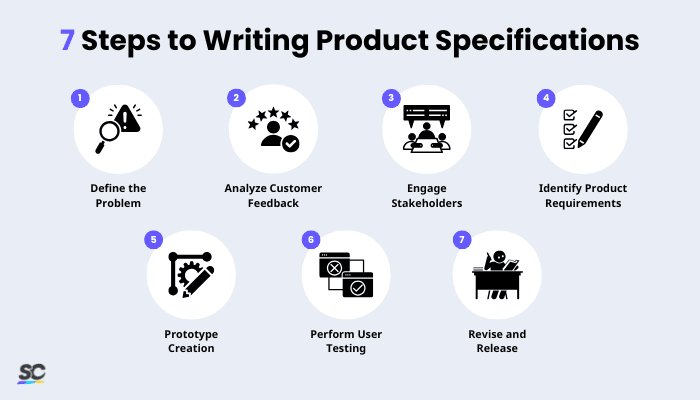
7 Steps to Writing Product Specifications
The first step in writing a product spec is to define the problem you are trying to solve. It’ll help you create a clear vision of what the product should do and how it should function. It’s essential to be specific and include details about the target audience, their needs, and how the product will meet those needs.
Customer feedback is essential for product development. Whether it’s customer complaints, questions, suggestions, or feature requests, it helps you understand what customers want and how they use the product.
It’s vital to bring together the right people from different departments and have them discuss the product, its features, and how it should be developed. Every idea is heard, and everyone is on the same page. Additionally, it allows for a more collaborative approach to product development by bringing in fresh and innovative ideas.
Product requirements are the criteria that must be met for a product to be successful. It includes features, performance, usability, and other factors. It’s essential to create a list of requirements that are specific and measurable, focusing on your Critical to Quality (CTQ) characteristics, so that progress can be tracked throughout the development process.
Additionally, it’s vital to prioritize these requirements based on importance and feasibility. It’ll help ensure that the essential features are implemented first.
It allows you to test the product and its features before committing to full-scale development. It helps ensure that the product meets customer needs, expectations, and other requirements. Additionally, it can be used to gather feedback from potential customers and make any necessary changes before launching the product.
User testing allows you to test the product with real users and get feedback on how it works, what features are missing, and what needs to be improved. You can use it to identify any potential usability issues or bugs.
Once the product has been tested and feedback has been gathered, it’s time to revise it and make any necessary changes. It includes ensuring all features are working correctly, addressing usability issues, and applying the valuable insights discovered during user testing. Once satisfied with the adjustments, provide your product details to the development team so they can start building it.
SafetyCulture is a mobile-first operations platform adopted across industries such as manufacturing, mining, construction, retail, and hospitality. It’s designed to equip leaders and working teams with the knowledge and tools to do their best work—to the safest and highest standard.
Streamline processes, eliminate bottlenecks, enhance resource utilization, and build an agile and scalable infrastructure with SafetyCulture. Strive for operational excellence to boost competitive advantage, foster sustainable growth, and deliver long-term value.
Save time and reduce costs
Stay on top of risks and incidents
Boost productivity and efficiency
Enhance communication and collaboration
Discover improvement opportunities
Make data-driven business decisions