A Look at Smart Farming: Agriculture’s Future
Smart farming could be the future of agriculture. Learn what it is, how it differs from traditional farming, certain smart farming solutions, and how smart farming can impact the entire farming cycle.
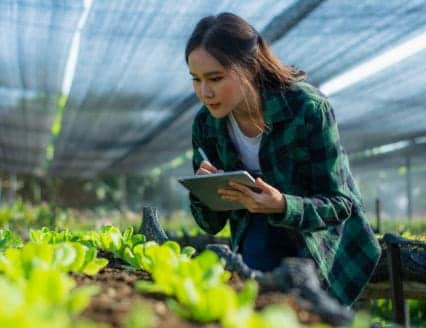
Smart farming could be the future of agriculture. Learn what it is, how it differs from traditional farming, certain smart farming solutions, and how smart farming can impact the entire farming cycle.
Published 27 Apr 2026
Article by
11 min read
Smart farming is a practice in agricultural production that involves using technology like IoT, robotics, drones, and AI, among others, to manage farms, increase output, and reduce environmental impacts. Smart farming’s goal is to increase both the quality and quantity of farming products while optimizing human labor to ensure the best possible results.
Farms and agricultural sites that utilize smart farming techniques are known as smart farms. These farms typically utilize new tools such as sensors that monitor weather round the clock and mobile inspection apps that help farmers improve their agricultural practices to increase their produce while supporting sustainability and maintaining product quality.
Smart farming has been the go-to solution for companies that want to integrate advanced technology into their agricultural workflows. Below are some of the advantages they enjoy upon properly utilizing smart farming technologies in their system:
Higher yields and better crop quality: Sensors provide real-time information on crop health, soil conditions, and weather, allowing farmers to reduce crop stress and disease for higher yields. Access to better insights also enables precision timing for planting, irrigation, and harvesting, greatly improving the quality of outputs for higher sale prices.
Resource efficiency and cost savings: Smart irrigation and fertilization apply the right amount, at the right time and place, cutting costs on water, fertilizer, pesticide, and energy. Automation also reduces manual labor and errors, further minimizing operational expenses.
Sustainability and environmental benefits: Using fewer resources translates to less chemical runoff, lower greenhouse gas emissions, and improved soil health over time. Data-driven decisions from smart farming also open the door to more sustainable strategies that protect local ecosystems.
Better decisions and remote control: Smart farming features real-time, remote monitoring of crop quality, soil conditions, and other factors at scale, allowing agricultural managers to oversee multiple fields or sites. Dashboards and analytics turn field data into actionable insights rather than relying on gut feel and blind experimentation.
Farming itself was a huge innovation for humankind and allowed us to further grow as a species, but traditional farming methods are slowly becoming outdated and inefficient. A great way to fully grasp the concept of smart farming and its importance is to compare it with traditional farming methods.
Point of comparison | Traditional farming | Smart farming (precision / digital) |
Decision‑making | Based on experience, intuition, and visual field checks | Based on real‑time data from sensors, drones, satellites, and analytics |
Tools & technology | Simple tools, basic machinery, minimal electronics | IoT devices, Global Navigational Satellite System (GNSS), auto‑steer tractors, drones, farm management platforms |
Labor | Highly manual; large workforce; long hours in the field | More automated; smaller, more skilled team managing machines and software |
Crop monitoring | Walking fields, visual inspection for pests, disease, and stress | Remote sensing, imaging, and sensor data for early detection and precise intervention |
Irrigation | Fixed schedules or visual judgment (i.e., if it looks dry, then it’s probably time to irrigate) | Automated systems triggered by soil moisture, weather forecasts, and crop models |
Fertilization & spraying | Uniform application across the whole field, higher risk of over/under‑application | Variable‑rate application, targeting only required zones to reduce waste and runoff |
Land preparation | Leveling and tillage by eye or simple equipment, less precise | GNSS‑guided leveling and tillage with centimeter‑level accuracy for water and soil optimization |
Record‑keeping | Paper notebooks, spreadsheets, and by memory | Digital logs, cloud dashboards, and automatically captured machine and field data |
Productivity & yield | Lower average yield per hectare; more variability across fields | Higher yields and more uniform stands due to precise planting, inputs, and timing |
Input use (water, fertilizer, pesticide, etc.) | Higher water, fertilizer, and pesticide use per unit of output | Lower inputs per unit of output via precise targeting and automation |
Environmental impact | Can be low if organic and diverse; can also be inefficient on a large scale | Designed to cut waste and emissions; risk depends on how tech is used and powered |
Farm scale | Often small to medium, local markets, with limited scalability | Scales more easily to large, multi‑site operations |
Up‑front investment | Lower tech costs, but higher long‑term labor and opportunity costs | Higher initial cost for equipment and software, lower ongoing cost per unit of production |
Risk management | Reactive (respond after problems show visibly) | Proactive (predict and prevent using models, alerts, and forecasts) |
The traditional farming cycle is quite straightforward and easy to understand. And while IoT and smart farming can affect this cycle, it doesn’t change it that much. The entire goal of IoT is to collect data and input, which is then transported over the internet to another device.
That way, any issues or problems that the IoT sensors catch are reported immediately, giving the farmers a clearer window for them to act on the problems. So, under an IoT or smart system, the farming cycle will look something like this:
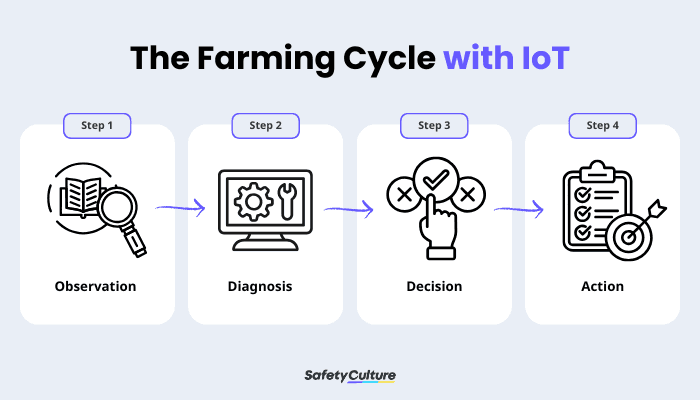
Observation: The process begins with sensors and other devices observing soil conditions, temperature, humidity, and other parameters. From there, it records the data that it observes.
Diagnosis: After the data is transmitted via the internet, the IoT platform will decide the best course of action. These platforms are equipped with complex algorithms that are able to dictate the best action based on specific observations.
Decision: The next step is deciding which specific action to take based on the data. This could be done by a person or a machine-learning system. Alternatively, both the AI IoT platform and the user can work together to figure out if the action is necessary and which specific action to take.
Action: Once the decision has been made, the next step is to actually perform the said actions. Again, this could be done by a team of robots, autonomous agricultural machines, humans, or a mix of all three.
At the heart of smart farming systems are the pieces of technology that make automation and efficient data gathering possible. Below are some of the advanced technologies that companies often utilize in their smart farming systems:
Drones provide an aerial view of crop conditions, allowing early detection of issues. They’re equipped with cameras to spot gaps in plant stands, lodging, and storm damage, while others are rigged with thermal cameras to detect water-stress patterns and fine-tune irrigation. Some cameras have a built-in multispectral or hyperspectral sensor to pick up plant stress invisible to the naked eye.
Other companies use drones to spray fertilizers, pesticides, and herbicides at controlled rates and heights. This reduces chemical use and off‑target drift compared to traditional blanket spraying with ground equipment. Some systems also handle seeding or reseeding, especially on difficult terrain, which tractors often struggle to navigate.
Aquacrop is a software used by the Food and Agriculture Organization of the United Nations (FAO) to predict yields in a field based on water availability. In a broccoli field trial in eastern Spain, crop data captured by drones during three separate flights were fed into the Aquacrop software, reducing system error by 12%. This shows that drone-collected data effectively improved crop yield prediction accuracy, driving better decision-making and healthier agricultural practices.
Smart sensors gather real-time data from soil, plants, and the air to support precision agriculture and workflow automation. They’re connected to apps and dashboards through IoT networks, turning raw field conditions into actionable insights that help save resources and boost yields. Sensors are used in smart farming in a variety of ways:
Soil and environmental sensors: Moisture and temperature sensors buried in the soil trigger automated irrigation only when levels drop, preventing overwatering. Additionally, pH and nutrient sensors measure nitrogen, phosphorus, and potassium in crops, providing fertilizer plans according to specific needs to avoid waste and runoff.
Crop health sensors: Multispectral or hyperspectral sensors detect stress from disease, pests, or drought using light reflection patterns for targeted sprays. Thermal sensors map water stress or canopy temperature, guiding precise irrigation in various field zones.
Weather sensors: Weather stations provide on-site data such as humidity, wind speed, and rain forecasts. When integrated with AI, they can assist in optimizing spray timing and providing frost protection.
An IoT pilot study conducted in Rural India incorporated sensors to monitor soil moisture, as well as pH and nutrient levels. These sensors were connected to smart irrigation systems that automated irrigation and optimized water distribution. AI was also used to determine ideal irrigation scheduling, effectively reducing water consumption by 40%.
Utilize advanced sensor technology to monitor crops and farm condition, automate vital alerts, implement actions, and report urgent issues.
Robotic systems bring hands-free automation to smart farming, tackling labor-intensive tasks with 24/7 reliability to boost efficiency and cut costs. Some agricultural tasks it handles include:
Planting and seeding (for consistent plant spacing, emergence timing, and growth across a field or row of crops)
Weeding and pest control (for chemical-free methods of zapping weeds and pest)
Monitoring and spraying (for targeted sprays and data integration for real-time decision-making)
Harvesting and soil management (for delicate harvesting with no bruising and more sustainable soil preparation)
Autonomous Solutions Inc. (ASI) automated tractor fleets for tillage, offsetting labor shortages with non-stop 24-hour operations. Pilots in Brazil (with partners like Agricef) showed optimized workflows across mixed OEM equipment, improving productivity levels on a larger scale without having to invest additional capital.
Numerous reports and case studies show how smart farming systems have helped farms efficiently produce higher-quality yields. But despite reports of positive results, not all companies are rushing to integrate smart farming systems into their current agricultural processes for a number of reasons:
Smart farming technology requires a large upfront investment (often tens of thousands of dollars for a modest hardware setup), exclusive of additional expenses for maintenance, upgrades, and more. Small to mid-sized farms struggle to justify the value of the significant costs they’d have to incur, provided that traditional methods still deliver sufficient results.
Smart farming introduces a steep learning curve, pushing farmers accustomed to purely hands-on experience to adopt new tools and methods, such as dashboards and AI analytics. These require a certain level of digital literacy that can’t be achieved overnight. Furthermore, missteps like poor sensor calibration or ignored alerts can cause crop damage, leading to skepticism about the technology's reliability.
Perhaps one of the greatest risks people face when adopting modern technology is equipment failure. Smart systems are only as good as their reliability, so the moment a glitch, bug, or power outage occurs, even the most expensive equipment can become ineffective without proper countermeasures in place. In fact, a malfunction can cause significant harm to crops, potentially halting operations completely or leading to over-irrigation, which can drown the roots.
IoT-connected farms are vulnerable to cybersecurity threats like data breaches. Attackers could spoof sensor data to trigger wasteful actions, steal yield forecasts for market manipulation, or lock systems with ransomware to demand payouts mid-season. Rural networks are particularly at a disadvantage, as their systems often lack robust security, leaving sensitive data vulnerable to breaches that compromise privacy and reduce competitive edges.
Reliable internet is scarce in remote fields, where spotty cell service or no broadband stalls real-time data flow. This means drones can't upload imagery, alerts go unseen, and automation grinds to a halt without cloud synchronization. While satellite options exist, systems that utilize them generally cost more. Satellite systems also introduce latency, preventing farmers from accessing real-time data and disrupting setups that rely on instant decisions like spray timing.
Smart farming systems use power-hungry data centers, gateways, and always-on devices that can significantly spike the electricity bill. To combat this, some companies use battery-dependent sensors in vast fields, but even these require frequent swaps or solar add-ons to become more sustainable at scale. For off-grid areas, this ongoing need for maintenance and replenishment often requires additional resources or manual labor (e.g., daily trips to replace batteries).
Many farmers view smart technology as unproven or overly complex, and failed trials only strengthen their skepticism. As such, they tend to stick to trusted methods to play it safe. Oftentimes, farmers are hesitant to try out smart farming systems unless they experience demos that show clear, farm-specific wins. Additionally, the complexity of unfamiliar tech and methods affects their confidence in decision-making.
SafetyCulture is a mobile-first operations platform adopted across industries such as manufacturing, mining, construction, retail, and hospitality. It’s designed to equip leaders and working teams with the knowledge and tools to do their best work—to the safest and highest standard.
Streamline processes, eliminate bottlenecks, enhance resource utilization, and build an agile and scalable infrastructure with SafetyCulture. Strive for operational excellence to boost competitive advantage, foster sustainable growth, and deliver long-term value.
✓ Save time and reduce costs
✓ Stay on top of risks and incidents
✓ Boost productivity and efficiency
✓ Enhance communication and collaboration
✓ Discover improvement opportunities
✓ Make data-driven business decisions