What is Design of Experiments (DOE)? Your Method to Optimize Results
Learn about Design of Experiments and how it can help you achieve optimal results from your experiments

Learn about Design of Experiments and how it can help you achieve optimal results from your experiments
Published 28 Apr 2026
Article by
5 min read
Design of Experiments (DOE) is a systematic method used in applied statistics to evaluate the many possible alternatives in one or more design variables. It allows the manipulation of various input variables (factors) to determine what effect they could have in order to get the desired output (responses) or improve on the result. It’s used to find an unknown outcome or effect, to test a theory, or to demonstrate an already known effect. They are done by scientists and engineers, among others, in order to understand which inputs have a major impact on output and what input levels should be targeted to reach a desired outcome (output).
Simply put, DOE is a way to collect information during the experiment and then determine what factors or which processes could lead to the desired result.
Ronald Fisher coined a DOE as a way to describe a method of planning experiments to find the best combination of factors that affect the response or output. With that said, ideally, a DOE should be used when the need to identify how one or more factors influence a response arises. It’s also used to understand the relationships between inputs and outputs or optimize outcomes.
DOE is more effective when multiple factors may impact results, as it serves as a way to confirm suspected input–output relationships, quantify effects, and develop predictive models for “what-if” analysis to identify optimal conditions.
When using an experimental design, it’s important to plan and control all components of the study to avoid and minimize bias, properly isolate variables, and ensure the causal conclusions that’ll be drawn from the results are valid. This is the purpose of experimentation—analyzing each factor to determine which of them provides the best overall outcome or the same quality.
The main components of experimental design are the following:
Factors or input parameters – Factors that can be classified as either controllable or uncontrollable variables.
Controllable variables – Factors that can be modified or changed in an experiment or a process.
Uncontrollable variables – Factors that cannot be changed and must be recognized to understand how they may affect the response.
In addition to controlling the components of an experimental design, it’s also important to keep an eye out for the following:
Levels or settings of each factor – Pertains to the quantity or quality that will be used in the experiment.
Responses – Pertains to the outcome of the process that gages the desired effect and are influenced by the factors and their levels.
Cultivate a culture of excellence with our digital solutions that enhance efficiency, agility, and continuous improvement across all operations.
Experimental design is not only conducted by scientists or engineers; it can be used by professional different industries as well if they want to maximize the results they’re getting.
In general, DOE is conducted to do the following:
Compare alternatives: DOE enables the evaluation of different alternatives, helping to identify the most effective options or necessary changes.
Maximize process response: Experimenting with design tests different factors and their levels to determine which combinations produce the desired quality in the response.
Reduce variations: DOE helps professionals better identify factors, interpret responses, and eliminate waste that causes excess variation, added expense, and quality differences in their processes.
Process Improvement: Proper experimentation helps uncover significant issues that are typically missed when conducting an experiment.
Evaluate the effect of change/s: With DOE, it becomes easier to determine the effects of changes made with the factors and their levels that influence the response.
Quality Control: Efficient experimenting helps improve manufacturing efficiency by identifying factors that reduce material and energy use, costs, and waiting time.
Below are some practical applications or examples on where DOE is applied:
In the pharmaceutical industry, DOE is most typically used throughout the drug formulation and manufacturing phases. Typically, it’s used for tesing drugs and reducing impurities in the process of making drugs before releasing it for consumer use. Quality is critical for drug products because the health and safety of consumers are at risk when a product doesn’t meet the standards.
The FMCG industry is a part of the consumer goods industry that includes all the products which are sold to the public by any means such as retail stores, internet, or by phone. These are mostly used by the consumers in their daily life and may include food, drinks, health and hygiene, cosmetics, household appliances, among others. DOE helps in comparing alternatives or options to get the response where price will be cheaper but does not compromise on quality.
In product design, DOE allows engineers to test and analyze multiple variables to identify which factors most significantly contribute to performance issues. By experimenting with different materials, component dimensions, or manufacturing methods, teams can determine root causes of problems and improve designs. Ultimately, DOE is a useful tool for determining specific factors affecting defect levels in a product, which may be used to improve the design of the product.
A standard DOE process typically follows a set of steps, providing a structured approach to identify the most effective response for a study, process, or workplace application. The steps are as follows:
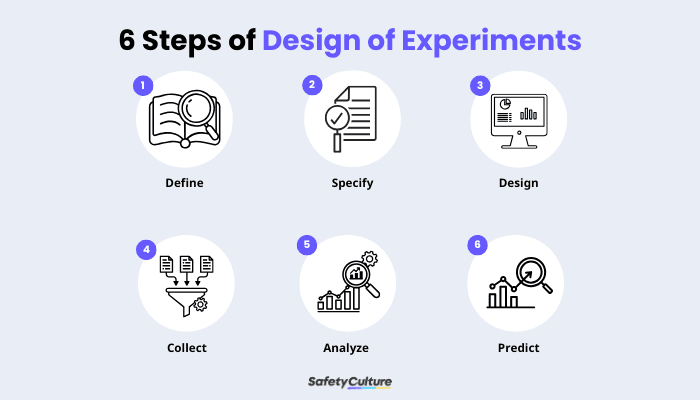
Define: Determine the goal, the desired response, and factors.
Specify: State what variables describe the physical situation, or the factors.
Design: Generate an experimental design model from which the evaluations after run/s or trial/s will be drawn from.
Collect: Execute the design, collect information from the run/s, and record the responses gathered.
Analyze: Review the responses if it does fit in the generated experimental design model, or if the runs should be repeated in order to correct model ambiguity.
Predict: Anticipate the results and determine which factor best optimizes the response.
SafetyCulture is a mobile-first operations platform adopted across industries such as manufacturing, mining, construction, retail, and hospitality. It’s designed to equip leaders and working teams with the knowledge and tools to do their best work—to the safest and highest standard.
Streamline processes, eliminate bottlenecks, enhance resource utilization, and build an agile and scalable infrastructure with SafetyCulture. Strive for operational excellence to boost competitive advantage, foster sustainable growth, and deliver long-term value.
Save time and reduce costs
Stay on top of risks and incidents
Boost productivity and efficiency
Enhance communication and collaboration
Discover improvement opportunities
Make data-driven business decisions
In this article