
Published 4 Sept 2025
Article by
4 min read
What is a Risk Assessment Template?
A risk assessment template is a standardized document used to identify, control, and record risks in the workplace. It involves a systematic examination of a workplace and its environment to determine hazards, assess injury severity and likelihood, and implement control measures to reduce risks.
Why Perform In-house Risk Assessments?
While outsourcing can save your team time and effort, performing in-house operational risk assessments can bolster your company’s culture in several ways:
Enable workers to be proactive rather than reactive – A proactive approach to safety pays off in the long run since the majority of workplace injuries are preventable only if workers know the possible risks and how to handle the situation.
Reinforce responsibility and accountability – When workers are obligated to look out for one another’s safety through in-house operational risk assessments, the habit and culture of responsibility and accountability are reinforced.
Promote transparency and collaboration against operational risks – To identify, evaluate, and control operational risks, teams need to be open and transparent with their activities and processes.
Risk Assessment Requirements in Different Countries
Beyond continued business operations, unhindered by incidents caused by hazards, another key reason to conduct a workplace risk assessment is that it is legally mandated in most countries and regions:
United Kingdom (UK)
In the UK, workplace risk assessments are required under the Management of Health and Safety at Work Regulations 1999 (MHSWR). According to the Health and Safety Executive (HSE) and Regulation 3 of the MHSWR, employers must:
Identify hazards. Anything that could cause injury or illness.
Determine the likelihood and severity of harm (the risk).
Take action to eliminate the hazard or, if that isn’t possible, control the risk.
Review the risk assessment whenever there is reason to believe it is no longer valid or when significant changes occur.
Implement any necessary updates following the review.
If an employer has five or more employees , they must also keep written records of:
Significant findings from the risk assessment.
Any groups of employees identified as being particularly at risk.
United States (US)
In the US, workplace risk assessments—commonly referred to as hazard assessments—are required under the Code of Federal Regulations (CFR) Title 29, Part 1910, Subpart I, specifically OSHA Standard 1910.132.
Canada
In Canada, risk assessments (also known as hazard assessments) are required under Part XIX of the Canada Occupational Health and Safety Regulations.
Australia
In Australia, while risk or hazard assessments are not explicitly mandated, Part 2 of the Work Health and Safety (WHS) Act 2011 requires employers to ensure the health and safety of their workers. Conducting risk assessments is widely recognized as an essential step in meeting this duty of care.
How to Write a Risk Assessment with a Template
One of the main things to keep in mind on how to perform a risk assessment is the format of your report. Depending on the type of the risk assessment, this format will serve as the outline of the full risk assessment.
What is the Correct Format of the Template?
Organize information with tables that contain the following required information:
Name of the hazard
Description of the hazard
Who will be at risk
Risk rating
Existing measures for risk control
Writing the Title Page
Who prepared it? Refers to the name of an individual risk assessor or the company/team working on the risk assessment report.
Who is it for? Indicate what or who the risk assessment is for.
Done on Specify the date on which the risk assessment and the report were completed.
Review date This indicates a specific date set for reviewing risk assessment protocols. As a general rule, a risk assessment review must be done whenever significant changes are made to operations.
Writing the Main Body
The two types of risks are physical and substance risks. Slips, trips, falls, getting or injuries due to falling objects all fall under physical risk. Injuries due to toxic, flammable, and caustic materials are covered under substance risks. These findings should be recorded, preferably in easily accessible risk assessment templates for future reference.
Risk Assessment Example Report
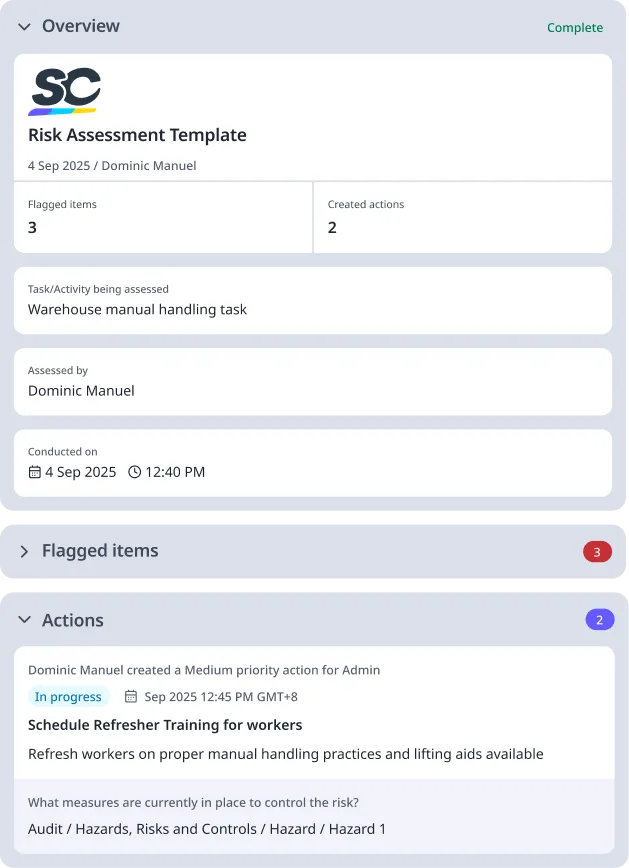
To help you visualize what a risk assessment report looks like, here’s an example report using the Risk Assessment Template.


Byblos Construction digitized safety checklists, compliance checks, and risk assessments with SafetyCulture, letting teams quickly notify leaders of risks for faster action and fewer blind spots. This improved risk management, communication, and visibility for safer job sites.
Still looking for a checklist?
Search, filter, and customize 60,000+ templates across industries and use cases.