The Golden Thread: How it Keeps UK Buildings and Occupants Safe
Learn more about the concept of the golden thread and its importance for UK building and occupant safety.

Learn more about the concept of the golden thread and its importance for UK building and occupant safety.
Published 28 Apr 2026
Article by
8 min read
In the UK, the golden thread refers to the legal requirement for all construction companies to keep a digital record of all safety‑critical information about a higher‑risk building. It includes provisions on how these digital records should be kept and updated through design, construction, occupation, and eventual refurbishment or demolition. While not required for lower-risk buildings, it’s generally understood that it’s a good practice for all types of buildings in the UK to follow.
In response to the Grenfell Tower fire that claimed the lives of 72 people, the UK government commissioned an independent review of building regulations and fire safety. The final report, written by Dame Judith Hackitt, introduced the concept of the golden thread as an effective measure against similar incidents in the future.
The golden thread is part of a wider legislation known as the Building Safety Act of 2022, which aims to enforce stricter regulations on the design, construction, operation, and management of buildings that are 18 metres or 7 stories and above, also known as higher-risk buildings. Under this act, buildings should also have at least two residential units to be within the scope of the Building Safety Act.
Today, the golden thread is important for all UK construction companies and building owners because it’s a major key in ensuring building safety information is complete, reliable, and actively used to keep people safe throughout a building’s life. By centralizing building and fire safety information in one digital source, it becomes easier to identify hazards early and avoid design, installation, and maintenance failures that could lead to another Grenfell‑type catastrophe.
The purpose of the golden thread of information is to ensure that everyone involved in building safety management, whether directly or indirectly, has access to key details that could help identify, assess, and mitigate risks. The intended outcome of putting the golden thread into legislation is to significantly reduce the severity of the consequences of fire and structural collapse on the lives and well-being of residents.
As the golden thread is also intended to rebuild and maintain trust after the Grenfell incident, it aims to make safety‑critical information more findable and shareable with those who need it, including residents, contractors, and emergency responders. This transparency helps residents understand how their building is being kept safe and enables informed scrutiny by regulators, lenders, and insurers.
Raise the level of safety for all workers through real-time data, standardized procedures, and effective communication across multiple sites.
The 10 principles of the golden thread concept are the following:
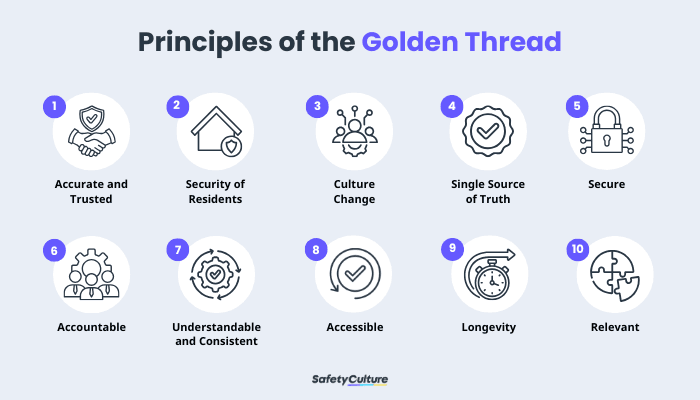
Since the golden thread is intended to be a key source of evidence during assessments of compliance with building regulations, the information within it should be as accurate and as trusted as possible. This means that all information should be checked and verified before being placed in the golden thread.
Another reason why the golden thread should be accurate and trusted is that it’s supposed to be passed down to the next building owner and their management team. However, this doesn’t mean that the information within the golden thread can never be changed. Instead, there should be a strict change control process whenever the golden thread is updated.
One of the key purposes of the golden thread is that it should help residents feel more secure about the safety of their homes. Additionally, it should provide residents with a method of obtaining accountability from the responsible people involved, such as the accountable persons and the building safety managers.
According to the Building Regulations Advisory Committee (BRAC), mandating the development, use, and maintenance of a golden thread of information will lead to a larger culture change in the construction industry. By having more requirements for competence, capability, working practices, processes, and information management, the golden thread sets higher standards for all stakeholders.
A particular feature of the golden thread is that teamwork is necessary for it to be successful. Without the support and participation of both previous and current stakeholders, the person in charge of the golden thread will not be able to implement it effectively.
All information pertaining to building safety should be in the golden thread. Therefore, the golden thread can be seen as a master document or database containing all the relevant information. To make the golden thread the “single source of truth,” duty holders, accountable persons, and building safety managers should refrain from providing updates via email or other means to prevent duplication.
Additionally, this means all information related to building safety should be easily accessible by all members of the construction company and building management.
The golden thread should not be vulnerable to cyber attacks that can greatly harm the privacy and security of the building and its residents. To this end, systems holding the golden thread should be General Data Protection Regulation (GDPR) compliant. Stakeholders should also establish extra measures to protect information from unauthorized access and use.
Since the golden thread will act as a validated record of all actions taken to improve building safety, then it can easily be used to track who did what and when. By clearly stating the duties of stakeholders and documenting their performance, the golden thread of information holds them accountable and responsible for the effects of their action or inaction on the lives of residents and on the safety and structural integrity of the building.
One of the current barriers against the information empowerment of those working in the construction industry is the miscommunication between stakeholders. Though there are many reasons why information is not shared successfully, a key factor leading up to this is a general lack of understanding and communication between the people involved.
For the implementation of the golden thread to be successful, duty holders, construction companies, accountable persons, and building safety managers should strive to over communicate to ensure that each individual or group understands the issues of the building, the proposed and/or existing solutions, and what they need to do to prevent or mitigate those issues and contribute to the solutions. To make the information within the golden thread more useful and more understandable, the BRAC recommends that stakeholders use standard methods, processes, and consistent terminology, where possible, when developing and maintaining the golden thread.
Aside from being readily available to those who need it, information within the golden thread should be organized and structured in such a way that retrieving specific information is easy. As of now, the BRAC recommends the golden thread to be stored like a library, where access is controlled and documented, but also highly specific.
To ensure the survival of information throughout the life cycle of a building, it’s important for the golden thread to be aligned with rules around open data and principles of interoperabilities. Contractors using different software and the new owners of a building should still be able to access the golden thread information.
Though durability and completeness of information is a major feature of using the golden thread concept in construction, there may be times when deleting parts of that information is more beneficial to the overall building safety. Outdated information or details that are no longer relevant should not be kept within the golden thread. This is also to provide more space for other pieces of information that are more relevant to the building’s current safety issues and risks.
Construction companies and building owners can ensure compliance with golden thread requirements by clearly allocating legal duties, building robust digital information systems, and embedding safety information management into everyday practice from concept to occupation. The focus is to create, maintain, and evidence a reliable digital record that satisfies Building Safety Act gateway and occupation requirements for higher‑risk buildings.
Other tips for ensuring compliance with the golden thread principles are the following:
Identify who are the accountable people for building safety, the building designers, the contractors, and safety officers on each project, and document their golden‑thread responsibilities in contracts and appointments.
Establish a governance framework (policies, procedures, sign‑off routes) for creating, verifying, updating, and approving safety‑critical information at each project stage and during occupation.
Implement a common data environment or equivalent digital platform aligned with UK laws and standards so plans, models, certificates, change records, and safety assessments are stored in a structured, searchable way.
Define data standards (naming, version control, templates, metadata) so information can be reliably filtered for golden‑thread needs and easily shared with regulators, maintenance teams, and residents.
Require members of the construction process and supply chain to provide verified digital deliverables (e.g., as‑built drawings, product certification, test reports, commissioning records) and link them to specific locations and systems in the building.
Train project teams, facilities staff, and managing agents on golden‑thread duties, how to use the chosen systems, and what information is safety‑critical.
Keep records that demonstrate compliance (procedures, training logs, audit reports, gateway submissions) in an accessible cloud, so officials and safety officers can see not just the data itself, but how it is controlled and governed, if needed.
SafetyCulture is a mobile-first operations platform adopted across industries such as manufacturing, mining, construction, retail, and hospitality. It’s designed to equip leaders and working teams with the knowledge and tools to do their best work—to the safest and highest standard.
Efficiently manage and streamline health and safety processes across the organization, including incident management, safety audits and inspections, risk assessment, waste management, and more, using a comprehensive EHS software solution.
Save time and reduce costs
Stay on top of risks and incidents
Boost productivity and efficiency
Enhance communication and collaboration
Discover improvement opportunities
Make data-driven business decisions