A Short Guide to Biosafety Levels
Learn more about biosafety levels, how they work, and how a digital tool can help create safer lab areas.
Learn more about biosafety levels, how they work, and how a digital tool can help create safer lab areas.
Published 28 Apr 2026
Article by
4 min read
Biosafety levels are standards set for the different levels of contamination, risk, and protective measures needed in laboratories for specific activities. Biosafety levels are for the benefit of not only the workers in laboratories but also the general public and the environment.
The main purpose of biosafety levels is to keep laboratory workers safe when dealing with different equipment, chemicals, and biohazards. Biosafety levels are often used for laboratories involved with microbiology as they are considered a workplace hazard, but they can be used for other situations as well.
By definition, biosafety refers to the application and management of a set of safety guidelines to reduce human and environmental exposure to infectious agents and contaminants. Created by the US Centers for Disease Control and Prevention (CDC), biosafety levels were made to address these concerns by providing scientists and other lab workers a way to identify, control, and assess the biological hazards they deal with to reduce risk depending on the factors they have to consider.
The different biosafety levels each have their own controls for the following:
Laboratory practices and tasks
Safety equipment
Facility structure, design, and construction
Waste disposal and management
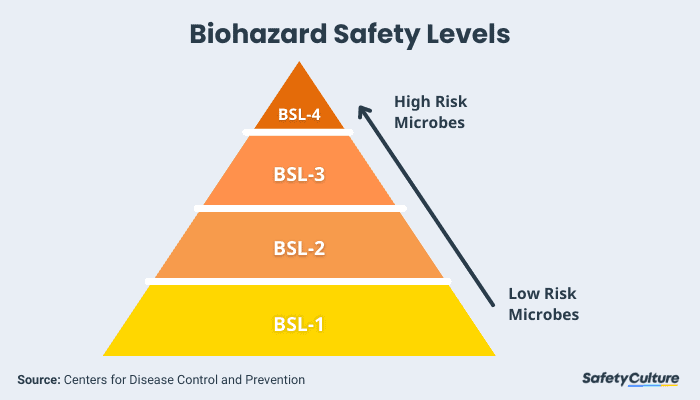
There are four biosafety levels commonly used across the world. The higher the level, the higher the risk of contamination and overexposure to dangerous bacteria, microbiomes, and chemicals. These levels are:
Biosafety level 1 (BSL-1)
Biosafety level 2 (BSL-2)
Biosafety level 3 (BSL-3)
Biosafety level 4 (BSL-4)
BSL-1 is the lowest biosafety level. This level applies to any type of work done with agents, bacteria, and chemicals that are considered to only be minimally hazardous to people and the environment. Research work done in laboratories with a BSL-1 level is usually performed in standard open laboratory benches without special containment equipment and facilities and not in separate buildings.
Generally, BSL-1 activities do not cause diseases in healthy adults, but all lab workers are still required to wear Personal Protective Equipment (PPE) such as face masks.
Building upon BSL-1 standards is BSL-2, which deals with moderate hazards. The most common lab work that falls under BSL-2 includes work with bacteria, chemicals, microbes, and other infectious organisms associated with human diseases.
As the risk of getting sick is high, lab workers need to exercise great care when conducting research and tests under BSL-2. Extra precautions must be taken to prevent injury or ingestion and control or reduce contamination between equipment and users with additional or modified barriers, equipment, and facilities by wearing more PPEs as needed.
In this kind of work environment, laboratories are usually restricted to authorized personnel only and have self-closing doors. It is not recommended for lab workers to conduct their research or tests in open areas.
Work in environments classified as BSL-3 is considered to be more dangerous than BSL-2; thus, they must be strictly controlled and registered with the proper government agencies for operation. Research and tests done in this environment usually involve serious hazards, such as agents lethal to human life, particularly through inhalation.
Under this biosafety level, laboratories must have self-closing doors that separate them from the general environment. Ideally, there should be two sets of doors for this. Ventilation must be controlled with clean air coming into the laboratory from clean areas towards possibly contaminated areas. Following this, exhaust air must not be recirculated back into the area to ensure the safety of the workers.
One known microbiome studied in BSL-3 environments is Mycobacterium tuberculosis, the bacteria that causes tuberculosis. As it attacks the human respiratory system, multiple safety measures have to be implemented to successfully study it.
The highest biosafety level is BSL-4. Environments, researches, and tests classified under BSL-4 mean that lab workers are dealing with microbes and chemicals that are dangerous and pose a high risk of aerosol-transmitted infections that frequently lead to deaths. There are only a few BSL-4 laboratories around the world due to the risk it poses not only to the lab workers but also to the environment around them.
Common microbes and bacteria studied in BSL-4 laboratories are those that cause outbreaks and great concerns for public health. Examples of these are the Ebola virus and the Marburg virus.
There are ongoing conversations about this biosafety level, as studies on these dangerous microbes and chemicals are essential for safer public health and better ways of managing outbreaks. Safer and more efficient ways of researching in BSL-4 environments are always being discussed for both the improvement of science and the safety of lab workers. Government bodies are almost always involved in these environments, as public health is a national concern. In some cases, the military is also included.
Ensure compliance with biosafety levels with the help of a digital auditing application that you can access anytime and anywhere. SafetyCulture (formerly iAuditor) is one such tool that can help you with inspection, compliance, and risk assessment all in one place. It is a mobile-ready app that utilizes smart checklists that you can create from scratch or download from the Public Library as templates that you can edit as you see fit.
With SafetyCulture, you can:
Conduct and schedule inspections on your laboratories before, during, and after research and testing
Work offline and sync back to the cloud once an internet connection is available
Sort your checklists and templates by using folders and bookmarks
Control who can access specific checklist templates and inspection reports by modifying the access controls as you see fit
Create incident report forms by reporting issues and incidents in real time
Address incidents and problems with compliance by creating corrective actions and assigning them to the proper personnel
Share important information across your team and organization by raising a Heads Up any time
Train your staff on proper biosafety practices through Training by SafetyCulture
Monitor your lab workers when they’re alone with help from SHEQSY by SafetyCulture
Generate analytical reports on your findings and incidents for future reference and recordkeeping