Make Product Assembly and Repair Easier with a Bill of Materials
Learn how to create a bill of materials and why it’s crucial for product assembly.

Learn how to create a bill of materials and why it’s crucial for product assembly.
Published 28 Apr 2026
Article by
6 min read
A Bill of Materials (BOM) is a document that lists all the parts and components that go into building a product. In other words, it’s a shopping list or blueprint for manufacturers. A BOM typically includes a description of each part and information about its price, supplier, and product code.
The goal of a BOM is to provide a complete overview of the materials needed to create a product, making it easy for manufacturers to order the correct parts and assemble them correctly. While BOMs are essential for large-scale manufacturing operations and supply chain management, they can also be helpful for smaller businesses and hobbyists who need to keep track of the parts used in their products.
In particular, a well-crafted bill of materials aids companies in materials requirement planning by providing an accurate and quickly followed roadmap. A good BOM can improve different parts of production and supply chains, such as the following:
Planning purchases of raw materials
Tracking and planning material requirements
Estimating material costs
Managing inventory and budgets
Avoiding downtimes
Identifying the cause of a product failure
Replacing faulty equipment
Finding vulnerabilities in various software and supply chain components
Cultivate a culture of excellence with our digital solutions that enhance efficiency, agility, and continuous improvement across all operations.
BOMs come in different forms and types, depending on their structure and use. Based on business purpose, the most common types of BOMs are the following:
Engineering BOM (EBOM): Represents the product as designed by engineering, listing all components and sub‑assemblies to meet design requirements and usually aligned to CAD/PLM structures.
Manufacturing BOM (MBOM): Represents the product as it will actually be built on the shop floor, including all components, sub‑assemblies, and sometimes process-related references needed for production and planning in ERP/MRP.
Sales BOM (SBOM): Represents the product as it is sold, typically driven from sales orders and including the sellable parent item plus its child items/options needed to fulfill a customer configuration.
Service or Support BOM: Represents the product as maintained in the field, focusing on replaceable parts, service kits, and maintenance-relevant structure for aftersales and repair.
The most common types of BOMs based on structure, on the other hand, are the following:
Single-level BOM: Single-level BOMs help provides a shopping list, but they have limitations. For example, they do not indicate how assemblies, subassemblies, and components relate to each other.
Multi-level (indented) BOM: A multi-level bill of materials (also called a parent-child or indented BOM) differs from a single-level BOM in that it shows the relationship between components, subassemblies, and assemblies. Materials or subassemblies used to make up the higher-level assembly or part are usually indented.
Flattened BOM or parts list: This format "rolls up" every part from across all levels of the original hierarchical BOM, treating sub-assemblies as dissolved or invisible, resulting in a simple linear inventory. It typically includes part numbers, descriptions, total required quantities (e.g., multiples from nested assemblies), and sometimes costs or units of measure.
BOM records should always include specific product information, such as the following:
BOM level: Numbered BOMs are much easier to follow and understand, showing where each component fits into the larger assembly.
Part number: Designate a specific number for each part or assembly so you can locate and identify them rapidly.
Part name: By recording the unique name for each element or assembly, you can identify individual parts faster.
Phase: Maintain a record for every item needed in production and assembly and at which stage in its lifespan each component is at.
Description: To avoid confusion and help with identification, provide a detailed description of each separate part.
Quantity: By recording the necessary parts for each assembly or subassembly, you can help dictate and streamline purchasing and manufacturing processes.
Unit of measurement: Be sure to use the exact measurements for all similar types of parts so that there is no confusion about quantities later on.
Procurement type: By detailing how every component is bought or built (for example, from a store shelf or to customer specifications), you can make your manufacturing, planning, and procurement activities more efficient.
Reference designators: Adding reference designators to your BOM can help avoid time-consuming confusion and save you money in the long run.
BOM notes: Keep everyone interacting with your BOM up-to-date by capturing other relevant notes.
Depending on your industry, different people need to look at the bill of materials to ensure it is correct. Here are several steps involved in making a helpful bill of materials, including:
Here’s a simple step-by-step guide to creating your own BOMs:
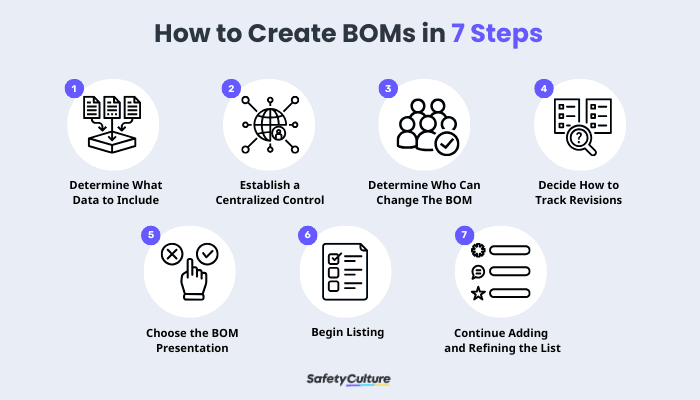
How to Create BOMs in 7 Steps
Determine what data to include: For example, the BOM might include consumables necessary for the product, like glue or wire. The inclusion of these in the BOM from the beginning ensures smooth production in the future.
Establish a centralized control of the BOM: Because various departments or functions in an organization usually use different information systems, the BOM (Bill of Materials) will need to be accurate and up-to-date by gathering data from all these separate systems into one primary record.
Determine who will be able to change the BOM: It is best to have only a few editors so that there are fewer chances for mistakes.
Decide how to track revisions to the BOM: Although BOMs are revised frequently, every modification must be documented so that the BOM provides value and remains accurate. Ensure that each change can be attributed to its author.
Choose the BOM presentation format or type: Choose between single- or multi-level depending on what’s perfect for the product.
Begin listing: Enlist each material, component, and parts that will make up the product since this is subject to change over time.
Continue adding and refining the list: As the product changes, so will the BOM. Keep it updated as much as possible to ensure everyone is on the same page.
While a BOM is typically used in the manufacturing sector for the assembly of products, it’s also used in other industries, such as these:
Automotive: Automotive BOMs detail thousands of components for vehicle assembly, facilitating just-in-time inventory and supplier coordination..
Electronics: Electronics companies use modular BOMs to track resistors, capacitors, sensors, and circuit boards, streamlining Printed Circuit Board (PCB) fabrication and testing for devices like smartphones.
Aerospace: In aerospace, engineering BOMs emphasize precision parts with traceability for regulatory audits, reducing risks in critical assemblies.
Construction: Construction organizations adapt BOMs as Bills of Quantities (BOQ) to specify materials like steel beams and concrete for projects, supporting budgeting and procurement while aligning with safety regulations such as the UK's golden thread for compliance tracking.
Food: Food and beverage industries employ BOMs for recipe formulations, listing ingredients and packaging to ensure batch consistency and hygiene standards.
Pharmaceuticals: Pharmaceutical companies use BOMs for drug compounding, incorporating active ingredients and controls for legal compliance.
SafetyCulture is a mobile-first operations platform adopted across industries such as manufacturing, mining, construction, retail, and hospitality. It’s designed to equip leaders and working teams with the knowledge and tools to do their best work—to the safest and highest standard.
Streamline processes, eliminate bottlenecks, enhance resource utilization, and build an agile and scalable infrastructure with SafetyCulture. Strive for operational excellence to boost competitive advantage, foster sustainable growth, and deliver long-term value.
✓ Save time and reduce costs ✓ Stay on top of risks and incidents ✓ Boost productivity and efficiency ✓ Enhance communication and collaboration ✓ Discover improvement opportunities ✓ Make data-driven business decisions