10 Safety Moment Ideas and Topics to Use in Your Workplace
Discover practical safety moments ideas and tips to keep your team aware, engaged, and protected on the job.

Discover practical safety moments ideas and tips to keep your team aware, engaged, and protected on the job.
Published 27 Apr 2026
Article by
7 min read
A safety moment is a short, specific exercise designed to get employees thinking about safety. They usually involve a problem or scenario that employees are likely to encounter on the job, followed by a few minutes of reflection and discussion.
The goal of a safety moment is to help employees identify potential hazards and take steps to avoid them. By routinely practicing these exercises, employees will become more aware of their surroundings and the risks associated with their jobs. This can help reduce the risk of workplace accidents and injuries.
According to OSHA, worker deaths in the US have fallen from around 38 per day in 1970 to 15 per day in 2023, a direct result of stronger safety habits and consistent workplace practices. That said, the U.S. Bureau of Labor Statistics still recorded over 5,000 fatal work injuries in 2024.
This serves as a reminder that there's still real work to do. When teams take just a few minutes to talk through a hazard or safety procedure, they build habits that stick, and those habits are what prevent accidents from happening in the first place.
Here's why making safety moments a regular part of your workplace routine is worth the effort:
Reduced workplace accidents: Short, consistent safety reminders keep hazards top of mind. Workers who regularly attend safety moments are more likely to spot risks before they turn into injuries.
Stronger safety culture: When safety is discussed openly and often, it stops feeling like a compliance checkbox and starts feeling like a shared value. That shift in mindset is what a genuine safety culture looks like in practice.
Engaged and informed teams: Safety moments give workers a voice. Encouraging employees to share near-misses or raise concerns during these sessions surfaces issues that might otherwise go unreported.
Improved compliance: Regular safety discussions help ensure workers are up to date with procedures, regulations, and any changes to how tasks should be performed.
Low costs with high impact: No special equipment or lengthy training sessions are required to conduct safety moments. Just a few focused minutes at the start of a shift or meeting can establish hazard awareness and save lives.
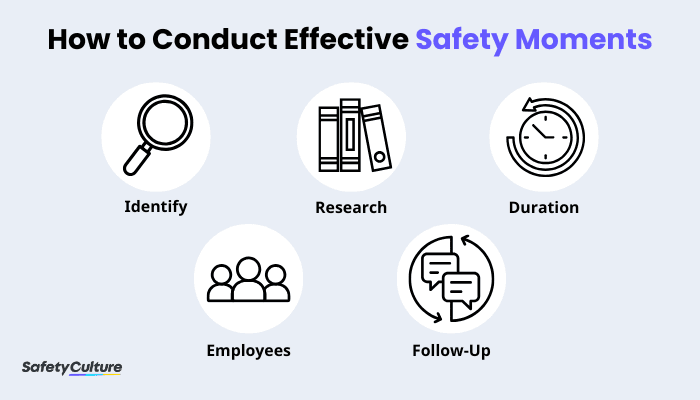
Choose a relevant topic. Identify potential hazards and risks in your workplace and choose a relevant topic for the safety moment.
Researching potential hazards and risks in the workplace is an essential step in conducting a safety moment. This allows you to identify the most relevant topics to address and gather information and resources to support your presentation.
Keep it short and engaging. Keep the safety moment to no more than 10-15 minutes in length. Use interactive methods to keep employees engaged.
Involve all employees. Encourage participation from all employees and ensure everyone has a chance to share their thoughts and ideas.
The follow-up of a safety moment is crucial to assess its effectiveness and make improvements for future presentations. Encourage employees to provide feedback and document hte session for reference.
Discuss ways to prevent slips, trips, and falls in the workplace. This entails teaching your team crucial topics like keeping walkways clear of obstacles and using non-slip flooring as an extra precaution.
Falls from ladders are a common cause of injury in the workplace. Emphasize the importance of using ladders properly. This means checking for stability, ensuring the ladder is on a flat surface, and facing the ladder while climbing or descending.
Discuss the importance of using electrical equipment safely, including proper grounding and following manufacturer instructions.
Discuss proper lifting techniques and equipment, such as using a dolly or forklift, to prevent injuries associated with manual handling.
Handling chemicals in the workplace requires care and caution. Discuss the importance of wearing gloves and protective gear, properly labeling chemicals, and storing them safely.
In case of a fire, knowing how to use a fire extinguisher can save lives. Explain the proper steps for using a fire extinguisher, tackling important concepts like the PASS (Pull the pin, aim the nozzle, and sweep side-to-side) technique for maximum effectiveness.
Now that we know how essential safety moments are. We have provided you with a list of 10 safety moments to use in your workplace.
Always use proper form when lifting heavy objects. Bend your knees, keep your back straight, and hold the object you are lifting close to your body. Proper Body posture is essential to avoid any back or joint pain. Keep in mind the following:
When sitting: Keep your feet flat on the ground and use a chair with good lumbar (lower back) support
When standing: Keep your weight evenly distributed between both feet and avoid standing in one spot for too long
Be aware of your surroundings and what is happening around you. Keep an eye out for potential hazards and take caution when necessary. When walking in an unfamiliar area, be sure to take your time and look around. Pay attention to your surroundings and be aware of what is going on around you.
Make sure you are wearing clothing that is appropriate for the tasks you will be performing. Avoid loose clothing that could get caught in machinery, and always wear safety gear when necessary. These include:
Gloves
Safety goggles
Helmets
High visibility vest
Protective boots
Whenever possible, use handrails to help maintain your balance when walking up or downstairs. This will help prevent slips and falls especially when you are in a rush or when the floor is slippery.
The parking lot can be a risky area, make sure to be alert and cautious when walking through.
Below are some basic safety tips when in the parking lot area:
Park your car in a well-lit area
Bring your valuables with you if you can or hide them safely in locked storage in your car
Always remember to lock your doors and roll up your windows
Be attentive and alert
Always use a ladder safely. Falls are among the most common causes of serious work-related injuries and deaths, with ladders being a major contributor. OSHA requires fall protection to be in place for workers at elevations as low as four feet, which is a good indicator of just how seriously ladder risks are taken at a regulatory level.
Before climbing, make sure the ladder is the proper height, the footing is stable, and that you're using it for its intended purpose. Avoid rushing when going down to prevent falls. If possible, ask a co-worker to help you when going up and down a ladder.
Be sure to watch out for wet or icy surfaces. Always use caution when walking in these areas. If you do fall, try to relax and fall into a fetal position. This will help reduce the number of injuries sustained.
Make sure you know where the nearest exit is in case of a fire. Remember to stay calm if there is a fire. If there is heavy smoke, crawl your way to the exit to avoid inhaling it.
Exit the building in an orderly fashion. Do not stop to collect personal belongings.
When working with chemicals, always read the safety data sheet first. Under OSHA's Hazard Communication Standard, employers are legally required to make safety data sheets available for every hazardous chemical in the workplace. This supports workers’ rights to understand what they're handling.
Always handle chemicals with care and store them in a safe place. Wear the correct personal protective equipment and follow all safety instructions to maximize safety.
Check-in procedures are essential for ensuring the safety of lone workers, especially during late hours. Make sure to have a system in place for checking in with these employees, such as regular phone calls or check-in visits.
SafetyCulture is a mobile-first operations platform adopted across industries such as manufacturing, mining, construction, retail, and hospitality. It’s designed to equip leaders and working teams with the knowledge and tools to do their best work—to the safest and highest standard.
Now it’s easy for teams to run consistent, engaging safety moments across every shift and site. With features like SC Training, you can deliver short safety lessons digitally, so workers can complete them on their own device, in their own time. The Inspections feature also lets you build custom safety moment checklists, track attendance, and follow up on action items, all in one place.
✓ Save time and reduce costs
✓ Stay on top of risks and incidents
✓ Boost productivity and efficiency
✓ Enhance communication and collaboration
✓ Discover improvement opportunities
✓ Make data-driven business decisions