Ein kompletter Leitfaden für die Wasserschadensanierung
Erfahren Sie mit diesem umfassenden Leitfaden mehr über den Prozess der Wasserschadensanierung
Erfahren Sie mit diesem umfassenden Leitfaden mehr über den Prozess der Wasserschadensanierung
Veröffentlicht 28 Apr 2026
Artikel von
6 lesezeit
Bei der Wasserschadensanierung geht es darum, den ursprünglichen Zustand der Immobilie vor dem Wassereinbruch wiederherzustellen. Der Prozess besteht aus Inspektion, Extraktion, Entfeuchtung, Sanierung und Wiederaufbau (falls erforderlich). Auch wenn für die Sanierung von Wasserschäden in der Regel keine Zertifizierung erforderlich ist, sollte sie idealerweise von einem Spezialisten für Wasserschadensanierung durchgeführt werden, der über die richtigen Werkzeugen und Kenntnisse verfügt.
Water damage affects around 14,000 individuals in the US per year, while faulty water systems also cause Americans to waste nearly 1 trillion gallons of water annually. Proper water damage restoration is important because it helps prevent further structural and environmental damage, health risks, and costly repairs.
Water damage and structural damage are closely connected and the presence of one often indicates the presence of the other. Walls, ceilings, and even floors can collapse due to water damage. Neglecting water damage repair or not responding to it quickly enough can also pose long-term health risks from mold, bacteria, and pests.
Minimizing the importance of water damage restoration not only diminishes the skill, knowledge, and experience required to do such work, but also significantly endangers the lives of building occupants.
Knowing what caused the problem you’re supposed to fix is just the first step to solving it. For water damage restoration specialists, being familiar with the major causes of water damage can help them easily locate the source when inspecting a property.
The major causes of water damage include the following:
air conditioning unit condensation
rubber or PVC water supply lines
broken household appliances
clogged drains and gutters
septic tank and sewer backups
burst or leaking pipes
old or faulty water heaters
damaged sprinkler systems
water overflow from toilets
inoperative sump pumps
inefficient roof water drainage
Aside from knowing where to look, water damage restoration specialists should also know what to look for. Water damage can still be present in areas that don’t contain or seemingly haven’t been affected by any of the major causes listed above. Therefore, restoration specialists should be able to spot the signs of water damage right away.
One of the main protocols of the water damage restoration process is the ability to spot the signs of water damage proactively.
The signs of water damage include the following:
swollen or warped materials
cracks on the ceiling or wall
peeling or bubbling paint
sagging or soft spots
structural damage
puddles of water
mold or mildew
water stains
Specialists typically perform the whole water damage restoration process in 5 easy steps:
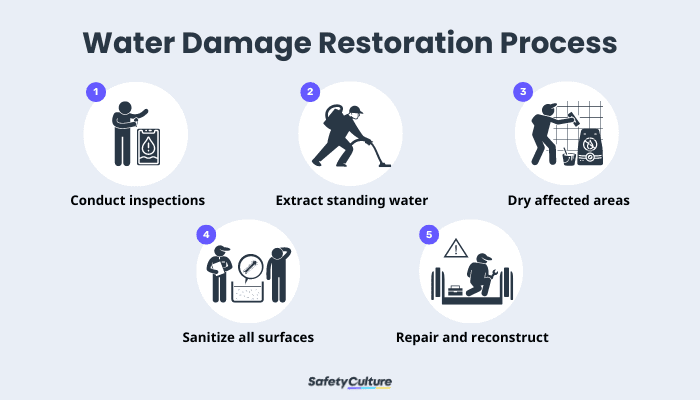
A water damage inspection or water damage assessment is conducted by the specialist to identify the water source, the water contamination category, and the water damage class. This process can be streamlined with a checklist to carry out the assessment systematically and provide comprehensive documentation.
After identifying and stopping the flow of the water source, the specialist will identify the water contamination category:
Name | White Water | Gray Water | Black Water |
Category | 1 | 2 | 3 |
Contamination Level | Little to None | Has Contaminants | Hazardous |
Water Sources / Causes of Water Damage | Bathtubs, Sinks, Pipes, Water Heaters | Dishwashers and Washing Machines | Sewage, Toilets, Flooding |
Identifying the water contamination category will help the specialist decide on the scope and type of decontamination needed later on. The third part of the inspection is the identification of the water damage class:
Class 1 | Class 2 | Class 3 | Class 4 | |
Wet Porous Materials Percentage of Surface Area | Less than 5% | 5% to 40% | More than 40% | More than 40% |
Low Evaporation Materials Moisture Absorption | Minimal | Minimal | Minimal | Significant |
Wet porous materials include carpet, gypsum board, fiber-fill insulation, Concrete Masonry Unit (CMU) and textiles. Low evaporation materials include plaster, wood, concrete, and masonry. Identifying the water damage class is important because it indicates the extent of drying and dehumidification needed later on.
Especially crucial when a property has a flooded basement, removing the standing water (also known as stagnant water) is done through extraction. Extractors include industrial vacuums and submersible pumps.
After all standing water is removed, surface water can be extracted through portable wet/dry vacuums. The specialist may also use a moisture meter or infrared thermal camera to uncover hidden pockets of saturation behind walls or underneath floorboards. Residual surface water may also still be present even after vacuuming.
Similar to water extraction, the specialist will also use equipment such as heavy-duty fans (including air movers) and commercial-grade dehumidifiers to dry and dehumidify affected areas. Aside from using these tools, the specialist may also open windows and doors to increase air circulation.
However, drying and dehumidification will generally take longer than water removal, especially if water damage is Class 3 or 4 and requires removing parts of walls and/or floors.
Before mold cleanup, the specialist needs to wear Personal Protective Equipment (PPE) such as an N-95 mask, gloves, googles, rubber boots, and disposable clothing or protective overalls. Similar to both extraction and dehumidification, the specialist will also use equipment such as a High Efficiency Particulate Air (HEPA) vacuum, an air scrubber, and other types of negative air machines during sanitation. If water damage is Category 3, all surfaces will need to be cleaned with an antimicrobial solution.
In the final part of water damage restoration, the specialist will remove unsalvageable parts (e.g., drywall below the flood line, low to medium density trim boards, carpet padding). Carpets can be deep cleaned, though they will more than likely need to be replaced.
In some cases, wooden trim boards may be reused and drywall can be repaired, if the water damage isn’t Class 4 or Category 3. However, reconstruction may also be necessary, especially if the cause of the water damage is a natural disaster.
Although the process can be very complex at times, following some basic water damage restoration protocols can help ensure a thorough and effective restoration approach.
Fachleute für die Sanierung von Wasserschäden können diese Checkliste für die Sanierung von Wasserschäden verwenden, um Folgendes zu tun:
Dokumentieren von Wasserquelle, Verschmutzungsgrad, Kategorie der Wasserverschmutzung, prozentualem Anteil feuchter poröser Materialien an der Oberfläche, Grad der Feuchtigkeitsaufnahme durch Materialien mit geringer Verdunstung und Wasserschadensklasse.
Verifizieren, dass das gesamte Wasser abgesaugt wurde und keine Sättigungsstellen vorhanden sind.
Verifizieren, dass Sie beim Aufräumen und Reinigen die richtige PSA tragen.
Angeben, ob ein größerer Wiederaufbau erforderlich ist und den erforderlichen Wiederaufbau beschreiben.
PDF-Bericht erstellen (einschließlich Medien) und ihn an die Versicherungsgesellschaft senden.
Mit SafetyCulture können Sie Ihre Mitarbeiter auch in der Wartung und Verwaltung verschiedener Geräte und Anlagen schulen, die bei der Wasserschadensanierung zum Einsatz kommen.
In diesem Artikel