
“Employees really see the value in the SafetyCulture platform. It provides them with visibility, comfort and reliability, all vital for the safe day-to-day running of Jurassic Fibre.”
Preventing Repetitive Motion Injuries
Explore repetitive motion, its risk factors, and effective ergonomic and safety measures to reduce injuries and improve worker health.

Published 5 Jan 2026
Article by
|
7 min read
What is Repetitive Motion?
Repetitive motion refers to the sustained or frequent use of the same physical movements, often caused by repetitive tasks, physical exertion, and working in awkward postures. Over time, this repeated strain can lead to musculoskeletal disorders (MSDs), affecting soft tissues such as tendons, nerves, and muscles, especially in the upper arms and neck.
Importance of Prevention
Repetitive motion can cause injury. It accounts for nearly 40% of all musculoskeletal disorders, making it one of the leading causes of lost workdays across industries. Without ergonomic safety practices, these injuries can reduce productivity, increase healthcare costs, and lead to long-term worker disability. Here are reasons for prioritizing this:
Reduce workplace injuries : Without appropriate ergonomic controls, even simple tasks like typing can lead to chronic conditions like carpal tunnel syndrome and tendonitis, which may result in permanent damage.
Lower absenteeism and lost workdays : MSDs are a top cause of absences at work. Some studies show that factories that introduced job rotation and rest breaks reported drops in sick leaves related to arm and shoulder injuries.
Cut healthcare and compensation costs : Repetitive motion injuries often require surgery and long-term treatment . Preventing these from the onset, especially in high-risk industries, helps cut down on these associated costs.
Improve productivity and work quality : Workers who experience pain and fatigue tend to slow down and make more mistakes. Supporting good ergonomics helps maintain output by reducing strain-related discomfort and disruptions.
Support long-term workforce sustainability : Ergonomics is not a luxury. It’s a fundamental part of workplace safety that protects the organization’s most valuable asset: its people.
Improve your EHS Management
Cultivate a safe working environment and streamline compliance with our EHS solutions.
What is Repetitive Motion Injury?
Repetitive motion injury at work is often overlooked by both employees and managers. Everyday actions, such as typing, lifting, and gripping, are easy to ignore until the pain interferes with work or the damage becomes permanent. Below are some of the most common MSDs, their symptoms, and the 10 examples of repetitive motion that can be hazardous:
Carpal Tunnel Syndrome
This compression disorder affects the median nerve in the wrist, causing numbness, tingling, and weakness in the hand. One of the most common RSIs, this affects up to 6% of adults worldwide because of the following:
Repeated typing and mouse use
Forceful pinch grips on small tools or components
Tendonitis
Tendonitis occurs when tendons get inflamed due to overuse and insufficient recovery. Millions of outpatient visits are linked to symptoms, such as pain, swelling, and limited movement. These are some of the reasons:
High-frequency lifting with moderate load and limited recovery time
Repeated overhead reaching (e.g., stocking, painting)
Bursitis
Bursitis is the inflammation of the bursae, the fluid-filled sacs that cushion the joints in the shoulders, elbows, hips, and knees. Common in construction, healthcare, and maintenance, this is due to the following:
Sustained pressure on joints (e.g., kneeling on hard surfaces and leaning on elbows)
Awkward, static postures that compress the joints
Epicondylitis (Tennis Elbow)
This condition develops when the tendons around the elbow get inflamed from repetitive forearm motion. Some studies suggest up to 3% of adults experience this each year, particularly those with manual labor jobs in manufacturing and construction.
Repeated forearm rotation from twisting tools (e.g., screwdriving)
Continuous gripping with wrist extension
De Quervain’s Tenosynovitis
This occurs when the tendons at the base of the thumb become inflamed, sending sharp pain into the wrist. A challenge frequently faced by caregivers, this is commonly triggered by the following:
Repetitive thumb abduction and extension (e.g., texting, gaming)
Frequent one-hand lifting that uses the thumb for support
Create your own ergonomic assessment checklist
Build from scratch or choose from our collection of free, ready-to-download, and customizable templates.
How Can Repetitive Motion Injuries Be Prevented?
The repetitive motion injury examples detailed above cost companies billions of dollars annually in medical expenses, compensation claims, and lost productivity. The impact on affected workers is even more profound—causing lasting harm that can continue long after retirement. These best practices are simple but effective in protecting both employers and employees:
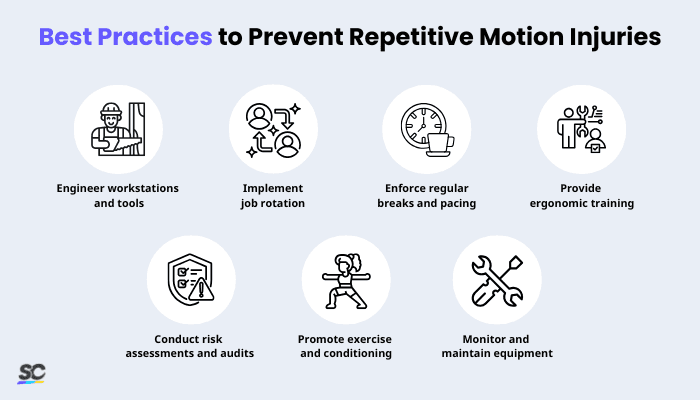
Engineer workstations and tools.
Fitting the job to the worker instead of forcing the body to adapt reduces strain. Here are some practical examples you can do:
Adjust desk, chair, and monitor heights to maintain neutral postures.
Use ergonomic tools (e.g., bent-handle tools with non-slip grips, vertical mice) that reduce grip force and wrist deviation.
Position frequently used items within easy reach.
Implement job rotation.
Microtrauma can accumulate into permanent damage. By limiting continuous exposure to the same movements and muscle groups, muscles can recover effectively. The following approaches can help:
Rotate tasks that use different body parts, such as alternating between plugging in data and answering calls.
Balance high-repetition tasks with lower-demand duties.
Schedule rotations based on fatigue and risk level.
Enforce regular breaks and pacing.
Muscles need to recover to reduce cumulative strain. When they get to adapt properly, they get stronger for more tasks. These are some strategies:
5-minute microbreaks per hour are adequate.
Set realistic productivity targets that discourage rushing.
Use reminders or software prompts for breaks.
Provide ergonomic training.
Education is the first line of defense. When workers can recognize hazards and adjust their setup or behaviors, they can better protect their long-term physical health. Here are some actions to make this happen:
Train workers on neutral postures (e.g., straight spine, relaxed shoulders, elbows at the sides) and safe movement.
Teach early symptom reporting and self-correction.
Refresh ergonomics training when tasks or tools change.
Conduct risk assessments and audits.
Identifying high-risk tasks help teams put the right controls in place. These are some ways to accomplish this:
Assess repetition, force, posture, and duration.
Involve workers in identifying problem tasks.
Track trends and follow up on corrective actions.
Promote exercise and conditioning.
The body can better adapt to work demands with musculoskeletal strengthening. Employees are more resilient against injuries by doing the following:
Stretch before and during shifts.
Offer wellness and conditioning programs.
Share simple, on-the-desk exercises targeting high-risk muscle groups, such as:
Chin tucks
Neck tilts
Shoulder shrugs
Palm presses
Seated spinal twists
Overhead reaches
Calf raises
Leg extensions
Monitor and maintain equipment.
Faulty or inefficient tools can increase strain. Regular equipment maintenance helps reduce vibration, prevent mechanical failures, and preserve ergonomic features. These simple steps are beneficial:
Regularly inspect tools for wear and resistance.
Replace outdated or poorly designed equipment.
Maintain machinery to ensure smooth, low-force operation.
Telecommunications leader Jurassic Fibre strengthened its operational sustainability by moving to digital safety tools. This shift reduced paper-based inefficiencies and helped frontline teams maintain strong ergonomic and safety standards through real-time visibility, mobile-first inspections, and streamlined risk reporting.
Standards and Regulations
Rising rates of musculoskeletal injuries in manufacturing highlight the need for stronger ergonomic oversight. To combat the increase in carpal tunnel and related disorders, several regulations such as the following have been established to protect worker health and safety:
Occupational Safety and Health Administration (OSHA) of the US: Employers should provide a workplace free from recognized hazards under the General Duty Clause . These risks range from poorly configured workstations to constant physical strain—factors that may seem non-threatening, but ultimately prove that repetitive motion can cause injury.
Health and Safety Executive (HSE) of the UK: The Health and Safety at Work Act and Display Screen Equipment (DSE) Regulations outline employer responsibilities for managing ergonomic risks and controls to prevent such injuries.
Safe Work Australia : A person conducting a business or undertaking (PCBU) should eliminate or minimize risks from hazardous manual tasks. Recommended controls include the proper setup of workspaces and guidelines on sitting and standing .
Canadian Centre for Occupational Health and Safety (CCOHS) of Canada: Federal and provincial regulators provide guidance to prevent RSIs. They cover identifying hazards, implementing controls, and training workers on MSD prevention.
European Agency for Safety and Health at Work (EU-OSHA) of the European Union: This agency coordinates safety efforts across member states, based on evidence that musculoskeletal disorders can be caused by repetitive motion. The Framework Directive and Display Screen Equipment Directive mandates risk assessments, ergonomic workplace design, and preventive measures to minimize work-related MSDs.
Mitigate Repetitive Stress with SafetyCulture
Why Use SafetyCulture?
SafetyCulture is a mobile-first operations platform adopted across industries such as manufacturing, mining, construction, retail, and hospitality. It’s designed to equip leaders and working teams with the knowledge and tools to do their best work—to the safest and highest standard.
Gain real-time visibility into high-risk repetitive motions by digitizing ergonomic audits and task tracking. Proactively implement corrective actions and data-driven workstation redesigns, effectively minimizing physical strain across teams. Protect the workers’ long-term health while complying with strict regulations through a unified platform.
✓ Save time and reduce costs
✓ Stay on top of risks and incidents
✓ Boost productivity and efficiency
✓ Enhance communication and collaboration
✓ Discover improvement opportunities
✓ Make data-driven business decisions
FAQs About Repetitive Motion
Related articles
Food Safety
Safety

Allergen Awareness Training: Importance and Key Topics
Understand allergen awareness training, its importance, and the key topics to include to provide an effective training program for your team.
Manufacturing Safety
Safety

Visitor Induction Guide: Best Practices for Workplace Safety
Learn what visitor induction is and why it matters, along with the legal requirements, challenges, and best practices to ensure workplace safety for guests.
Food Safety
Safety
Food Transportation
Learn more about food transportation: why it is a factor for food safety, what are transportation issues, and how to avoid them.