Visitor Induction Guide: Best Practices for Workplace Safety
Discover how visitor induction works and how businesses use it to manage visitor safety, minimize hazards, and maintain regulatory compliance.

Discover how visitor induction works and how businesses use it to manage visitor safety, minimize hazards, and maintain regulatory compliance.
Published 5 May 2026
Article by
7 min read
A visitor induction is a formal greeting and safety briefing for guests arriving at a workplace. This formalized onboarding process introduces guests to site rules, potential hazards, and emergency procedures. By establishing clear safety and behavioral standards, this process minimizes risks and ensures a secure, protected environment for everyone on the premises.
Safety isn't just for the workforce. Millions of workplace accidents occur globally each year, highlighting the hidden risks faced by guests, including contractors, vendors, and visiting family or friends. Formal safety briefings are the critical first step to ensure the following:
Prevent accidents and injuries: Untrained visitors often fail to spot slip and trip hazards, such as spills and trailing cables. The most basic pre-entry orientation raises hazard awareness, helping visitors better protect themselves from harm.
Reduce liabilities: Visitor injuries can lead to compensation claims and reputational damage. Informing visitors of what to expect on-site reduces the likelihood of incidents and avoids the financial burden of safety failures.
Ensure legal compliance: Safety laws require employers to protect everyone on the premises, including visitors. This upholds duty of care, shielding visitors and the company from harm.
Improve emergency preparedness: Guests who are informed of evacuation routes and appropriate actions are safer during emergencies. Clarity replaces confusion, allowing responders to act effectively and maintain order during incidents.
Promote safety culture: Structured visitor induction signals that safety applies to everyone, including workers, contractors, and guests. Strengthening safety protocols minimizes occupational risks, ensuring a safer, more productive outcome for all stakeholders.
Early workplace safety laws primarily addressed the protection of workers after significant industrial accidents. Later safety frameworks expanded duties to “everyone affected”, including managing visitors on site. This led to formal visitor safety inductions, which are now legally mandated in various jurisdictions through these agencies:
The Occupational Safety and Health (OSH) Act of 1970 mandates companies to ensure safe workplaces. There is no explicit “visitor induction” rule, but employers should provide adequate information, instruction, and training for safety and hazards to all on-site persons.
The Health and Safety at Work etc. Act 1974 states that the duty of care extends to “persons not in employment”, which includes visitors. Employers should also assess risks to guests by providing site-specific safety information and induction appropriate for their visit. Supervision and documentation are also expected.
The Model Work Health and Safety (WHS) Act imposes duties on “persons conducting a business” to ensure the health and safety of workers and others affected by work. Beyond direct supervision, employees and visitors alike must complete tailored safety training and instructions prior to site entry.
While occupational health and safety laws vary per province, they share a common requirement: employers ensure health and safety for all persons on site. On top of adequate risk communication and controls, organizations must provide safety orientation based on the risks on-site.
Directive 89/391/EEC (OSH Framework Directive) requires employers across the region to ensure worker safety and protect others affected by operational activities. Hazard communication and safety training are required for all individuals entering high-risk areas.
Site safety training and briefings are often undervalued. While guests may only be observing from afar, unfamiliar environments and hidden hazards leave them vulnerable. Underestimating the following risks disrupts operations and compromises lives.
Inconsistent or informal orientation: Improvised explanations create gaps in critical safety information, increasing misunderstandings and unintentional violations.
Time pressure and operational disruptions: Rushing inductions leave visitors unprepared, increasing the likelihood of unsafe behaviors or incidents.
Visitor resistance: Lengthy or generic overviews often lead to a lack of audience engagement. When this happens, guests might miss key points in the induction. This can cause them to unknowingly enter restricted areas, ignore warnings, or respond incorrectly during emergencies.
Language and literacy barriers: Poorly translated induction programs increase the chance of misinterpretation, leading to confusion and elevated safety risks.
Poor documentation and record-keeping: Manual or paper-based systems make it difficult to track completed briefings, weakening compliance protocols. This exposes the company to legal risks in the event of an incident.
Failure to update induction content: Outdated materials do not reflect new hazards, equipment, or site layouts. Visitors may receive inaccurate safety training during inductions, leaving them unprepared during an emergency.
Scalability across sites: Organizations with multiple locations often struggle to deliver consistent inductions. These variations can result in uneven standards, compliance gaps, and confusion for visitors moving between facilities.
Well-defined induction protocols turn complex site safety into a repeatable success. These practices help overcome visitor resistance and encourage full compliance, protecting both the guest and the organization’s reputation.
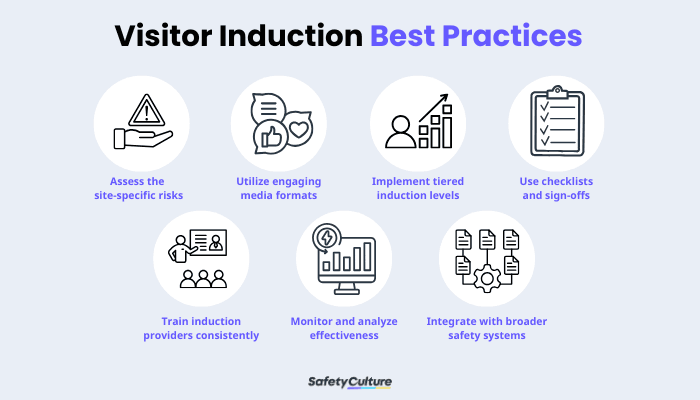
Each location presents unique risks that make generic safety training insufficient. Identifying them before a visitor arrives can accurately address site-specific risks. This ensures relevance and reduces confusion caused by outdated or inconsistent safety information. Here are some examples:
Office setting: Restricted IT areas, emergency exits, electrical equipment
Production line: Moving machinery, noise levels, forklift traffic
Hospital laboratory: Biological samples, chemicals, controlled equipment
Use videos, visuals, and interactive content to communicate safety rules. Aside from improving understanding, this overcomes language barriers and increases engagement, helping address visitor resistance and poor information retention.
Tailor content based on visit type, duration, and risk exposure. This prevents information overload, ensuring visitors receive only what’s relevant to their level of site access. Here are some examples specifically seen in a construction site:
Low-risk visitors: Clients and auditors staying in site offices should understand general site rules and conduct emergency evacuation procedures.
Moderate-risk visitors: Designers, inspectors, and suppliers entering active areas should be required to wear PPE and be informed about site-specific traffic and hazards.
High-risk visitors: Long-term consultants, specialist technicians, and subcontractors should learn permit-to-work systems, isolation procedures, and reporting processes, in addition to basic induction.
Create consistency and accountability with documentation. These formal acknowledgements of safety requirements reduce reliance on verbal briefings, helping organizations demonstrate compliance across multiple sites.
Staff who deliver orientations should ensure accurate, consistent messaging. They can only do this if they, too, receive proper induction training courses. This reduces mismatch between induction providers across different locations, improving clarity and reliability while strengthening overall safety culture.
Track completion rates, feedback, and incident data to identify gaps in induction quality. Continuous monitoring ensures inductions stay relevant, effective, and aligned with evolving site risks. Some key metrics to check include:
Induction completion rate
Visitor incident / near-miss rate
Induction comprehension or engagement score
Integrate visitor induction with safety management systems. This effectively aligns everyday goals with permits, incident reporting, and risk assessments. Utilizing a centralized platform for induction improves scalability, data visibility, and overall operational control.
SafetyCulture is a mobile-first operations platform adopted across industries such as manufacturing, mining, construction, retail, and hospitality. It’s designed to equip leaders and working teams with the knowledge and tools to do their best work—to the safest and highest standard.
Automate visitor briefings using digital checklists and electronic sign-offs to ensure seamless compliance. Standardize induction materials to guarantee every visitor understands site hazards, PPE requirements, and emergency protocols. Mitigate safety risks through real-time tracking and analytics that drive proactive incident management. Allow safety teams to focus on strategic oversight rather than manual paperwork, enhancing accountability and safety for all stakeholders across sites, through a unified platform.
✓ Save time and reduce costs
✓ Stay on top of risks and incidents
✓ Boost productivity and efficiency
✓ Enhance communication and collaboration
✓ Discover improvement opportunities
✓ Make data-driven business decisions