A Complete Guide to Scaffolding Safety Training
Improve construction site safety and enhance worker well-being by implementing effective scaffolding training topics and safety protocols.

Improve construction site safety and enhance worker well-being by implementing effective scaffolding training topics and safety protocols.
Published 27 Feb 2026
Article by
6 min read
Scaffolding safety training is a specialized program that teaches workers and supervisors to safely erect, modify, and dismantle scaffolding systems. The primary goal of completing this training is for relevant personnel to identify hazards and effectively use fall protection systems to minimize safety incidents and structural failures on construction sites.
Unsafe scaffolding practices have been one of the most common OSHA violations in the US since 2016, with the Bureau of Labor Statistics citing that it also causes thousands of worker injuries and fatalities per year. This highlights a critical reality: scaffolding safety is a life-saving necessity.
Upholding effective scaffolding safety is achieved through proper training that builds hazard awareness, which helps workers recognize unsafe conditions. It also teaches correct erection, inspection, and dismantling practices, reducing structural failures. Proper PPE and fall protection use are also reinforced, improving confidence and compliance, especially when working at heights. All these lower incidents, protect lives, cut downtime, and create consistently safer, more productive worksites.
Not all workers require safety scaffolding training, as it largely depends on whether they interact with scaffolds during construction or maintenance. However, providing scaffolding safety training for all workers helps them understand the main hazards of working on scaffolding and prevent serious injuries and structural collapses. Here is a quick guide:
Scaffold Worker | Why Training is Needed | Common Hazards Faced |
Erectors and Dismantlers | Building and dismantling scaffolding structures requires precise technical instruction to manage high-risk assembly and teardown. | Fall from height, struck-by falling components, structural collapse |
Users | Personnel must master stabilization techniques to ensure structural integrity during routine daily tasks and weight-bearing activities. | Slips and falls, overloading platforms, unsafe access or missing guardrails |
Planners | Engineers and designers who design scaffold systems should be suited to site conditions and work requirements. | Design miscalculations, |
Supervisors and Site Managers | Workers must be trained to thoroughly evaluate structural integrity before and during each shift to prevent failures. | Undetected defects, unsafe worker practices, lack of proper inspection leading to incidents |
Inspectors | Construction front liners must be able to evaluate structural integrity before and during every shift to prevent failures. | Hidden structural damage, environmental impacts, overlooked load limits |
Scaffolding safety requires a comprehensive approach to effectively minimize risks and create a safer worksite. These are the core pillars of targeted construction safety training, the specific modules needed, and the certifications that validate competence and compliance.
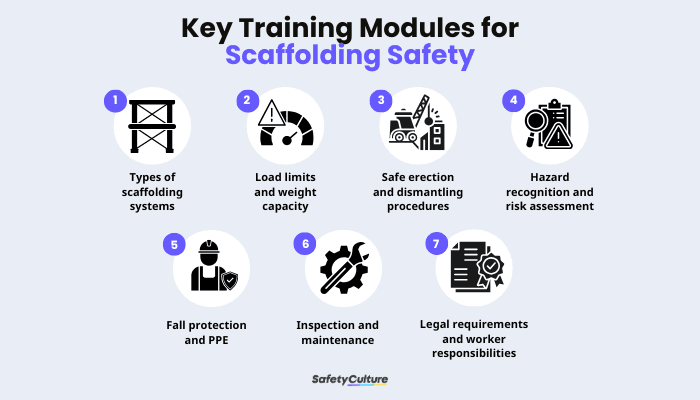
Workers must be able to identify and differentiate scaffolding structural configurations, as each one has unique stability requirements. Learners who complete the Principles of Scaffolding (OSHA #3085) earn certificates by demonstrating they can:
Differentiate between supported (frame, tube & clamp), suspended, mobile, and aerial lift scaffolds
Identify key components, including platforms, braces, and base plates
Select the correct system for specific environments and tasks
Structural failure is often caused by simple math errors. As such, it is crucial to provide planners and safety officers with modules on load-capacity to refresh their math knowledge and prevent structural collapses. Examples of this include:
Maximum intended loads
Component ratings
Environmental load variables
A scaffold is at its most vulnerable when it’s incomplete, especially during assembly and disassembly. The training program should include these lessons to get certified as erectors and dismantlers:
Pre-erection planning and site assessment
Step-by-step assembly sequence
Approved components and compatibility
Majority of scaffolding accidents can be prevented if workers are trained to identify general construction hazards and those specific to scaffolding, and then assess their potential risks through:
Site inspections
Environmental and fall hazard awareness (OSHA #7405)
Reporting procedures
Falls consistently rank as a leading cause of workplace fatalities. As such, courses involving fall protection (OSHA #3115) are non-negotiable in construction scaffold safety training. The program should include these essential topics:
Guardrail installation (top and midrails)
Personal fall arrest systems (PFAS)
Proper use of hard hats and non-slip footwear
Neglected defects can lead to expensive and fatal catastrophes. It is important to conduct routine checks to ensure scaffold integrity and stability. Workers can get certified to become a Competent Person or scaffold inspector by completing lessons on:
Pre-use inspection processes
Documentation
Corrective action procedures
Personnel at all levels must take ownership of their safety duties to effectively manage risks, investigate incidents, and maintain precise safety documentation. To uphold these, workers should have the right tools for inspections and be knowledgeable about the following responsibilities:
Duty or Care and mutual responsibility
Incident reporting, investigation (OSHA #7505), and documentation
In a high-stakes environment, proactive safety is the most effective defense against catastrophe. Comprehensive training empowers workers to master risk control, preventing incidents and ensuring project continuity.
Here are some best practices to consider when building a scaffolding safety training program:
Identify task-specific hazards and responsibilities early to create targeted training programs that address issues. This helps workers better understand risks and apply correct controls from the outset, rather than relying on generic safety instructions.
Merge compliance requirements with practical, hands-on application to create a training program that workers can easily adjust to. Integrating on-the-job instruction with specialized construction-focused platforms creates a scalable and consistent framework for operational safety.
Experienced trainers can facilitate training based on their previous job experiences and other qualifications. Besides improving credibility and comprehension, they can efficiently correct unsafe habits to strengthen worker confidence, reinforce correct techniques, and reduce errors.
While hands-on sessions are essential for field readiness, effective programs begin with interactive instructions. With digital scaffolding training modules, workers gain crucial safety knowledge to prepare them for hands-on experience and allow them to grow confident before they step into high-risk physical environments.
Training modules should be regularly refreshed to eliminate workplace complacency. This can be achieved by conducting regular assessments to pinpoint knowledge gaps and reinforce critical safety habits. Doing so also helps technical skills can remain sharp even when regulations, equipment, and site conditions evolve.
SafetyCulture is a mobile-first operations platform adopted across industries such as manufacturing, mining, construction, retail, and hospitality. It’s designed to equip leaders and working teams with the knowledge and tools to do their best work—to the safest and highest standard.
Create and share bite-sized modules on general construction safety guidelines, load limits, and fall protection. Empower workers who will erect, use, inspect, and dismantle these temporary platforms by enabling instant safety alerts, tracking real-time hazards, and assigning corrective actions. Develop competent persons and enhance scaffolding safety by delivering comprehensive training through a unified platform.
✓ Save and reduce costs
✓ Stay on top of risks and incidents
✓ Boost productivity and efficiency
✓ Enhance communication and collaboration
✓ Discover improvement opportunities
✓ Make data-driven business decisions
In this article