Published 23 Feb 2026
Article by
4 min read
What is a Food Storage Temperature Control Checklist?
A food storage temperature control checklist is a digital tool used to ensure perishable foods are stored, cooled, and controlled at safe temperatures. It is designed to verify and track whether freezers and refrigerators are at appropriate temperatures to prevent contamination and bacterial growth.
Importance
A food storage temperature control checklist is crucial for keeping food items out of the temperature danger zone to avoid spoilage and bacterial growth. By creating a structured approach to monitoring food storage temperature, this checklist provides several key benefits:
Prevents foodborne illnesses: Using this checklist for proper temperature monitoring helps prevent the growth of pathogens and bacteria such as Salmonella and E. coli.
Compliance with food safety standards: Consistent temperature updates and logs provide support and evidence for compliance during food safety audits.
Ensures proper stock rotation: The checklist also checks if inventory adheres to FIFO (First-In, First-Out) principles, which helps reduce food waste.
Maintains food quality: Using this checklist verifies that food items are stored at ideal temperatures and conditions to preserve their quality and prevent spoilage.
Items and Checkpoints Included
The elements included in a food storage temperature control checklist may vary depending on business needs, the kind of food to be stored, and the quantity of items being kept. However, some of the commonly included items and checkpoints are:
Log items and details
This section lists the names and details of the food items being stored. Aside from the name of the inspector, the date, and time of the check, it should also include some components such as:
Food classification: It specifies Time/Temperature Control for Safety (TCS) foods such as poultry, meat, seafood, dairy products, eggs and egg products, and prepared or mixed dishes.
Storage unit identification: This indicates whether the food should be stored in a cool, dry storage room, a refrigerator, or a freezer.
Temperature reading and control
This section is focused on recording food storage temperatures to ensure food freshness. Some factors to consider are:
Temperature readings: Recorded in the food storage temperature control log, these indicate the actual temperatures of the refrigerator, freezer, and chiller, as measured by installed sensors.
Temperature zones: Verify whether the temperature falls within the ideal zone for cold holding, dry storage, or frozen storage. This determines whether the temperature is within or out of range and whether corrective action is needed.
Equipment
This section notes the equipment used to store and preserve food items in. This section includes:
Refrigeration, freezers, and chillers: These are the most commonly used food storage locations that can maintain ideal temperatures for food items.
Digital technologies: This includes digital tools such as temperature-monitoring systems or temperature data-loggers & sensors to obtain accurate, real-time temperature readings 24/7.
Best practices and guidelines
This section outlines best practices to maintain good temperature control in food storage. Some of these include:
Food storage guidelines: This typically follows a Hazard Analysis Critical Control Point (HACCP) Plan, which serves as a reference for checking the critical control points of food items.
Hygiene and cross-contamination practices: A checklist can also be used as a reference for hygiene expectations. This helps keep storage areas clean and sanitized, preventing spills, pests, and chemical contamination.
How to Use this Food Storage Temperature Control Checklist
Follow these steps to effectively use a food storage temperature control checklist to uphold food quality standards:
Provide the necessary details on the title page. This usually includes the inspector's name, the date, the time, and the inspection site.
Verify and document the food items that will be stored and cooled, including its categories. Classify the storage equipment used for each food item.
Update and record the readings from temperature-monitoring systems, temperature data loggers & sensors as often as needed.
Check if best practices for food storage guidelines are being followed. Assign corrective actions as needed to immediately resolve issues.
Attach any media annotations and notes to provide details or corrective actions for food storage temperature control.
Complete the food storage temperature control checklist with a sign-off.
Sample Food Storage Temperature Control Report
For reference, here is a completed food storage temperature control checklist report:
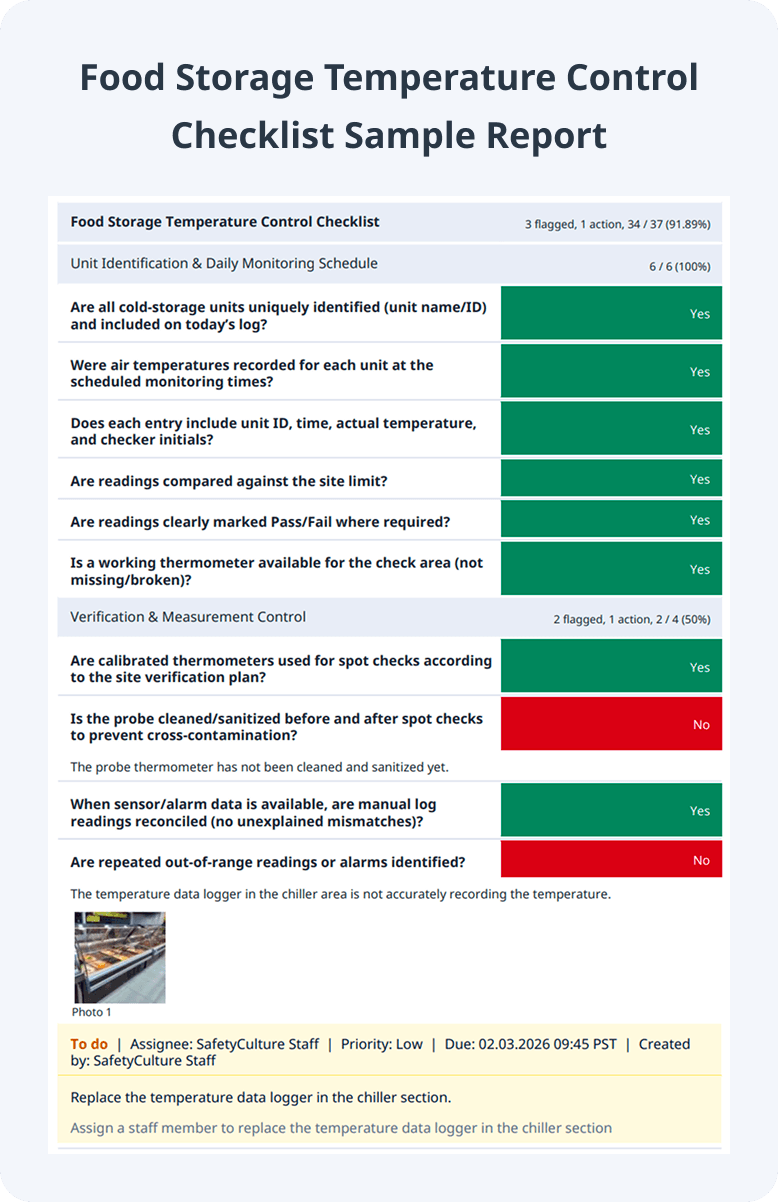
Preview Food Storage Temperature Control PDF Report
Recording and Monitoring Fridge Temperatures with MLSE

“We knew the food came from a trusted source, we knew how all the products were shipped. We have a process for internal movement and of course we have a history of all the people who had eaten it. With SafetyCulture, we have the history of the fridge temperatures and our food safety logs in a centralized place.”

Still looking for a checklist?
Search, filter, and customize 60,000+ templates across industries and use cases.