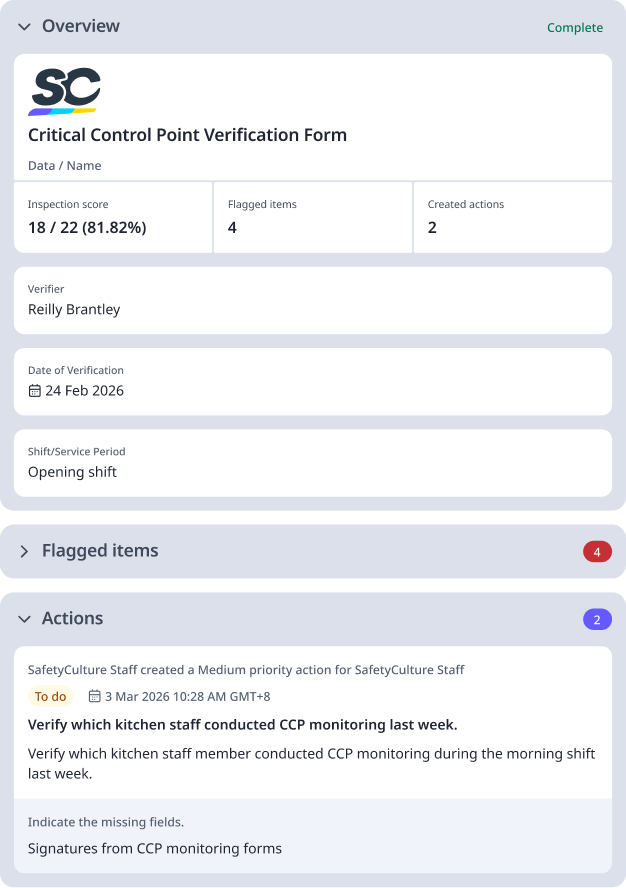
This critical control point verification form ensures that monitoring activities are compliant with regulatory bodies. Kitchen managers and senior staff members can use this checklist to verify that the critical limits for food items are controlled.
The checklist can also be used to:
Validate the accuracy of thermometers and sensors
Verify the consistency of recorded temperatures
Review the performance of the kitchen staff during monitoring activities
What is a Critical Control Point Verification Form ?
A critical control point verification form is a structured document that helps ensure organizations' food safety plans are implemented correctly in accordance with the HACCP system and that equipment is calibrated. This kind of checklist confirms that checks and inspections are carried out effectively.
Importance
A CCP verification form supports the HACCP plan, which monitors and validates the critical control points for food safety. You can use this checklist to:
Adhere to regulatory compliance: This checklist helps organizations meet regulatory requirements set by governing authorities such as the Food and Drug Administration (FDA) and the United States Department of Agriculture (USDA) by providing documentation for food safety audits.
Identify equipment and process issues: Efficient calibration checks in this checklist ensure accurate readings from thermometers and sensors. This helps confirm that key food processes, such as cooking, holding, and storage, are done properly.
Preventfoodborne illnesses: Using this checklist, you can continuously check and verify temperatures to prevent bacterial growth.
Demonstrate system effectiveness: This checklist also ensures that the Food Safety Management System (FSMS) is implemented to keep food safe to consume.
Information Included in a Critical Control Point Verification Form
A structured critical control point verification form template should consist of the following information to confirm that food monitoring and validation activities are performed correctly and effectively.
Verification details
This section of the checklist provides the inspector's name, the facility name or location, and the date and time of the verification activity.
Product details and CCP process
Here, you’ll find a detailed description of the food item, including its batch labels and production line. This outlines specific CCP processes, including cooking, cooling, metal detection, and pH control, along with the ideal temperature for each food item and CCP process.
Verification checks and tests
This part presents verification activities to ensure that the CCP process is valid and consistent, and not merely recorded. Some of these include:
Equipment calibration checks: Examine the accuracy of thermometer and sensor readings.
Monitoring records reviews: Verify that the CCP monitoring forms are recorded and signed completely and consistently.
In-person verification: Observes a person-in-charge or kitchen staff on how they record and monitor temperatures.
Laboratory tests: Performed when necessary to detect microbial growth in food products.
Compliance confirmation and corrective actions
This section assesses whether the process remains in compliance with the established critical limits set in the HACCP plan. If inconsistencies or inaccuracies are found, corrective measures are determined to mitigate the issues.
Filling out and Reviewing the Form
Follow these steps to create an effective critical control point verification form and ensure monitoring activities and equipment checks are correctly implemented.
Provide the necessary details on the verification details page. This usually includes the inspector's name, the date, and the inspection site.
Verify and document the product details, its batch labels, and the production line. Also, validate the CCP processes implemented for the food products.
Perform calibration checks for thermometers and sensors. Check if CCP monitoring records are complete and consistent.
Attach any media evidence and notes to provide details on deviations found in CCP verification.
Complete the critical control point verification checklist with a sign-off.
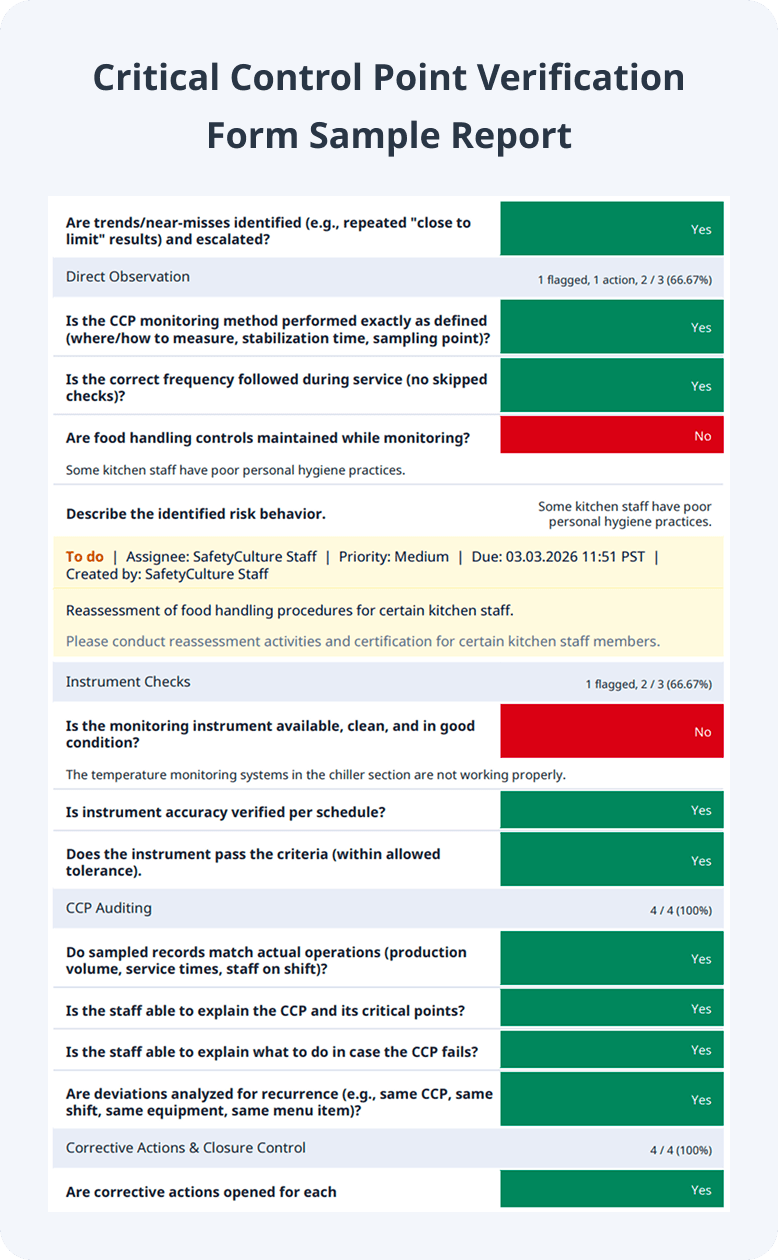
Sample Critical Control Point Verification Report
For reference, here is a sample report of critical control point verification:
“HACCP is about mitigating risk and ensuring we do everything we can within our production to prevent food safety hazards. Using SafetyCulture platform, we have become a paperless HACCP company, which has given us greater operational efficiency and analytics to share back with our CEO.”