A Comprehensive Guide to Natasha’s Law Training
Learn about the importance of implementing proper training for Natasha’s Law and how it helps food businesses comply with UK allergen labeling laws and improve food safety practices.

Learn about the importance of implementing proper training for Natasha’s Law and how it helps food businesses comply with UK allergen labeling laws and improve food safety practices.
Published 27 Apr 2026
Article by
7 min read
Natasha’s Law training refers to in-house competency programs focused on managing allergen risks by labeling prepackaged foods correctly. The primary goal of having workers undergo this kind of training to create actionable steps for workers to uphold food safety standards, protect consumers from harm, and ensure compliance with UK food safety legislation.
Natasha’s Law was first enacted in October 2021, following a tragic incident that exposed critical gaps in food labeling within the UK. This highlighted the need for comprehensive allergen awareness training to upskill workers’ knowledge of food labeling standards to protect vulnerable customers and achieve the following:
Reduce life-threatening errors - Proper training helps staff accurately identify and label the 14 allergens defined under the law. This lowers the risk of accidental anaphylactic reactions and other health risks.
Prevent cross-contamination - Proper food handling and hygiene practices are key components of compliance with Natasha’s Law training standards. These reduce accidental allergen exposure, which commonly happens in restaurants and cafes.
Enhance operational consistency - Standardizing training ensures consistent allergen practices across shifts. This unified approach reinforces a culture of safety, ensuring every staff member upholds standards at all times.
Ensure legal compliance - Employees must meet the prepacked for direct sale (PPDS) labeling rules to avoid fines and legal risks.
Improve customer trust - Customers, especially those with existing allergies, are more likely to support businesses that provide clear allergen information because this supports safe food choices.
Equip your team with the knowledge and skills to operate safely through extensive training programs.
Effective Natasha Law training goes beyond allergen labels. Food safety training should involve practical competencies such as basic hygiene for food handling and knowledge of proper storage methods. Here is the full scope of the training program designed for Natasha’s Law:
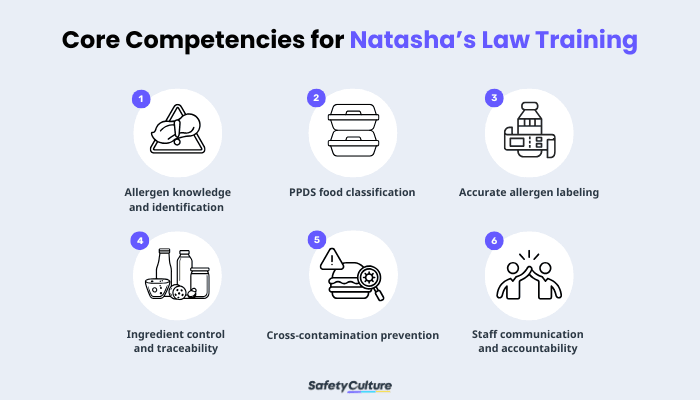
Workers must accurately recognize regulated allergens to prevent incorrect labeling and accidental exposure that can cause severe or fatal allergic reactions. These are the 14 food allergens that UK businesses are required to disclose:
Gluten
Sulphites or Sulphur dioxide
Celery
Crustaceans
Egg
Fish
Lupin
Milk
Mustard
Molluscs
Tree nuts
Peanuts
Sesame
Soya
Correctly identifying Prepacked for Direct Sale (PPDS) foods determines whether Natasha’s Law applies, reducing misclassification and regulatory noncompliance. Here is a basic guide that can help distinguish PPDS from non-PPDS foods:
Feature | PPDS | Non-PPDS |
Timing (When was it packed?) | Before the customer orders or selects it | After the customer orders or not packed at all |
Location (Where is it packed?) | On the same premises where it is sold | Usually served at a table or over the counter |
Packaging Type | Fully or partially enclosed (contents can’t be altered) | Loose, on a tray or in open-faced packaging |
Labeling Requirement | Mandatory full labeling | No labeling required |
Allergen Information | Emphasized in bold or italics in the on-pack ingredients list | Provided verbally or via signage (e.g., “Ask us”) |
Common Examples | Grab-and-go sandwiches Boxed salads Pre-potted sauces | Made-to-order burgers Loose pastries Restaurant meals |
Clear, comprehensive allergy labeling is at the core of Natasha’s Law. It is the primary safeguard for consumers who have hypersensitive reactions to certain foods. Workers should be well-versed in the following:
Creating full ingredients list, emphasizing allergens
Ensuring consistency across packaging formats
Managing label updates when ingredients or food formulations change
Proficiency in food traceability prevents allergen errors that may have been caused by supplier changes, substitutions, or poor documentation. Employees should learn to:
Check the pack habit
Have transparent communication with suppliers
Accurately document food inventory
Reporting protocols and managing changes in suppliers or formulations
Even correctly labeled foods become unsafe if allergens unintentionally transfer to another during preparation, storage, or service. Cross-contamination can happen easily, which is why the following practices should be prioritized:
“Clean-Clean” routine (e.g., full washing of hands, surfaces, and tools)
Identifying the hidden sources of allergens—such as molluscs in oyster sauce or celery in seasonings
“Stop and Ask” protocol requires pausing the preparation or transaction and asking about an ingredient instead of guessing.
While distinct from daily kitchen tasks, this module is essential to Natasha’s Law training course as it provides the foundational knowledge that reinforces all other safety protocols. The following teaches employees to understand the “why” behind the law, how to explain “may contain risks”, and what to do when an error has occurred.
Build from scratch or choose from our collection of free, ready-to-download, and customizable templates.
Everyone involved in food preparation, packaging, and sales must understand food-related risks to prevent contamination. Here are a few examples:
Kitchen staff and food handlers who prepare raw ingredients, recipes, and substitutions that directly affect allergen presence and cross-contamination.
Packaging and labeling staff that handle and seal PPDS foods, create ingredient labels, and update allergen declarations, making their accuracy critical to consumer safety.
Front-of-house and service crew who answer allergen-related questions, handle packaged foods, and influence customer decisions. Misunderstandings or assumptions can pose a health risk to customers with known allergies.
Supervisors and shift managers who oversee food preparation, approve labels, manage changes, and ensure allergen procedures are followed consistently across shifts and locations.
Procurement and inventory staff that source ingredients and manage supplier changes that may introduce new allergens. They should update labels and revise allergen controls as needed.
Cleaning and maintenance teams who clean equipment, utensils, and food areas. Any food residue could potentially contaminate supposedly allergen-free foods.
Natasha’s Law demands absolute accuracy. Beyond defining core competencies and identifying training needs, businesses must prioritize consistency. Implementing a structured program is the only way to unify staff practices and strengthen long-term compliance.
It is highly effective to deliver food safety training courses tailored for each role within a food business. Combine theory and practical learning to ensure relevance and accurate application. Here are some examples:
Restaurant kitchen staff - Practice preparing, packaging, and labeling menu items
Retail cafe front-of-house - Learn communication principles followed by practice simulations or on-the-job training.
Bakery packaging staff - Review allergen labeling requirements then cross-check ingredients before putting products on display.
Document staff training and what topics were covered to demonstrate compliance and identify gaps. Using digital logs can help managers centralize recordkeeping and deliver routine reminders for refresher courses.
Validate training effectiveness by observing how employees act while at work. Regularly shadow staff during work shifts until theory becomes a habit. This type of assessment identifies knowledge gaps before they become safety risks since workers can be corrected on the spot.
Measure performance using common indicators to assess training impact. These are some that should be checked:
Allergen labeling accuracy rate
Allergen incident and near-miss rate
Training compliance and competency rate
Based on the KPI results and observations, address weaknesses through targeted re-training or process changes. For example, as soon as an incorrect label is identified, the team should pause production, update the ingredients list, retrain staff, and revise the labeling checklist.
Roma Food Products utilize digital training and safety tools to upskills teams and support compliance goals. By digitizing training delivery and certification tracking, the company provides consistent food safety knowledge and learn skills across the manufacturing staff, contributing to higher quality and safer processes in allergen-friendly food production.
SafetyCulture is a mobile-first operations platform adopted across industries such as manufacturing, mining, construction, retail, and hospitality. It’s designed to equip leaders and working teams with the knowledge and tools to do their best work—to the safest and highest standard.
Build and deliver accurate training programs by enabling rapid course creation, mobile microlearning, online quizzes, and on-the-job assessments. Support role-based assignments, reminders, and certification tracking with robust analytics. Ensure workforce competency and compliance to Natasha's Law across departments and sites through a unified platform.
✓ Save and reduce costs
✓ Stay on top of risks and incidents
✓ Boost productivity and efficiency
✓ Enhance communication and collaboration
✓ Discover improvement opportunities
✓ Make data-driven business decisions