Allergen Awareness Training: Importance and Key Topics
Discover what allergen awareness training is, why it’s important, and the key topics covered in these training programs.

Discover what allergen awareness training is, why it’s important, and the key topics covered in these training programs.
Published 28 Apr 2026
Article by
6 min read
Allergen awareness training teaches workers how to identify common food allergens, understand how cross-contact occurs, and follow procedures to prevent accidental exposure. It covers proper handling and clear labeling to control allergens during storage, preparation, and service. It also helps protect consumers with allergies and supports compliance with food safety regulations.
Conducting allergen awareness training helps organizations reduce the risk of allergic reactions that can cause serious harm. It’s a key aspect of allergen management that lowers the chance of regulatory violations, lawsuits, and costly product recalls. Consistent training builds employee confidence and customer trust by demonstrating a clear commitment to food safety.
In the European Union, allergen awareness training is effectively required as part of food safety obligations under Regulation (EU) No 1169/2011. Food businesses must ensure staff are knowledgeable about allergens so they can provide accurate information and prevent cross-contact.In practice, this means training employees on allergen risks and controls.
In the United States, there is no federal law that specifically requires allergen awareness training for all food service workers. However, many jurisdictions base their food safety rules on the FDA Food Code, which strongly encourages training. Several states and one county also have their own requirements for allergen training and certification:
Illinois: Certified Food Protection Managers (CFPM) must complete ANSI-accredited allergen awareness training within 30 days of their hiring date. They are then required to renew this training every three years.
Massachusetts: MGL Ch 140, S. 6B mandates that food protection managers secure a state-issued allergen awareness certificate. Their training must cover the eight major allergens, reaction signs, safe food preparation, and proper customer interaction.
Rhode Island: Although training completion is not required, the Rhode Island Department of Health (RIDOH) expects persons in charge to raise allergen awareness among all staff to support workplace safety.
Virginia: There are no statewide mandates, but per the FDA Food Code, a dedicated allergen certification is highly recommended for food handlers and managers. Basic training is available online if needed.
California: Food handler and manager courses must discuss the FDA’s major allergens, reactions, and cross-contact prevention techniques. These courses need to be renewed every three years. Elijah’s Law requires childcare staff to be trained on kids’ allergies, but retail/food service sticks to general food safety.
Montgomery County, Maryland: Food establishments that need a food service manager must have at least one trained employee on-site during food prep and service. This person must have completed a county-approved course and exam to be considered trained.
Allergen awareness training should be provided to anyone involved in handling, preparing, serving, or managing food. This includes kitchen staff, front-of-house employees, managers, supervisors, and temporary or seasonal workers who may interact with food or customers. Training is also valuable for procurement and cleaning staff to ensure allergens are properly controlled across the entire operation.
Allergen awareness training can cover a broad and varied range of topics depending on the nature of the service, regulations, and other factors. That said, the following topics must be covered in any training program.
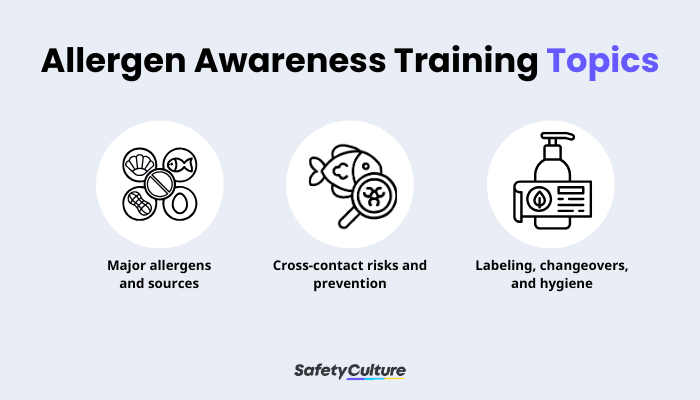
This topic explains which food allergens are most commonly regulated and their presence in ingredients and finished foods. Employees will learn to identify hidden allergens in recipes, additives, and supplier products. Understanding these sources can help staff avoid accidental exposure during handling and service.
Cross-contact occurs when allergens are unintentionally transferred from one food or surface to another. Training covers risks such as shared equipment, utensils, storage areas, and preparation surfaces. It also includes preventive practices such as segregation, proper cleaning, and controlled workflows.
Clear labeling ensures allergen information stays accurate from receiving through service. Changeover procedures teach staff how to clean equipment and work areas when switching between allergen-containing and allergen-free items. Good personal hygiene and handwashing reduce the risk of spreading allergens during food handling.
Organizations can choose the most efficient and effective way to deliver their training program to their team. There are multiple approaches teams can take for this, each with its own set of advantages and drawbacks. Here’s a quick look at some of the main training delivery methods teams use.
On-the-job training allows employees to learn allergen controls directly within their work environment. It focuses on real tasks such as food handling, cleaning, and communicating with customers about allergens. This reinforces practical habits but requires consistent supervision to ensure accuracy. In café settings, a barista training checklist can act as a hands-on guide to make sure allergen procedures are covered during live service.
Online courses and digital training programs provide standardized allergen awareness content that employees can complete at their own pace. They’re useful for consistently covering regulations, major allergens, and best practices. This approach works well for onboarding, but it should be reinforced with site-specific training material.
Blended learning combines online instruction with hands-on, in-person training. It ensures employees understand allergen principles and practice correct procedures in real operations. This method improves knowledge retention and supports consistent compliance across teams.
On top of providing food allergen awareness training, it’s critical for teams to constantly test and check their effectiveness. Various ways to do this include the following:
Competency checks and observations: Verifies that employees understand allergen risks and can apply procedures correctly. Observations during daily tasks help identify knowledge gaps or unsafe practices, while regular assessments ensure training is effective and consistently followed.
Corrective actions and retraining: Addresses issues found during inspections, incidents, or observations, preventing repeat errors and strengthening long-term allergen control. Retraining reinforces proper procedures and updates employees on changes to menus, ingredients, or regulations.
SafetyCulture is a mobile-first operations platform adopted across industries such as manufacturing, mining, construction, retail, and hospitality. It’s designed to equip leaders and working teams with the knowledge and tools to do their best work—to the safest and highest standard.
Efficiently manage and streamline health and safety processes across the organization, including incident management, safety audits and inspections, risk assessment, waste management, and more, using a comprehensive EHS software solution.
✓ Save time and reduce costs
✓ Stay on top of risks and incidents
✓ Boost productivity and efficiency
✓ Enhance communication and collaboration
✓ Discover improvement opportunities
✓ Make data-driven business decisions
In this article