PUWER Explained: Ensuring Safety in the Use of Work Equipment
Understand the PUWER and how it protects workers by setting safety standards for workplace equipment.
Understand the PUWER and how it protects workers by setting safety standards for workplace equipment.
Published 28 Apr 2026
Article by
6 min read
The Provision and Use of Work Equipment Regulations (PUWER) are a set of health and safety regulations in the United Kingdom that require employers and the self-employed to ensure that any equipment used at work is suitable, safe, and properly maintained. It mandates regular inspections, adequate training for users, and the implementation of safeguards where necessary.
Introduced in its current form in 1998 after replacing the 1992 version, PUWER incorporated new requirements to reflect advances in machinery and workplace safety needs and to align with the European Use of Work Equipment Directive. PUWER 1998 was strengthened for these reasons:
Prevention of workplace injuries and fatalities -Contact with moving machinery is one of the major causes of deaths across industries, especially in construction, agriculture, and manufacturing. PUWER reduces high incidences related to machinery by ensuring equipment is safe and used correctly.
Ensures comprehensive safety controls and training - The law mandates that equipment must have suitable safety measures, such as machine guards and emergency stops, and be operated by trained individuals. This approach minimizes hazards from malfunction and misuse.
Improves legal compliance and employee responsibility - The legislation places clear legal duties on the duty holder, promoting personnel accountability that grows into a culture of safety and protects the organization from liabilities and legal penalties.
Stay ahead of regulations and maintain a safe workplace with a digitized compliance tool.
PUWER compliance isn’t just the job of a single individual. This is a coordinated effort that involves multiple people across the organization. Each function demands different expertise, levels of access, and day-to-day involvement. These are the most crucial roles and their responsibilities:
Role | Responsibility |
Employer or Duty Holder | Legally accountable under the law, this duty holder ensures overall compliance with PUWER across the organization through the following: - Providing suitable, safe, and well-maintained equipment- Implementing procedures for inspection and maintenance |
Health and Safety Manager | This personnel manages PUWER compliance programs and supports implementation by: - creating and maintaining PUWER assessments; |
Supervisors or Line Managers | The first line of defense in daily compliance, they ensure that safe work practices are followed on the ground and report faults and other issues promptly. |
Employees or Equipment Operators | As the organization's frontline personnel, they should use equipment strictly following the instructions and training provided. Employees may be held partially responsible if negligence in their duties is established. |
Maintenance Technicians or Engineers | Critical for ongoing compliance, technicians inspect, maintain, and repair the company’s assets. Their work directly impacts whether the equipment is deemed safe for continued use under PUWER. |
PUWER applies to all work equipment used by employees at work, regardless of whether it’s owned, leased, or hired. The scope is intended to be broad because any equipment can pose a risk if it’s inappropriate, rundown, or used erroneously.
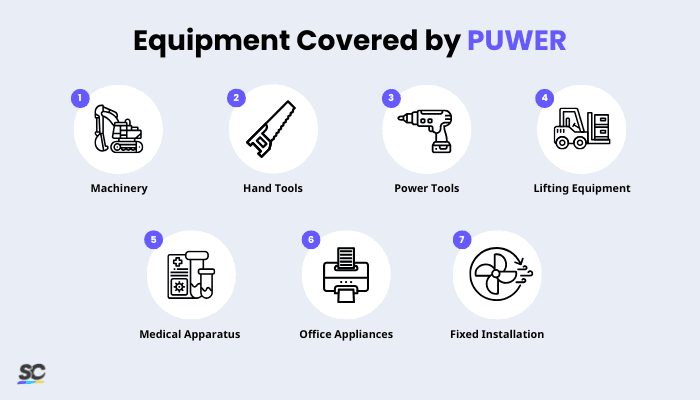
Equipment Covered by PUWER
Moving parts can cause entanglement, crushing, or cutting injuries. Here are some examples of heavy machinery and light equipment:
Excavators
Bulldozers
Wheelbarrows
Post-hole diggers
Chainsaws
Poor condition or improper use can lead to electric shock and hand injuries. These hand tools have caused a lot of injuries:
Hand saws
Hammers
Screwdrivers
These pose risks from electricity and high-speed moving parts. Prolonged use of these vibrating power tools can also lead to Hand-Arm Vibration Syndrome (HAVS):
Drills
Grinders
Nail guns
Manual or mechanical height access equipment can fail, causing musculoskeletal injuries. While most of these may be under the Lifting Operations and Lifting Equipment Regulations (LOLER), there may be some overlap to ensure proper maintenance:
Pallet jacks
Forklift trucks
Mobile Elevating Work Platforms (MEWPs)
Misuse of medical equipment can lead to chemical exposure, electrical issues, or mechanical failure. Here are some examples:
Centrifuge
Autoclaves
Fume cupboards
Many continue to underestimate the hazards of office appliances because the setting isn’t considered high-risk. But these pose electrical, fire, and ergonomic risks, jeopardizing office safety:
Photocopiers
Shredders
Electric sit-stand desks
Immobile systems can still pose electrical or mechanical risks if they’re not properly managed or maintained:
Conveyors
Ventilation systems
Automated packaging lines
Achieving and sustaining a safe and legally compliant workplace warrants a comprehensive understanding of PUWER requirements, each contributing to effective risk mitigation and prevention of incidents:
Unsuitable equipment can lead to inefficiency, accidents, or catastrophic failure. PUWER risk assessments ensure work equipment is appropriate for its intended use. Take note of the following best practices:
Conduct pre-purchase risk assessments and compatibility checks.
Match equipment capability with job needs and site conditions.
Consider the operator’s needs, ergonomics, and environmental factors.
Deterioration through wear, damage, or time can introduce hazards. Keeping equipment in a condition where it remains safe and efficient is crucial.
Develop maintenance schedules based on manufacturer guidance and operational intensity.
Carry out planned servicing, lubrication, and replacement of worn parts.
Maintain logs to track servicing history and identify recurring issues.
Build from scratch or choose from our collection of free, ready-to-download, and customizable templates.
Identify early faults before they lead to incidents by conducting regular and event-driven inspections. Consider the following:
Assign inspection responsibilities to trained, competent individuals.
Use digital tools to capture, flag, and escalate issues in real time.
Document findings and follow up with corrective actions.
Lack of training is a leading cause of equipment-related injuries. Ensure that only competent individuals operate work equipment. Take note of these tried and tested workplace training tips:
Provide task-specific and equipment-specific training, including refreshers.
Use certified external trainers for high-risk equipment (e.g., forklifts, MEWPs).
Implement a training matrix to track qualifications, expirations, and needs.
All work equipment should be fitted with appropriate safety features, such as guards, emergency stops, and warning devices. These controls are essential in preventing injuries during normal and abnormal use.
Install and regularly test built-in protective devices.
Ensure that safety mechanisms are not bypassed by implementing a Lockout/Tagout (LOTO) system during servicing and repairs.
Train staff to recognize and report missing or damaged safety features.
SafetyCulture is a mobile-first operations platform adopted across industries, such as manufacturing, mining, construction, retail, and hospitality. It’s designed to equip leaders and working teams with the knowledge and tools to do their best work—to the safest and highest standard.
Enable real-time tracking of equipment status by utilizing machine sensors and integrating the company’s asset list into the system. Efficiently manage equipment inspections, maintenance schedules, and training records through the centralized data hub. Empower workers to report faults, near misses, and non-compliances, facilitating prompt corrective action. Foster a proactive safety culture and support PUWER compliance through a unified platform.
✓ Save time and reduce costs
✓ Stay on top of risks and incidents
✓ Boost productivity and efficiency
✓ Enhance communication and collaboration
✓ Discover improvement opportunities
✓ Make data-driven business decisions