Transforming Workplaces with AI Safety Inspection
Explore safety inspection using Artificial Intelligence (AI) and how it enhances hazard detection, reporting, and workplace safety outcomes.

Explore safety inspection using Artificial Intelligence (AI) and how it enhances hazard detection, reporting, and workplace safety outcomes.
Published 27 Apr 2026
Article by
8 min read
An AI safety inspection is the use of AI to enhance, automate, and optimize workplace safety assessments. Instead of relying solely on manual checklists and paper-based audits, it leverages modern technologies to identify hazards, assess risks, and recommend corrective actions in real time.
By analyzing large volumes of safety data—from photos and videos to sensor readings and historical incident reports—AI-driven systems can detect patterns and risks that might otherwise go unnoticed. This enables organizations to move from reactive incident response to proactive risk prevention.
Implementing AI for safety inspections delivers measurable advantages by transforming traditional safety processes into intelligent, data-driven systems. Below are the key benefits organizations can expect when integrating AI into their safety inspection programs:
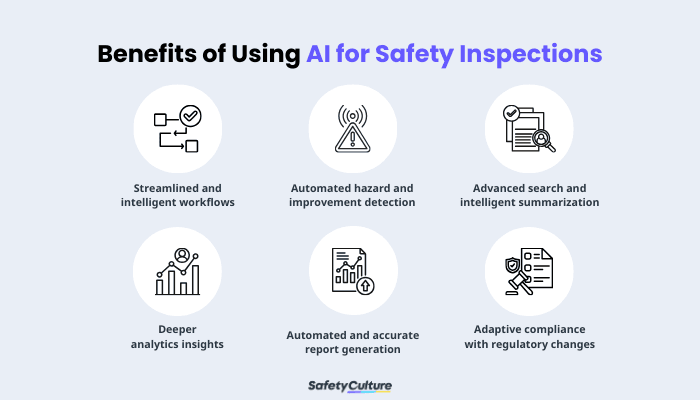
Benefits of Using AI for Safety Inspections
According to Verdantix, AI for safety inspection significantly improves operational workflows by reducing manual, repetitive tasks and digitizing inspection processes. Smart automation guides inspectors through dynamic checklists, flags incomplete entries, and ensures consistent data capture across sites.
By minimizing administrative burdens, safety teams can focus more on hazard prevention rather than paperwork. The result is faster inspections, improved accuracy, and stronger cross-team collaboration.
With technologies like pattern recognition, AI for safety inspection can automatically detect safety risks and improvement opportunities from images, videos, and historical reports. Instead of relying solely on human observation, AI safety management systems identify trends, recurring hazards, and non-compliant conditions in real time.
This proactive detection helps organizations address risks before incidents occur. Over time, the system becomes more precise as it learns from new inspection data.
AI-powered tools can instantly search across thousands of past inspections, incident reports, and safety documents to highlight relevant information. This enables safety managers to quickly grasp the context, compare similar cases, and pinpoint the root causes.
Intelligent summarization condenses lengthy reports into actionable insights, saving valuable time. This way, AI for safety inspection enhances risk-based decision-making and response speed by improving access to information.
AI for safety inspection goes beyond surface-level observations by analyzing large datasets to uncover hidden risk patterns. Predictive models can forecast potential safety issues based on past trends, environmental conditions, or operational behaviors.
These comprehensive insights enable organizations to allocate resources more effectively and prioritize high-risk areas. Ultimately, this data-driven approach strengthens prevention strategies and reduces workplace incidents.
Generating extensive safety reports can be time-consuming, but AI simplifies this process through automated documentation. Inspection findings, risk scores, and corrective actions can be compiled instantly into structured, audit-ready reports. This improves reporting consistency and also reduces human error. Faster reporting ensures leadership teams have real-time visibility into safety performance.
Regulatory environments are constantly evolving, and AI for safety inspection helps organizations stay ahead of these changes. AI systems can monitor regulatory updates, map new requirements to existing inspection frameworks, and recommend necessary adjustments. This adaptive capability reduces compliance risks and ensures inspections remain aligned with industry standards.
Conducting an AI safety Inspection requires more than simply adding automation to existing processes. It involves a structured approach that integrates intelligent tools into planning, execution, and follow-through to ensure accurate insights, reliable data, and measurable safety improvements.
Begin your AI safety inspection by generating or refining inspection templates using an AI Assistant in SafetyCulture. Provide a clear description of the site, recent incidents, or applicable standards, and instruct the system to create a tailored checklist aligned with company policies.
For example, prompt it to build a weekly warehouse safety walk template based on your Personal Protective Equipment (PPE) requirements or operational risks. This ensures your inspection framework is current, standardized, and aligned with compliance expectations.
Next, instruct the AI system to locate and launch the correct inspection template. Instead of manually searching through folders or databases, use a simple command to start the appropriate inspection for a specific site, store, or department. This reduces setup time and ensures inspectors always work from the most up-to-date version, eliminating administrative friction and improving consistency across locations.
Leverage AI tools on mobile devices to access procedures, safety standards, and supporting documents instantly. Instead of navigating complex document libraries, prompt the AI assistant to retrieve the exact information relevant to the task at hand. This keeps inspectors focused on hazard identification rather than document searches, improving both efficiency and accuracy.
Use the AI assistant to complete structured fields quickly and accurately. Provide prompts to auto-fill site details, asset information, and timestamps when manual entry slows down the process. Add notes through natural language commands to capture observations in real time. This hands-free, voice-enabled support makes the safety inspection process faster, more intuitive, and less prone to data entry errors.
After completing the inspection, instruct the AI assistant to generate a concise summary of key findings. Request highlights such as non-conformances, recurring issues, and trends compared to previous weeks or months. Automated summarization speeds up reporting and ensures decision-makers receive clear, actionable information without manual data analysis.
Direct the AI assistant to create and assign corrective actions based on failed items or identified hazards. Specify priority levels, responsible teams, and due dates to ensure accountability. This transforms inspection findings into trackable tasks immediately, strengthening follow-through and risk mitigation.
Finally, request quick analytics to uncover broader performance patterns. Ask the system to identify sites with the highest failure rates, recurring compliance gaps, or emerging safety risks. By generating insights on demand, the AI safety inspection program empowers leaders to make informed decisions without building complex manual reports.
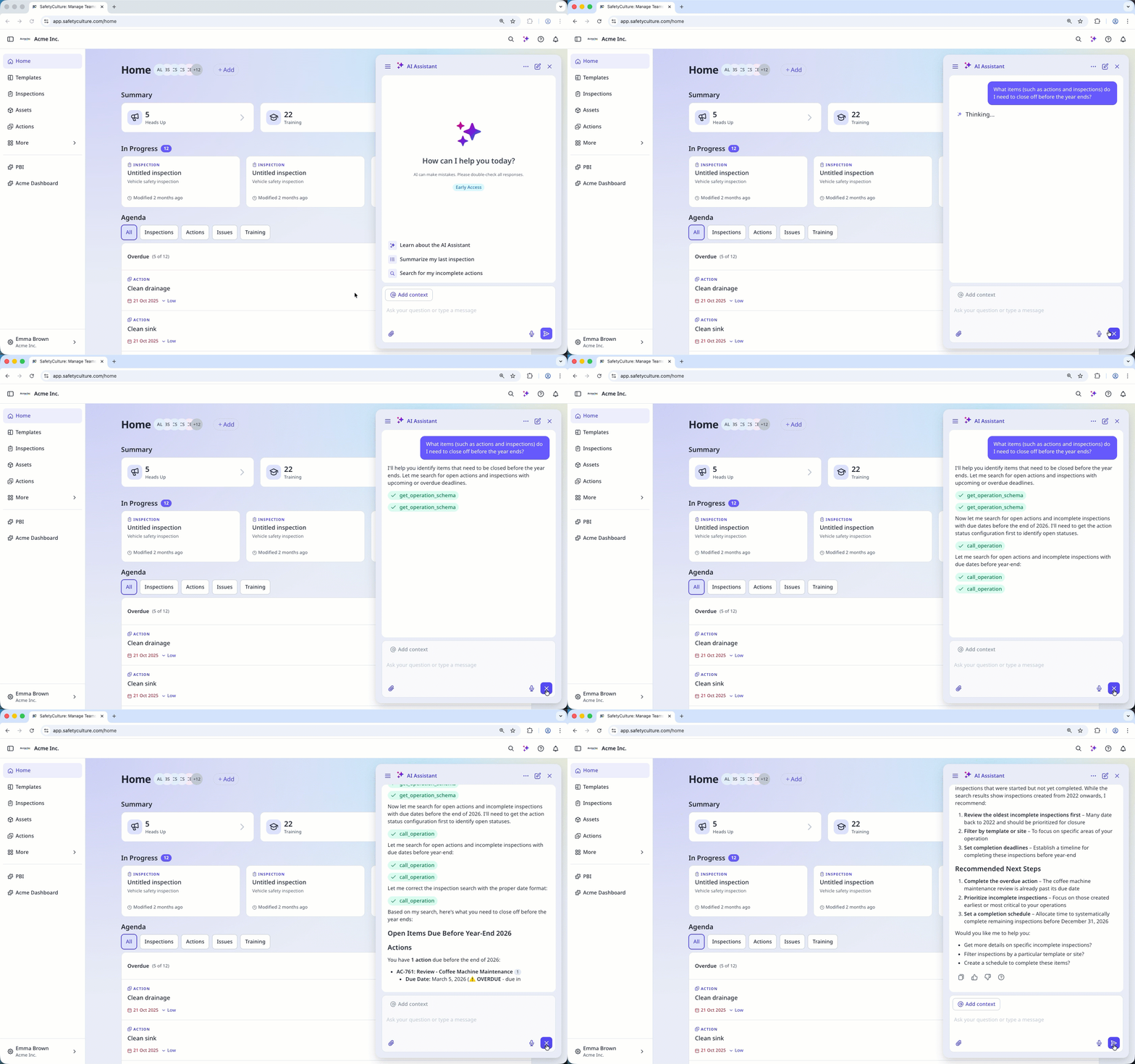
The AI Assistant feature in SafetyCulture is currently in Early Access. If you're interested, please contact your customer success manager to check if your organization is eligible.
While AI-driven safety inspections are generally beneficial, many organizations encounter recurring challenges when adopting AI tools without proper research. Understanding these barriers is essential to selecting the right solution and ensuring AI delivers value in safety management:
One of the biggest concerns in AI safety inspection is the risk of incorrect or misleading outputs. Some AI tools generate answers that sound authoritative but misinterpret inspection data or present inaccurate conclusions. In critical cases, even minor factual errors can undermine compliance and increase operational risk. When teams feel the need to manually verify every response, trust erodes, and productivity gains disappear.
Many AI tools operate like standalone chatbots rather than embedded safety solutions. While they may generate conversational responses, they often lack deep access to historical inspection records, analytics dashboards, or corrective action systems.
Without the ability to query real-time data or trigger workflows, AI safety inspection becomes disconnected from core operations. True value comes from seamless integration with existing safety management platforms.
Slow response times, system errors, or loss of context during complex queries can significantly impact usability. Reliability is crucial, especially in situations where inspections and analytics drive time-sensitive decisions. If the AI tool frequently displays errors or forgets prior inputs, users will hesitate to depend on it. Consistent performance is essential for making AI safety inspection a trusted daily tool.
Data protection remains a major consideration when implementing the AI safety inspection technology. Organizations often question whether sensitive inspection data is being used to train external models or transferred outside approved regions.
Also, concerns around Role-Based Access Controls (RBACs) and regulatory compliance can delay adoption. Hence, transparent governance policies and secure data handling are non-negotiable for enterprise deployment.
AI tools are designed to simplify processes, yet some solutions introduce unnecessary complexity. Overloaded interfaces, excessive features, and multiple configuration modes can overwhelm frontline workers. In safety inspections, clarity and speed matter more than advanced controls. An effective AI safety inspection solution should deliver clear guidance and actionable next steps, not a complicated interface.
The market for AI safety inspection solutions is highly competitive, and some vendors highlight bold claims without tangible results. When tools fail to reduce incidents, save time, or improve reporting accuracy, mistrust grows among operational leaders and finance teams. Organizations need AI that directly influences Key Performance Indicators (KPIs), not just surface-level automation.
Even the most advanced AI safety inspection system can fail without proper onboarding. The tool feels abstract when users aren’t shown clear, role-specific examples of how the assistant supports their daily duties. Many users experiment once, receive average results, and abandon the system. Effective adoption requires structured onboarding, practical workflows, and ongoing reinforcement of real-world value.
By choosing the right software solution, organizations can implement AI safety inspection technology in a way that builds trust, enhances operational efficiency, and drives meaningful safety outcomes.

We used the AI function to upload our text based documents and it lays it all out so it’s got your lesson structures and all of the content there, and we can make it flow how we want it. It’s just so simple.
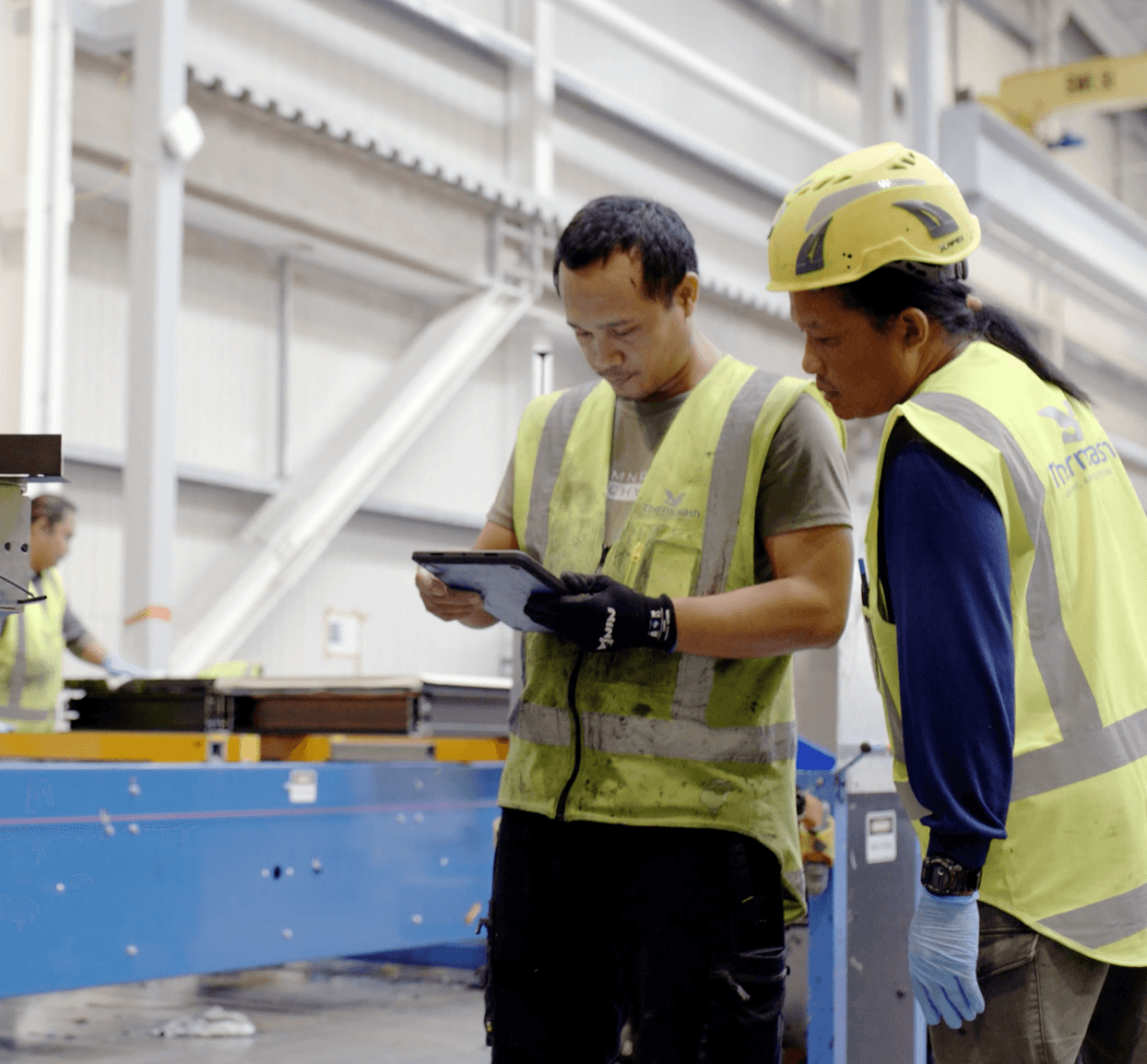
SafetyCulture is a mobile-first operations platform adopted across industries such as manufacturing, mining, construction, retail, and hospitality. It’s designed to equip leaders and working teams with the knowledge and tools to do their best work—to the safest and highest standard.
Streamline and strengthen your AI safety inspection program by embedding intelligent automation directly into your health and safety workflows. Eliminate inaccurate outputs, reduce manual double-checking, and ensure inspections connect to real operational data. Use AI to standardize audits, accelerate risk assessments, improve incident analysis, and generate reliable insights—while maintaining strong governance, security, and performance across every site.
✓ Save time and reduce costs
✓ Stay on top of risks and incidents
✓ Boost productivity and efficiency
✓ Enhance communication and collaboration
✓ Discover improvement opportunities
✓ Make data-driven business decisions
In this article