A practical guide to food handling in hospitality
Everything restaurant managers, kitchen supervisors, and hospitality operators need to know about food handling standards, compliance, and best practices.
Everything restaurant managers, kitchen supervisors, and hospitality operators need to know about food handling standards, compliance, and best practices.
Published 2 Jul 2026
Article by
7 min read
Food handling in hospitality refers to the set of practices used to safely prepare, store, cook, and serve food to prevent contamination and protect guests from foodborne illness. Included in proper food handling protocols are the handwashing practices, temperature controls, separation of raw and cooked foods, and sanitation procedures your team follows every shift.
Poor food handling directly relates to not only possibly harming guests, but also to degrading your business’ reputation.
The World Health Organization (WHO) estimates that 600 million people fall ill from contaminated food each year globally. For a restaurant or hotel, a single foodborne illness incident can trigger:
Negative press and online reviews that damage bookings or table reservations
Regulatory fines, mandatory closures, and license suspensions from health inspectors
Legal action from affected guests, including compensation claims
Staff turnover and reputational harm that affects your ability to attract quality hires
In many jurisdictions, the person in charge of a food establishment carries personal legal responsibility for maintaining compliance.
The cost of getting food handling right is far lower than the cost of getting it wrong. Operators who treat compliance as a minimum threshold rather than a genuine operational standard tend to find this out the hard way.
Keep food safe, your team on track, and operations running smoothly.
The US Centers for Disease Control and Prevention (CDC) and FoodSafety.gov have created a four-step food safety framework, which is the most widely used structure for food handling in commercial settings. Here's how each step applies in a hospitality context:
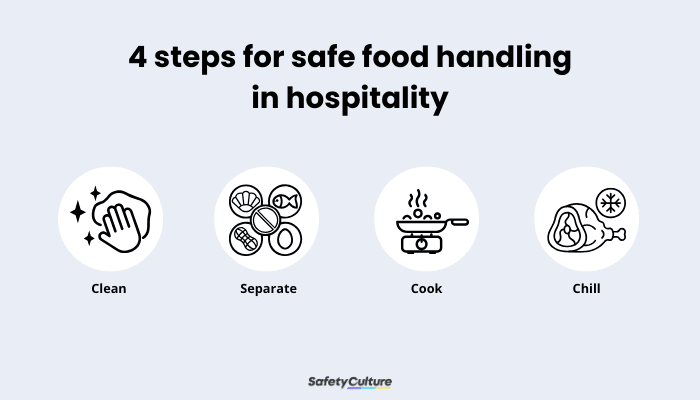
This step is all about ensuring cleanliness and the sanitization of both workspaces and workers. Handwashing is the single most effective way to stop contamination before it reaches food. Food handlers should wash with soap and warm water for at least 20 seconds before touching food, after handling raw ingredients, after using the restroom, and after touching their face or phone.
However, note that cleaning and sanitizing are not the same thing. Cleaning removes visible dirt and grease, while sanitizing kills the bacteria left behind. Surfaces, cutting boards, and equipment need both, in that order. A kitchen cleaning schedule that assigns specific tasks, frequencies, and responsible staff is the most reliable way to make sure nothing gets skipped during a busy service.
Raw meat, poultry, and seafood can carry bacteria that can transfer to ready-to-eat foods through shared surfaces, utensils, or hands. In a commercial kitchen, the standard controls include the following:
Using dedicated cutting boards and equipment
Using color-coded tools by food type
Using the correct storage hierarchy in refrigerators, with raw meat always stored below ready-to-eat items
A single cross-contact incident can also trigger a serious allergic reaction in a guest, giving them a health risk while exposing the business to significant legal liability. Clear food safety signage in prep areas helps staff apply these rules consistently, even under service pressure.
Heat kills bacteria, but only at the right temperature. The standard safe benchmarks for commercial kitchens to eliminate pathogens like Salmonella and E. coli are:
poultry at 165°F (74°C);
ground meat at 160°F (71°C ); and
whole cuts of beef, pork, and seafood at 145°F (63°C).
Calibrated food thermometers are the only reliable way to verify this. Visual checks also aren't accurate enough for compliance. Thus, thermometer calibration logs should be kept and checked regularly.
Bacteria multiply fastest between 41°F and 135°F (5°C and 57°C). Keeping food out of this range is the core of safe cold and hot storage in hospitality.
Cold storage should be maintained at or below 40°F (4°C). Relatedly, freezers should hold at 0°F (-18°C). For food that needs to be served, they need to stay at 135°F (57°C) or above. For buffets and catered events, perishable food that's been held outside of these temperatures for more than two hours should not be served anymore.
In practice, temperature drift is one of the most common compliance failures. Common examples of this include a fridge that runs slightly warm overnight, and a hot holding unit that drops during a busy service. Platforms like SafetyCulture allow teams to connect temperature sensors to cold storage and hot holding equipment, receiving real-time alerts when readings go out of range before they become a food safety incident. Food inventory management tools that integrate with temperature monitoring can also track stock condition and flag items that may have been compromised.
SSP, Australia's largest food and beverage provider in travel locations, uses SafetyCulture across 100+ airport-based outlets to manage food safety compliance at scale. After digitizing their inspection and temperature monitoring processes, their compliance rates improved from 60% to nearly 100% across all locations.
Hospitality operators don't operate in a single regulatory environment. The frameworks you're required to follow depend on where your business is located, and in some cases, which market you're selling into. Here's the landscape most operators need to understand:
Hazard Analysis and Critical Control Points (HACCP) is the internationally recognized methodology for managing food safety risk. It's legally required in many jurisdictions and forms the backbone of food safety management systems worldwide.
For hospitality, the FDA recommends a Process Approach to HACCP: grouping food flows by preparation type rather than building a separate plan for each menu item. This makes HACCP practicable for restaurants and hotels, where the menu complexity would otherwise make full product-by-product HACCP unmanageable.
The major regulatory frameworks hospitality operators need to know per region are as follows:
US: The FDA Food Code sets baseline food safety and handling requirements for restaurants and food service establishments, including temperature controls, personal hygiene, and facility standards. Following the Food Safety Modernization Act (FMSA) also adds preventive control requirements for larger operations.
Australia and New Zealand: FSANZ Standard 3.2.2 covers food safety practices including temperature control, food handling, and food hygiene. Standard 3.2.2A, which came into effect in December 2023, requires all food service businesses and caterers to ensure food handlers have documented food handler training before handling high-risk foods.
International: ISO 22000:2018 is the global standard for food safety management systems, which also covers food handling. It's not a legal requirement in most markets, but is increasingly required by enterprise customers and used as the framework for building HACCP-aligned food safety management systems across multi-site or multi-country operations.
Building your Standard Operating Procedures (SOPs) and inspection checklists around a recognized standard is typically the most scalable approach. SOPs built around these frameworks give kitchen teams clear, auditable guidance at the point of work.
Enhance operational efficiency with monitoring sensors. Track real-time data and insights to never miss another food safety incident.
Without proper training, food handling can easily go wrong. Food handler training requirements vary significantly by jurisdiction, and keeping up with changes to those requirements is part of what makes multi-location hospitality operations complex.
In the US, requirements are set at the state or local level. Most jurisdictions require at least one certified food protection manager per establishment, typically certified through a program. The safest approach is to check requirements with your local health department, since the rules differ enough between states to make blanket compliance statements unreliable.
In Australia, FSANZ Standard 3.2.2A requires food businesses operating as food service establishments or caterers to ensure food handlers have appropriate food safety training before handling high-risk foods. A qualified food safety supervisor is also required in many categories of food business.
Beyond meeting the minimum legal threshold, regular training also has a direct operational benefit. High-turnover hospitality environments see the most food handling failures during the first weeks of a new hire's employment, and during service periods when staff are time-pressured. Digital training platforms let operators push food safety refresher courses to all staff, while helping managers track completion without relying on in-person sessions. Pairing training with clearly documented standard operating procedures gives staff a reference point they can access when they need it, not just during onboarding.
SafetyCulture is a workplace operations platform adopted across industries such as manufacturing, mining, construction, retail, and hospitality. It's designed to equip leaders and working teams with the knowledge and tools to do their best work — to the safest and highest standard.
Efficiently manage and streamline health and safety processes across the organization, including incident management, safety audits and inspections, risk assessment, waste management, and more, using a comprehensive EHS software solution.
✓ Save time and reduce costs
✓ Stay on top of risks and incidents
✓ Boost productivity and efficiency
✓ Enhance communication and collaboration
✓ Discover improvement opportunities
✓ Make data-driven business decisions
In this article