Risk prioritization: how to rank and act on risks that matter most
A practical, step-by-step method for ranking risks by likelihood and impact, so your team acts on what matters most first.

A practical, step-by-step method for ranking risks by likelihood and impact, so your team acts on what matters most first.
Published 3 Jul 2026
Article by
5 min read
Risk prioritization is the process of ranking identified risks by how likely they are to happen and how much damage they'd cause, so limited time and budget go toward the threats that matter most. Most teams can't fix every risk on the list at once. A leaking pipe and a data breach both belong on a risk register, but they don't deserve equal attention. Prioritization gives you a repeatable way to decide which one gets addressed first.
Risk prioritization doesn't happen in isolation. It's one step inside a wider risk management process, sitting right after identifying and assessing your risks and before you decide how to control them.
Ranking risks doesn't need a complicated system. Three steps get you most of the way there:
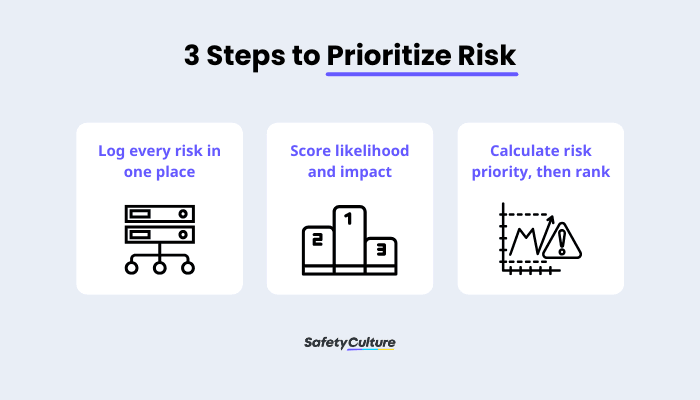
3 Steps to Prioritize Risk
Log every risk in one place - Before you can rank anything, you need a single risk register that captures each risk, who owns it, and when it was identified. Digital templates for risk prioritization make it easier to document identified risks.
Score likelihood and impact separately - Rate how likely each risk is to occur, on a scale of one to five, for example, and how severe the consequences would be if it did. Keep these as two separate numbers at first. Don't blend your gut feeling about "how bad it feels" into one score.
Calculate a risk priority number and rank accordingly - Multiply likelihood by impact, and by vulnerability for a more detailed model, to get a single comparable score for every risk on your register: Risk = Threat × Vulnerability × Impact. Sort your register by that score, and the risks that need attention this week rise to the top automatically.
From simple scoring matrices to more advanced quantitative models, the right framework depends on the complexity of the risks involved and the maturity of the organization's risk management practice.
Most teams start with a qualitative approach: scoring risks as low, medium, or high based on team judgment and experience. It's fast and works well when you don't have hard data to draw on.
Quantitative prioritization replaces those labels with numbers: dollar exposure, probability percentages, or historical incident rates. It takes longer to set up, but it holds up better when you need to defend a prioritization decision to finance or the board. Larger organizations often blend both, qualitative scoring for a first pass, then quantitative modeling for the risks that make the shortlist.
Risk-based prioritization is the practice of ranking hazards, tasks, or issues according to their potential severity and likelihood, rather than tackling them in the order they're discovered or reported. Instead of treating every risk equally, teams assess factors like potential impact (injury, financial loss, downtime, reputational damage) and probability of occurrence to determine which items demand immediate action versus which can be scheduled or monitored over time.
This approach ensures limited resources—time, budget, personnel—are directed toward the risks that matter most, reducing the chance that a low-probability, low-impact issue consumes attention while a high-severity threat goes unaddressed.
Cost-benefit and risk-benefit analysis weighs the expense of mitigating a risk against the potential losses it could cause if left unaddressed. Rather than assuming every risk warrants the same level of investment, this method asks a straightforward question: does the cost of controls, training, or process changes outweigh the financial, safety, or reputational damage the risk could cause if it materializes?
Risk-benefit analysis takes this further by considering trade-offs—some risks may be worth accepting if the potential upside (faster output, lower costs, competitive advantage) outweighs the downside, while others demand mitigation regardless of cost because the consequences are too severe to tolerate.
Centralize risk registers, scoring, and reporting in one platform.
Even teams with a solid process get their rankings wrong in predictable ways. Here are some common mistakes to avoid:
Scoring inconsistently across teams or sites. One site manager's "high" is another's "medium." Fix this with a shared scoring guide that defines exactly what each likelihood and impact level means, with examples.
Relying on gut feel instead of the scale. It's tempting to bump a risk up the list because it feels urgent. Stick to the numbers you assigned, and revisit the scale itself if it keeps producing rankings that don't match reality.
Scoring once and never touching it again. A risk that was low-likelihood last year might not be this year. New suppliers, new regulations, and new threats all shift the picture.
Treating every risk the same way regardless of type. A safety hazard and a compliance gap don't always fit the same scale cleanly. Consider separate registers or scoring adjustments for very different risk categories.
SafetyCulture is a workplace operations platform adopted across industries such as manufacturing, mining, construction, retail, and hospitality. It’s designed to equip leaders and working teams with the knowledge and tools to do their best work—to the safest and highest standard.
Promote a culture of accountability and transparency within your organization where every member takes ownership of their actions. Align governance practices, enhance risk management protocols, and ensure compliance with legal requirements and internal policies by streamlining and standardizing workflows through a unified platform.
✓ Save time and reduce costs
✓ Stay on top of risks and incidents
✓ Boost productivity and efficiency
✓ Enhance communication and collaboration
✓ Discover improvement opportunities
✓ Make data-driven business decisions