Kitchen worker safety: A guide for restaurant and kitchen managers
Learn how to protect your kitchen staff from everyday hazards, build a real training program, and stay compliant with OSHA and fire codes.
Learn how to protect your kitchen staff from everyday hazards, build a real training program, and stay compliant with OSHA and fire codes.
Published 9 Jul 2026
Article by
4 min read
Kitchen worker safety pertains to the practices, guidelines, and standards in place to ensure those working in a kitchen are safe at all times. This involves keeping chefs, servers, dishwashing staff, and janitorial staff free from hazards.
General kitchen safety touches on hazards from food storage to floor mats, but kitchen worker safety zeroes in on protecting the people who do the cooking, not the food itself or the diners eating it. Kitchen worker safety also considers staff left alone for periods of time, making them more susceptible to harm and hazards.
While employees are responsible for following safety procedures in the kitchen, kitchen worker safety is also a legal obligation. Under the US Occupational Safety and Health Administration’s (OSHA's) general industry standards, employers carry the primary duty to identify hazards, provide protective equipment, and train staff on safe procedures before they start a shift. That includes assessing each station for hazards, documenting what safety equipment each role requires, and keeping records of who's been trained on what. NFPA 96 ties into this, as most local fire marshals will check for kitchen ventilation and fire suppression directly during a routine visit.
Cuts, burns, and slips are the most common causes or harm to kitchen workers, often from prep work, portioning, dishwashing, and repetitive tasks. In particular, full-service restaurants reported 93,800 nonfatal injuries and illnesses in 2019, as per the US Bureau of Labor Statistics.
Thus, the Personal Protective Equipment (PPE) to be used should match the task, not just the job title. For example, cut-resistant gloves should be used during butchery tasks, and heat-resistant gloves and aprons for handling fryers and ovens. Running a regular hazard walk-through helps confirm the right protective gear actually reaches the right stations, instead of sitting unused in a supply closet.
Most kitchens hand new hires a stack of policies on day one and hope it sticks. However, a structured induction works better, and it doesn't need to take longer than a standard onboarding shift.
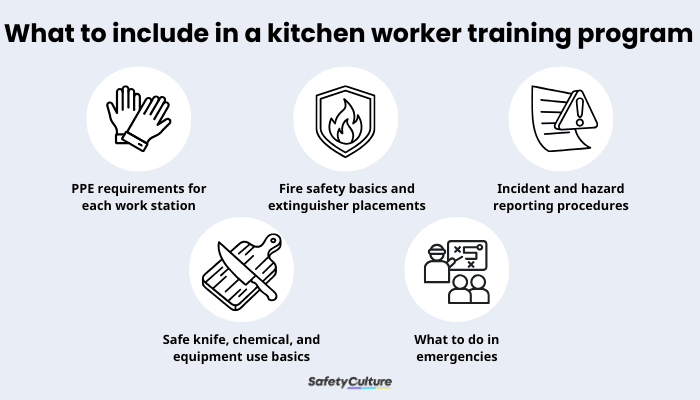
A training program for kitchen worker safety should include the following:
PPE requirements for each station
Where the fire extinguishers, suppression system, and exits are located
How to report a hazard or near-miss without waiting for a manager to ask
Safe knife handling, chemical use, and equipment operation basics
What to do in case of emergencies
Take note, however, that a single induction session doesn't cover a full year of kitchen work. Refresh fire safety and PPE training every 6 to 12 months, and immediately after any equipment change, layout change, or near-miss. New equipment should also have a training session every time. Each equipment or work area change resets what staff actually need to know, regardless of how long they've worked there. Tracking who's completed what through a dedicated safety training program keeps gaps from hiding until an inspection finds them for you.
Scotsman Hospitality Group, which runs more than fifty venues across Scotland, found that walking new kitchen staff through safety checks in person built more lasting ownership of the standards than handing over a printed policy on day one.
In many industries, it’s essential to monitor workers during their shift to ensure their safety. While not standard for the restaurant industry or food service industry, employers and managers can benefit greatly from utilizing lone worker solutions and other types of employee monitoring systems. Employee monitoring in a commercial kitchen also ensures regulatory compliance.
With these solutions, help can arrive faster for those in emergencies or accidents. Incident response can be done more smoothly, and more timely. In some cases, employee monitoring solutions can even prevent slip-and-fall injuries and catch equipment accidents or problems before they progress.
SafetyCulture is a workplace operations platform adopted across industries such as manufacturing, mining, construction, retail, and hospitality. It’s designed to equip leaders and working teams with the knowledge and tools to do their best work—to the safest and highest standard.
Efficiently manage and streamline health and safety processes across the organization, including incident management, safety audits and inspections, risk assessment, waste management, and more, using a comprehensive EHS software solution.
✓ Save time and reduce costs
✓ Stay on top of risks and incidents
✓ Boost productivity and efficiency
✓ Enhance communication and collaboration
✓ Discover improvement opportunities
✓ Make data-driven business decisions
In this article