A Comprehensive Guide to Risk-Benefit Analysis
Learn how using structured decision frameworks help organizations balance potential risks and outcomes to support safer and more consistent operations.

Learn how using structured decision frameworks help organizations balance potential risks and outcomes to support safer and more consistent operations.
Published 27 Apr 2026
Article by
6 min read
Risk-benefit analysis is a systematic approach used to evaluate the potential risks and benefits of a decision, action, or policy. It involves identifying and assessing potential negative outcomes or hazards to weigh them against anticipated positive outcomes or advantages. The goal of this analysis is to determine whether the benefits outweigh the risks or vice versa, thereby guiding decision-makers to make informed choices.
The process supports structured risk analysis by identifying hazards and assessing impact to guide business leaders into creating informed decisions across operations, safety programs, and project planning.
Here's why this process is essential in safety and operational environments:
Identifies hazards early: The process identifies potential risks in the planning and preparation phase. Early visibility allows teams to address hazards before they escalate into incidents or operational disruptions.
Improves risk mitigation strategies: Organizations can implement targeted controls once risks are identified and evaluated. These measures help reduce the likelihood and severity of safety incidents.
Ensures regulatory compliance: Documented risk-benefit evaluation supports compliance with safety regulations and industry standards. It also provides clear records for audits and inspections.
Optimizes resource allocation: Clear insight into risk levels helps organizations prioritize safety measures and operational investments. Resources can then focus on the most critical risks and opportunities for proactive prevention.
Reduces operational and financial losses: Early risk evaluation helps prevent safety incidents for employees and operational bottlenecks that can disrupt projects. Fewer incidents translate into lower costs and more predictable timelines.
Builds stakeholder confidence: A transparent evaluation process demonstrates accountability and responsible risk management. It strengthens trust among employees, regulators, partners, and clients.
Risk-benefit analysis focuses on safety risks, uncertainties, and potential impacts relative to expected benefits. On the other hand, cost-benefit analysis focuses on financial outcomes by comparing the total cost of an action with its expected economic value.
Here are a few more key differences:
A risk-benefit analysis is crucial in industries such as safety management, healthcare, engineering, and regulatory fields, where the main priority is protecting people and operations.
Here's an example of risk analysis:
A company is considering implementing a new safety process in its manufacturing plant. The potential advantages include improved worker safety, reduced accident risk, and regulatory compliance.
However, there are also risks, such as increased training and equipment costs, disruption to current workflows, and potential pushback from employees who may resist change.
In this scenario, organizations must carefully weigh the benefits of implementing the new safety process against the potential risks.
Cost-benefit analysis evaluates decisions based on financial viability. It compares the total project expenses with the measurable economic benefits it may generate.
For example, implementing a new safety process may involve purchasing equipment, training employees, and potential workflow disruptions. On the other hand, the benefits could be reduced workplace accidents, improved employee morale, and decreased insurance premiums.
To ensure accuracy in cost-benefit analysis, it’s importantto consider all relevant factors, including direct and indirect costs, the implementation timeframe, and potential long-term benefits. This table summarizes the primary differences between these two analysis frameworks:
Aspect | Risk-Benefit Analysis | Cost-Benefit Analysis |
Primary Focus | Safety risks and potential advantages | Financial costs and financial gains |
Purpose | Determine whether risks are acceptable relative to benefits | Determine whether an investment is financially worthwhile |
Evaluation Type | Often qualitative or probability-based | Quantitative and monetary |
Common Applications | Safety management, healthcare, regulatory compliance | Business investments, budgeting, project evaluation |
Key Question | Do the benefits justify the possible risks? | Do the financial returns exceed the total costs? |
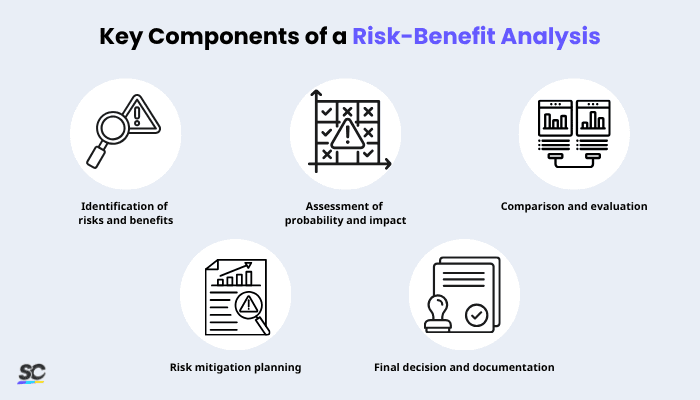
Risk-benefit analysis follows a structured process that helps organizations evaluate potential hazards alongside expected advantages before making a decision or implementing operational changes. Breaking the process into clear components ensures that risks are properly identified, assessed, and compared with the anticipated benefits. This includes:
Identification of risks and benefits: The process begins by listing all possible risks (e.g., safety hazards or equipment failures) and expected benefits (e.g., improved productivity or efficiency) associated with the decision.
Assessment of probability and impact: Teams evaluate each risk based on its likelihood of happening and potential consequences. Tools like risk matrices can help estimate severity levels and compare them to the expected benefits.
Comparison and evaluation: Decision-makers compare the identified risks against the expected benefits. This step, guided by risk prioritization methods, helps determine whether the advantages of proceeding outweigh the potential hazards.
Risk mitigation planning: Companies should implement control measures to reduce the likelihood or impact of identified risks. These can include safety procedures, protective equipment, training, or different approaches.
Final decision and documentation: The findings from the risks benefit analysis are summarized to support a final decision. Based on whether the benefits outweigh the risks, organizations may proceed with, modify, or reject the activity.
Conducting a risk-benefit analysis involves a structured approach that helps organizations evaluate potential risks alongside expected advantages before making a decision.
Here's a step-by-step guide on how to conduct a risk-benefit analysis:
Define the scope: Start by clearly defining the decision or activity under evaluation. Establish the objectives of the analysis, such as improving safety, increasing efficiency, or meeting project timelines. Gather input from relevant stakeholders to better inform the scope.
Identify risks and benefits: List all possible risks and expected advantages related to the activity. It may include hazards such as injuries or equipment failures, as well as benefits such as improved productivity, reduced costs, or faster project completion.
Assess and quantify impacts: Evaluate the likelihood and severity of each risk, and estimate the value of the expected benefits. Organizations may use tools such as risk matrices or historical incident data to understand potential outcomes better.
Compare results and implement mitigation: Weigh the identified risks against the potential benefits to determine whether the activity is justified. If risks are present, implement mitigation measures such as training, protective equipment, or improved procedures.
Make a decision and document findings: Based on the analysis, determine whether to proceed, modify the plan, or reject the activity. Document the results and communicate the findings to relevant teams to support implementation and future reviews.
SafetyCulture is a mobile-first operations platform adopted across industries such as manufacturing, mining, construction, retail, and hospitality. It’s designed to equip leaders and working teams with the knowledge and tools to do their best work—to the safest and highest standard.
Streamline processes, eliminate bottlenecks, enhance resource utilization, and build an agile and scalable infrastructure with SafetyCulture. Strive for operational excellence to boost competitive advantage, foster sustainable growth, and deliver long-term value.
✓ Save time and reduce costs
✓ Stay on top of risks and incidents
✓ Boost productivity and efficiency
✓ Enhance communication and collaboration
✓ Discover improvement opportunities
✓ Make data-driven business decisions