A Guide to the Sendai Framework for Disaster Risk Reduction for Businesses
A close look at how the Sendai Framework for disaster risk reduction works, why it’s important, and the best practices for teams when implementing it.

A close look at how the Sendai Framework for disaster risk reduction works, why it’s important, and the best practices for teams when implementing it.
Published 28 Apr 2026
Article by
5 min read
The Sendai Framework for Disaster Risk Reduction is a global agreement adopted in 2015 that guides countries in reducing disaster risks and enhancing resilience. It emphasizes understanding risk, strengthening governance, investing in risk reduction, and improving preparedness for effective response and recovery. The framework provides clear priorities and targets to help communities, organizations, and governments build safer and more disaster-resilient systems.
The Sendai Framework for Disaster Risk Reduction is important because it provides a unified global strategy for reducing disaster risks and disaster preparedness. By emphasizing risk understanding, prevention, and preparedness, it helps governments and organizations shift from reactive disaster response to proactive resilience-building. This, shift, alongside organizational efforts and the celebration of days such as the International Day for Disaster Risk Reduction, reduces loss of life, protects infrastructure, and strengthens community stability.
Its focus on governance and investment ensures that disaster risk reduction becomes an integral part of national planning and development. The framework also encourages international cooperation, data sharing, and capacity building, enabling even resource-limited countries to improve resilience. Ultimately, it helps create safer societies by promoting long-term, sustainable approaches to managing and reducing disaster impacts.
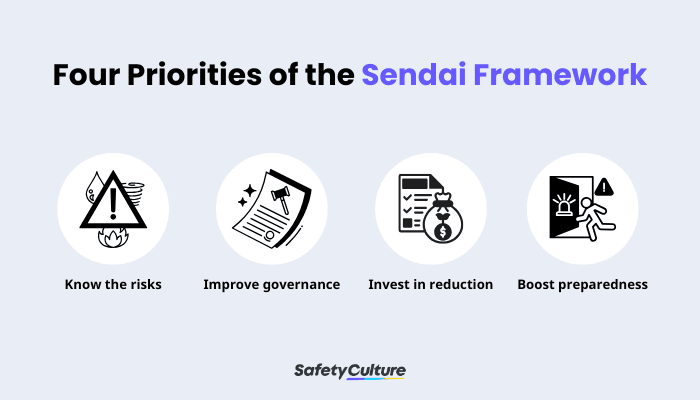
This framework is built upon four priorities, which are key areas that governments and organizations must focus on to better prepare for disasters and reduce risk. Below are the four priorities of the framework:
Four Priorities of the Sendai Framework
This priority focuses on identifying and analyzing the causes, patterns, and potential impacts of hazards. It emphasizes collecting and sharing accurate data so communities, governments, and organizations can make informed decisions. By improving knowledge, it ensures that risk reduction measures are targeted, effective, and science-based.
Strong disaster risk governance requires effective policies, legal frameworks, and coordination among institutions. It brings together governments, communities, and private sectors to create unified and accountable risk-management systems. With solid governance in place, societies can plan proactively and support long-term resilience.
This priority promotes allocating financial, technological, and human resources to reduce vulnerabilities and strengthen resilience. Investments can include infrastructure upgrades, early warning systems, and community-level programs. By prioritizing these actions, countries can reduce economic losses and protect lives before disasters occur.
Enhancing disaster preparedness focuses on building the skills, systems, and tools needed for effective emergency response. Preparedness includes evacuation planning, training exercises, community education, disability risk preparedness, and maintaining essential supplies. These efforts help communities react quickly and recover more efficiently when disasters occur.
While important for safety and risk management, it’s common for teams to run into challenges when implementing the Sendai framework for disaster risk reduction. Understanding these challenges before implementation is critical for proper preparation and planning.
Coordinating across multiple agencies, sectors, and levels of government can be difficult when responsibilities overlap or communication is weak. These gaps often slow decision-making and reduce the effectiveness of disaster risk reduction efforts. Stronger collaboration and clearer roles are needed to keep all stakeholders aligned.
Many countries struggle to allocate sufficient funding for prevention, mitigation, and long-term resilience planning. Limited budgets often push governments to focus on response rather than proactive risk reduction. Without sustained investment, vulnerabilities remain high, and disaster impacts become more severe.
Accurate and accessible data on hazards, exposure, and vulnerabilities is often lacking, especially in developing regions. Misconceptions about disaster likelihood or severity further hinder informed decision-making. Closing these gaps is essential for designing effective, evidence-based risk-reduction strategies.
Different cultural beliefs, traditions, and social norms can influence how communities understand and respond to disaster risks. In some places, long-held practices or mistrust of authorities may hinder the adoption of preparedness measures. Addressing these barriers requires culturally sensitive communication and community engagement.
Implementing the Sendai Framework for reducing disaster risk may look different for every organization. That said, below are a few best practices that apply to different teams and industries looking to reduce disaster risk:
Understanding risk across sectors, teams, and industries requires evaluating how hazards affect communities, businesses, infrastructure, and the environment. A holistic view ensures that vulnerabilities are identified early and addressed before they escalate. This cross-sector awareness leads to more coordinated and effective disaster risk reduction strategies.
Strengthening governance involves creating clear policies, roles, and communication channels across all levels of government and stakeholders. Effective coordination ensures that agencies work together rather than in isolation during planning and response. With strong governance, disaster risk reduction becomes more consistent, accountable, and strategic.
Investing in modern tools and resilient infrastructure improves a community’s ability to prevent, detect, and respond to hazards. Technologies like building vibration sensors, digital asset management platforms, and resilient building designs provide earlier warnings and reduce damage. These investments strengthen long-term resilience and lower recovery costs after disasters.
Enhancing community capacity means ensuring people have the skills, training, and resources to respond effectively to emergencies. Strong early warning systems give communities critical time to act before hazards escalate into disasters. Together, these efforts improve safety, reduce losses, and support faster recovery.
Improving business recovery systems focuses on restoring essential services, infrastructure, and livelihoods as quickly and sustainably as possible. Effective rehabilitation and reconstruction plans help communities and organizations rebuild in safer and more resilient ways. These systems ensure that recovery becomes an opportunity to reduce future risks rather than recreate past vulnerabilities.
SafetyCulture is a mobile-first operations platform adopted across industries such as manufacturing, mining, construction, retail, and hospitality. It’s designed to equip leaders and working teams with the knowledge and tools to do their best work—to the safest and highest standard.
Promote a culture of accountability and transparency within your organization where every member takes ownership of their actions. Align governance practices, enhance risk management protocols, and ensure compliance with legal requirements and internal policies by streamlining and standardizing workflows through a unified platform.
✓ Save time and reduce costs
✓ Stay on top of risks and incidents
✓ Boost productivity and efficiency
✓ Enhance communication and collaboration
✓ Discover improvement opportunities
✓ Make data-driven business decisions