Performance Benchmarking: Definition, Steps, and Examples
Discover what performance benchmarking is, how it works, real-world examples across industries, and the steps to run a successful benchmarking program in your organization.

Discover what performance benchmarking is, how it works, real-world examples across industries, and the steps to run a successful benchmarking program in your organization.
Published 13 Dec 2023
Article by
8 min read
Performance benchmarking compares and analyzes an organization’s performance against industry standards or best practices. It helps organizations identify their strengths and weaknesses and opportunities for improvement.
Benchmarking can be done in various areas, such as financial performance, customer satisfaction, employee productivity and efficiency, and operational processes. It can also be done internally within an organization or externally with other organizations in the same industry or market. It can also be done on a one-time basis or as an ongoing process to improve performance continuously.
Performance benchmarking is one of the most practical tools available to operations and quality teams looking to make smarter, faster decisions. It provides your organization with an objective baseline to measure against, enabling it to take data-driven actions. Here are some key benefits that make it worth integrating:
An external perspective is critical to performance benchmarking because realizing your business’s weaknesses can be difficult when you are too familiar with the business practices. By benchmarking your performance against others, you can identify best practices and strategies that have worked well for others and apply them to your business.
For example, suppose you’re benchmarking your customer service performance. In that case, you may find that other businesses in your industry use chatbots or other automated tools to provide faster and more efficient service. This information can help you improve customer service performance by implementing similar tools or processes.
Identifying specific areas of opportunity through benchmarking can also help you prioritize your improvement efforts and allocate resources more effectively. Rather than trying to improve every aspect of your organization, you can focus on the areas that will impact your overall performance and allocate your resources accordingly.
For example, if you are benchmarking your sales performance, you may discover that your sales team is not converting leads as effectively as your competitors. It could indicate a need for additional sales training or a shift in your sales strategy.
False assumptions can be dangerous. For example, you might assume that your pricing strategy is competitive because you’ve always been successful in the past. However, if you benchmark your pricing against competitors, you might realize you’re charging too much or too little. This information can help you adjust your pricing strategy to be more competitive.
By validating assumptions through benchmarking, you can also identify areas where your company excels and leverage those strengths to gain a competitive advantage.
When setting expectations, it’s essential to consider your industry, market, and competition. You can use industry benchmarks and best practices to set realistic goals and measure your performance against them.
Setting expectations also helps you communicate your goals and objectives to your team. By sharing your expectations, your team can align their efforts towards achieving those goals. It improves collaboration, productivity, and overall performance.
Another benefit of setting expectations is that it helps you make informed decisions. By measuring your performance against specific benchmarks, you can identify trends and patterns that inform your decision-making. It allows you to make data-driven decisions more likely to lead to success.
Monitoring performance can also help you stay ahead of the competition by identifying emerging trends and best practices in your industry. By benchmarking against top-performing businesses in your field, you can identify improvement opportunities and adopt new strategies to stay competitive.
In addition, benchmarking can help you manage change by clearly understanding how your business performs before and after implementing changes. By tracking performance metrics over time, you can measure the effectiveness of changes and make adjustments as needed to ensure continued success.
Performance benchmarking looks different depending on the industry and what you're trying to improve. Below are three real-world examples that show how organizations put it into practice.
The manufacturing industry runs on measurable outputs, making it a common candidate for performance benchmarking. A manufacturing plant might benchmark its Overall Equipment Effectiveness (OEE), cycle times, and defect rates against industry standards to pinpoint where production is losing time or value.
For example, a plant manager who benchmarks changeover time (i.e., the time it takes to switch a machine from one production run to the next) might discover that their team is averaging 90 minutes, while top-performing competitors complete the same task in under 30. That gap becomes a clear, data-backed target for improvement.
According to NetSuite's manufacturing benchmarking guide, key operational KPIs to track in this context include production schedule attainment, inventory turnover ratio, and planned maintenance percentage. All of this help operations teams set realistic goals grounded in industry norms rather than guesswork.
Healthcare organizations use performance benchmarking to assess everything from patient outcomes and readmission rates to staff productivity and cost efficiency. In a healthcare setting, benchmarking staffing levels against peer facilities can indicate whether a workforce is large enough to deliver quality service.
As Indeed notes, this type of benchmarking helps healthcare administrators manage resources, set realistic performance targets, and identify best practices. It also enables organizations to make informed decisions about where to invest in training or operational changes, rather than making costly adjustments based on assumptions.
The World Bank's International Finance Corporation (IFC), which runs one of the largest global healthcare benchmarking programs, has found that while many hospitals face similar challenges, they operate at very different levels of maturity. This makes external benchmarking essential for understanding where a facility truly stands.
Customer satisfaction is one of the most widely benchmarked metrics across industries. A business might track its Net Promoter Score (NPS) or customer satisfaction (CSAT) and compare it with competitors or industry averages to determine whether they meet customer expectations.
For instance, if an Operations Manager at a mid-sized company benchmarks their NPS against industry peers and finds a 15-point gap, that data becomes the foundation of an improvement plan. They can trace that gap back to specific touchpoints like response times, resolution rates, and onboarding quality and allocate resources as needed.
How you go about benchmarking determines whether your efforts lead to real, lasting improvement. Follow these steps to build a benchmarking process that's structured, data-driven, and built to deliver results your teams can actually act on.
Defining the benchmarking exercise’s scope and objectives is the first step in doing a performance benchmark. It’ll help you to focus on the areas that are most important to your business and save time collecting data that isn’t relevant.
Next, identify the metrics that you want to measure. These may include financial metrics such as revenue and profit, operational metrics such as production efficiency, or customer metrics such as satisfaction levels.
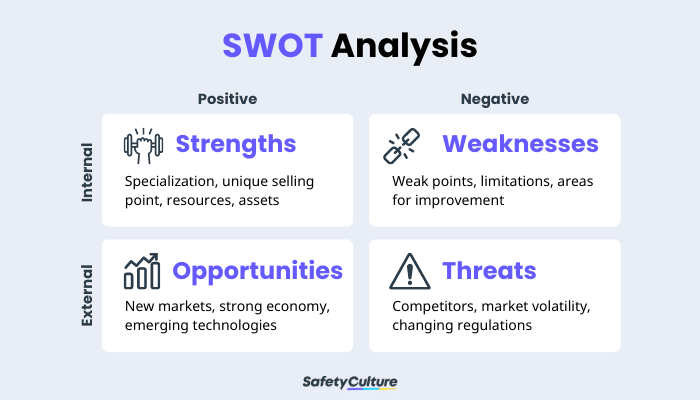
Once you’ve identified the metrics, perform a SWOT analysis (Strengths, Weaknesses, Opportunities, and Threats) to see where your business is lacking or doing well.
Additionally, senior management should participate in determining which processes are crucial to the organization’s success. You’ll also need their involvement to support any significant changes from your benchmarking, such as new product development, training, and purchasing new tools.
After determining the appropriate metrics, discussions with employees, competitors, customers, and other relevant business stakeholders can commence. Engaging in one-on-one, focus group discussions or collecting survey responses can offer significant insights to guide your benchmarking process.
The data collected should be accurate, reliable, and relevant to the specific metrics or Key Performance Indicators (KPIs) you want to benchmark.
This step is crucial in identifying performance gaps and opportunities for improvement. As a result of your research, you will be able to determine your performance level compared to that of other companies or departments, and you will also be able to identify a reasonable and achievable goal for your improvement.
Data visualization tools (e.g., graphs or charts) will help your process. It’s way easier for people to understand images than pages of numbers. Plus, it can give you a holistic picture of any gaps in your performance and how far you’ll need to go to meet your desired benchmark.
In this implementation phase of the benchmarking process, you develop actionable steps for you and your stakeholders to achieve your goals. Creating a plan and defining success criteria can provide a clear direction for achieving goals and milestones.
One effective way to start is by utilizing established goal-setting methods such as SMART (Specific, Measurable, Actionable, Relevant, Time-Bound) and HEART (Habit-Forming, Emotional, Actionable, Realistic, Time-Bound).
Either approach can help you break down your big-picture benchmarking goals into smaller, more specific steps. For example, to improve customer satisfaction, you might aim to increase your customer satisfaction rating by 10 percent within the next six months.
Without tracking, you won’t know if you’re making progress or not. It’s like driving without a speedometer or a GPS—you won’t know how fast you’re going or if you’re on the right track. It’s important to track metrics consistently.
Regularly check your progress against defined goals for success. You can do it weekly, monthly, quarterly, or annually. If meeting benchmarks, continue the plan. If not, revise the plan and make corrections.
SafetyCulture is a mobile-first operations platform adopted across industries such as manufacturing, mining, construction, retail, and hospitality. It’s designed to equip leaders and working teams with the knowledge and tools to do their best work—to the safest and highest standard.
Run standardized inspections, capture operational data, and track KPIs and performance trends through live Analytics dashboards, all in one platform. When gaps surface, corrective actions can be assigned instantly and monitored until completion, so improvements actually stick.
✓ Save time and reduce costs
✓ Stay on top of risks and incidents
✓ Boost productivity and efficiency
✓ Enhance communication and collaboration
✓ Discover improvement opportunities
✓ Make data-driven business decisions