Knowledge Management: Definition, Systems, and Key Components
Learn about the benefits of knowledge management, why it’s important, and how to create an effective strategy to streamline information sharing across an organization.

Learn about the benefits of knowledge management, why it’s important, and how to create an effective strategy to streamline information sharing across an organization.
Published 27 Apr 2026
Article by
6 min read
Knowledge management (KM) is the systematic process of creating, capturing, organizing, sharing, and applying knowledge within an organization to achieve its goals and improve performance. It covers both explicit knowledge and tacit knowledge for a holistic approach in preserving organizational memory, accelerating learning techniques, and making better-informed business decisions.
Knowledge management is an essential process because it helps organizations keep track of what they know and make sure the right people can access it when they need it. Mishandled or poorly implemented knowledge management leads to valuable information getting lost, duplicated, or buried.
Here are a few key reasons why it matters:
It saves time: People in an organization don't have to search endlessly for information because it's organized and easy to find.
It preserves experience: When someone leaves the organization, their knowledge stays behind with process documentation, instead of walking out the door with them.
It improves teamwork: Sharing knowledge across teams helps everyone work better together and avoid repeating the same mistakes.
It supports better decisions: When people have access to the right information, they make smarter, faster choices.
Cultivate a culture of excellence with our digital solutions that enhance efficiency, agility, and continuous improvement across all operations.
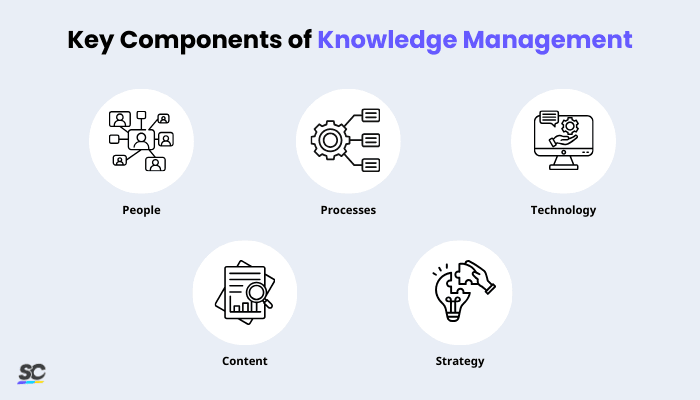
Knowledge management is a holistic approach and requires the coordination of different elements for effective capturing, sharing, and implementation of business information. As such, it’s crucial to take note of these key components:
People are at the heart of knowledge management. They are the ones who create, share, and use knowledge every day. Building a culture where employees are encouraged to share what they know because learning is valued creates a foundation that supports a successful knowledge management system.
Processes are the structured ways in which knowledge is captured, organized, and distributed. This includes how information is documented, reviewed, updated, and made accessible. Having clear processes ensures that knowledge flows smoothly through the organization and doesn't get lost or outdated.
Technology provides the tools and platforms that make knowledge management possible at scale. This includes databases, intranets, record management systems, and collaboration tools that store and deliver information to the people who need it, when they need it.
Content refers to the actual knowledge or data being managed. This includes the documents, guides, reports, best practices, lessons learned, and more. Good content needs to be accurate, up to date, and easy to understand so that it’s relevant and useful for organizational operations.
Strategy ties everything together. A good knowledge management strategy defines the goals, priorities, and direction for how data moves within an organization. Without a clear strategy, even the best tools and processes can fall short of delivering real value.
Implementation of knowledge management requires a structured approach to ensure data is accessible and recorded properly. There are different ways to manage knowledge across industries and businesses, but here are the most common types of knowledge management systems:
These systems handle broad, organization-level knowledge needs. It puts great emphasis on productivity and cost reduction through easy access to structured, semi-structured, or networked information. Making knowledge accessible throughout an enterprise supports decision-making across departments by centralizing data like policies and processes.
Businesses sometimes use digital tools such as checklists to keep a comprehensive record of different work processes. These tools make internal documentation a streamlined process and keep a digital record of information that can easily be shared within the organization for effective knowledge management.
Build from scratch or choose from our collection of free, ready-to-download, and customizable templates.
Designed for specialists like engineers or scientists, these tools enable creation and discovery of new knowledge via advanced workstations, such as CAD software, 3D modeling, or financial terminals. They foster innovation through specialized simulations and analysis for more efficient data sharing or improvement.
Centralized repositories for employee-accessible content like standard operating procedures (SOPs), work guidelines, and troubleshooting guides are essential for empowering employees to work independently. They reduce confusion and second-guessing tasks by consolidating scattered info into one searchable hub.
This kind of knowledge also increases productivity, ensures consistency, and fosters innovation among employees to support better workflows. Businesses like Jones the Grocer use digital training tools to highlight the value of continuous learning by empowering workers through consistent training and knowledge sharing.

“We can finally show the value of learning. It’s not just something nice to have — it’s driving consistency, efficiency, and brand strength. That’s a completely different conversation with leadership.”

Effective knowledge management is a continuous cycle involving specific steps to improve business processes and overall performance. After taking into consideration the type of system being used, it’s crucial to incorporate key steps such as:
Identify: The first step is figuring out what knowledge the organization needs and what it already has. This means recognizing gaps in knowledge and identifying where valuable knowledge currently exists.
Create: Once gaps are identified, new knowledge is generated. This can come from research, experience, problem-solving, employee innovation, or learning from mistakes.
Capture: This step involves collecting and recording knowledge so it doesn't get lost. It includes writing down processes, documenting lessons learned, recording best practices, and converting tacit knowledge into explicit knowledge.
Organize: Captured knowledge needs to be sorted, categorized, and stored in a way that makes it easy to find and use. This involves tagging, indexing, and structuring information in a logical and consistent manner.
Share: Knowledge only creates value when it reaches the people who need it. This step involves distributing knowledge through training or knowledge bases so that it’s accessible across the organization.
Apply: This is where knowledge is put to work. Employees use the available knowledge to make decisions, solve problems, and improve their work. This is ultimately the most important step, as it’s where knowledge creates real impact.
Evaluate: Finally, the organization reviews how well its knowledge management efforts are working. Knowledge being shared is checked for accuracy and relevance while making process improvements as needed.
SafetyCulture is a mobile-first operations platform adopted across industries such as manufacturing, mining, construction, retail, and hospitality. It’s designed to equip leaders and working teams with the knowledge and tools to do their best work—to the safest and highest standard.
Streamline processes, eliminate bottlenecks, enhance resource utilization, and build an agile and scalable infrastructure with SafetyCulture. Strive for operational excellence to boost competitive advantage, foster sustainable growth, and deliver long-term value.
✓ Save time and reduce costs
✓ Stay on top of risks and incidents
✓ Boost productivity and efficiency
✓ Enhance communication and collaboration
✓ Discover improvement opportunities
✓ Make data-driven business decisions