The Role of HR in Workplace Health and Safety Management
Learn about the role of HR teams in building a safe and productive work culture and how they effectively implement health and safety strategies.

Learn about the role of HR teams in building a safe and productive work culture and how they effectively implement health and safety strategies.
Published 27 Apr 2026
Article by
6 min read
Human resources (HR) health and safety refers to the strategic management of workplace risks through policy development, regulatory compliance, and comprehensive training. It primarily functions through the HR team, who also work alongside compliance and safety teams to bridge the gap between technical protocols and employee engagement. This partnership establishes a unified culture of care to prevent accidents and protect worker well-being.
Effective human resources management relies on the HR team to translate legal obligations and leadership intent into practical health and safety systems. Having a strong HR health and safety program presents benefits such as:
Reducing on-site hazards
Preventing injuries before they disrupt work
Building employee trust and morale
Encouraging safety behaviors with every task
All these benefits are able to sustain a resilient, high-performing, and people-centered organization by providing a safe workplace that allows employees to focus on productivity.
Cultivate a safe working environment and streamline compliance with our EHS solutions.
Workplace safety is a shared mission. HR collaborates with company leaders and safety departments to make safety a core part of the daily work. Effective human resources management ensures these key requirements of workplace protection are met:
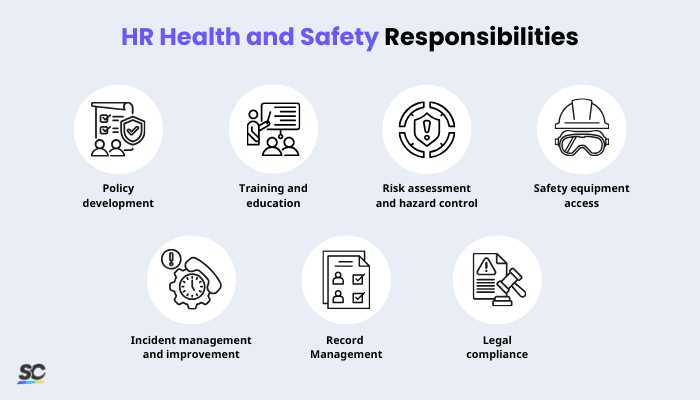
HR Health and Safety Responsibilities
As representatives of the company, HR helps create the rulebook that defines safety expectations, roles, and procedures. Having detailed health and safety HR policies sets the legal and behavioral foundation to encourage accountability and consistency across the operations.
Employees must have the right knowledge to perform their roles without risking their well-being. A robust health and safety strategy builds a "safety-first" culture through thorough and consistent instructional programs.
Proactive intervention maintains a safe working environment. Mitigating threats at the source is more efficient than managing the aftermath of a workplace injury. HR leaders must coordinate closely with safety experts to identify vulnerabilities and implement the appropriate controls to eliminate risk.
A crucial pillar of HR safety and health strategy is ensuring team members are equipped with the correct tools—ranging from personal protective gear to ergonomic workstations. Providing these fulfills employers’ duty of care, demonstrating that physical well-being is a core organizational priority.
Every incident is a lesson that should make the workplace more mindful about potential risks . HR teams should effectively address accidents, investigate the root cause, and make the necessary changes to prevent repeat offenses.
All safety sessions, incident reports, medical records, and inspections must be systematically documented. In the eyes of regulators, undocumented actions are non-existent; comprehensive documentation serves as an organization's primary defense for audits and insurance claims.
Regulatory requirements constantly evolve and HRis responsible for making sure the business adapts to updated mandates before they become a liability. It helps to use tools such as digital checklists to streamline compliance checks with local, state, and federal regulations and ensure good HR practices are being followed.
Build from scratch or choose from our collection of free, ready-to-download, and customizable templates.
Building a culture of safety takes more than just documentation. Regulations mandate companies to actively protect personnel by making HR safety management a foundational business requirement. Here are some safety regulations to take note of:
Country Law Enforcing Agency | Mandate | HR Focus |
US Occupational Health and Safety Act (OSHA) | Employers should provide a workplace free of recognized hazards | Safety training, hazard communication, injury and illness recordkeeping, policy enforcement, inspection readiness |
UK Health and Safety at Work etc. Act 1974 (HSE) | Establishes “employer duty of care” for employee health, safety, and welfare | Written policies, risk assessments, employee consultations, training programs, coordination with safety officers |
Australia Work Health and Safety (WHS) Acts | Delegates primary duty of care on employers to ensure health and safety | Safety management systems, incident reporting, consultation process,training,record maintenance |
Canada Provincial Occupational Health and Safety Acts (CCOHS) | Safety is a shared responsibility and employers are expected to collaborate with workers and supervisors | Joint health and safety committees,training compliance, incident documentation, enforcement of safe work procedures |
EU Framework Directive 89/391/EEC (EU-OSHA) | Requires systematic risk prevention and worker protection across member states | Risk assessments, preventive measures, employee training, documentation, coordination with local implementing laws |
HR’s primary role is to focus on the workforce—an organization's most valuable assets. But advocating for effective health and safety strategies requires more than just reactive communication when issues arise. Here are some best practices that provide a strategic roadmap to effectively develop, implement, and sustain high-level safety standards across an organization:
Health and safety policies should be aligned with legal requirements and organizational needs. This creates a consistent framework that defines the following:
Roles and responsibilities
Standardized controls
Clear expectations for safe conduct
Reporting procedures
An established safety framework must be accessible to all stakeholders, from internal staff to third-party suppliers and specialists. This ensures that everyone in the organization understands the specific hazards, safety responsibilities, and reporting procedures required to maintain a safe workplace.
HR teams should consistently enforce safety requirements across teams and work locations. This encourages accountability and verifies that safety governance is applied fairly and effectively throughout the organization.
Documentation of risk assessments, incident investigations, and daily inspections must be maintained to support legal compliance and audit readiness. Beyond meeting regulatory requirements, these records are used for trend analysis to make data-driven decisions that consistently improve workplace safety performance.
Health and safety requirements should also be adapted to remote and home-based settings. It should address ergonomic, psychosocial, and environmental risks that could affect worker well-being and productivity. This reinforces the idea of holistic HR health and safety, providing worker protection regardless of work location.
SafetyCulture is a mobile-first operations platform adopted across industries such as manufacturing, mining, construction, retail, and hospitality. It’s designed to equip leaders and working teams with the knowledge and tools to do their best work—to the safest and highest standard.
Ensure standardized compliance through digital health and safety checklists. Deliver training programs through online modules and bite-sized lessons to employees across sites, especially those working remotely. Provide real-time hazard visibility to immediately resolve issues then accurately analyze them for continuous improvements. Transform HR from reactive administrators to proactive leaders through a unified platform.
✓ Save and reduce costs
✓ Stay on top of risks and incidents
✓ Boost productivity and efficiency
✓ Enhance communication and collaboration
✓ Discover improvement opportunities
✓ Make data-driven business decisions
In this article