
“You are going to get better quality out in the field if you run a clean, quality and safe job. That’s just the way we see it.”
The Complete Process of Warehouse Construction
Learn how warehouse construction works—from planning, design, and commissioning.

Published 27 Oct 2025
Article by
|
7 min read
What is Warehouse Construction?
Warehouse construction is the systematic process of planning, designing, and physically building a large-scale storage facility where commercial goods are received, organized, and managed. This begins with site feasibility analysis and drawing detailed architectural and structural plans and ends with commissioning and official handover, all the while ensuring compliance with local building codes for safety, quality, and efficient integration of mechanical, electrical, and plumbing systems.
Benefits of Efficient Warehouse Construction
Warehouses are crucial assets in the modern economy, forming the backbone of the global supply chain. With the expected acceleration of the warehousing market in the next decade, the efficient and timely construction of these commercial spaces is non-negotiable. It also delivers the following advantages:
Increased cost savings - Well-designed warehouses reduce operational costs by optimizing spaces, minimizing product damage, and lowering energy consumption.
Improved operational efficiency - Efficient methods streamline project timelines, which leads to the space becoming operational quickly. Faster projected completion means faster inventory turnover and supply chain responsiveness.
Enhanced worker safety - Beyond adhering to construction safety rules, a well-planned warehouse is designed to reduce accidents by integrating key operational safety features, including ergonomic layouts and clear, safe traffic flow.
Guaranteed durability and quality - Quality warehouse building construction assures structural integrity, longevity, and the ability to withstand environmental and operational stresses.
Ensured regulatory compliance - Strategic construction plans require following local building codes, environmental regulations, and industry-specific requirements to ensure operational legitimacy.
Improve your EHS Management
Cultivate a safe working environment and streamline compliance with our EHS solutions.
Required Permits and Approvals
The regulations surrounding warehouse civil construction can be immensely complex. Having a comprehensive knowledge of the legal framework streamlines the project life cycle, helping companies and their contractors avoid unexpected problems, save time, and build legally.
Country | Agencies Responsible | Requirements |
US | Local, city, or county building departments Occupational Safety and Health Administration (OSHA) Environmental Protection Agency (EPA) State and local fire marshals | Building and zoning permits Workplace safety during construction Environmental approvals and certifications Fire safety inspections |
UK | Local planning authorities Building control bodies (local councils, approved inspectors) | Planning permission (construction or change of use) Structural safety, fire safety, energy, and accessibility Fire, health, and safety compliance |
Australia | Australian Building Codes Board (ABCB) Local councils or state planning departments State-level environmental protection agencies | National Construction Code for building safety and performance Zoning and land use Approvals depend on the site and project scale |
EU | European Committee for Standardization (CEN) National or regional building offices Customs and Import/Export Warehouse Permits | Harmonized standards for structural, fire, and safety (e.g., Eurocodes) Local zoning permits For bonded warehouse operations |
Canada | Municipal building departments Occupational Health and Safety offices | Permitting for construction and major renovations Worker safety during construction Customs bonded warehouse approval |
What are the Key Stages of Warehouse Construction?
Although every company has different needs and budgets, following a clear, staged process for industrial warehouse construction makes it easier to coordinate with stakeholders (e.g., designers, engineers, suppliers, regulators), which helps reduce risks and control costs.
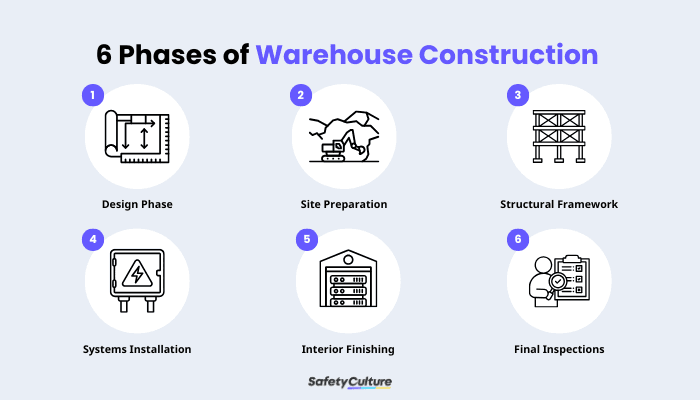
6 Phases of Warehouse Construction
Planning and Design
This stage serves as the project’s blueprint, involving the technical and strategic work that defines the scope, budget, schedule, and final physical layout of the warehouse. Typically spanning 6 to 16 weeks, the project leaders conduct the following:
Needs assessment - throughput, storage density, future expansion
Site selection input with zoning checks, soil tests, and flood studies
Concept and layout design
Construction method selection (e.g., traditional vs. pre-engineered building)
Engineering inputs - structural, geotechnical, Mechanical, Electrical, and Plumbing (MEP), fire protection plans
Permitting and compliance planning
Cost estimating and programming
Site Preparation and Foundation
Ground engineering efforts prepare the site for vertical construction, establishing the solid base that supports the warehouse and its contents. The entire process may last for 4 to 12 weeks, mostly focused on the installation of piles or columns, but also involves the following:
Site survey, clearing, and demolition of existing structures
Earthworks and grading
Geotechnical works (i.e., boreholes and soil testing)
Temporary utilities and access
Structural Framework and Exterior Construction
The warehouse will now gain its core structure and protective enclosure, including the main frame, roof, and exterior walls, to create a clear, secure internal space. This phase generally takes 4 to 16 weeks because of the complexity of the facade’s design and the construction of the following:
Structural erection of steel frames, reinforced concrete elements, roof trusses, and purlin systems
Roofing and cladding with insulated metal panels, composite roof decks, falls and gutters, and potential roof load for solar panels
Doors and docks installation
Windows, canopies, and facade treatments, if required
Installation of Building Systems
This stage is dedicated to integrating the essential functional infrastructure (MEP, fire protection, and data systems) that makes the warehouse safe and operational. Installation usually overlaps with the structural construction, lasting around 6 to 20 weeks.
Electrical distribution
Lighting
Plumbing
Fire protection (sprinkler system, fire pumps, hydrants, alarm and detection)
Data and automation infrastructure (fiber backbone, WiFi access points, Automated Storage and Retrieval System (ASRS) interfaces)
Interior Finishing and Equipment
Outfitting the interior with fixtures, fittings, and equipment takes 4 to 12 weeks because it involves the installation of high-value systems needed for the operations. This is one of the major cost drivers in the entire project, requiring careful budgetary review.
Floor finishing and marking
Racking and mezzanine installation
Material handling systems
Office fit-out and amenities
Equipment testing and commissioning; operator training
Final Inspections and Commissioning
The final step rigorously verifies the entire facility, confirming that the building structure, operational systems, and equipment meet the original design intent and fulfill all regulatory requirements. The whole commissioning process takes 2 to 6 weeks and involves the following:
Regulatory inspections
Systems commissioning
Safety and operational acceptance tests
Documentation handover
Training and soft-start
Create your own Construction Inspection checklist
Build from scratch or choose from our collection of free, ready-to-download, and customizable templates.
Best Practices to Address Common Challenges
A 2024 McKinsey report states that nearly 70% of large construction projects experience delays and up to 30% cost overruns. Adopting these industry best practices can help teams anticipate the most common challenges in building warehouses from scratch:
Early permitting and compliance planning - Project teams can identify potential legal hurdles before construction begins if they communicate with regulatory bodies regarding specific documentation.
Comprehensive site assessment - Geotechnical investigations (e.g., soil testing, topographic analysis, environmental impact assessment) allow engineers to detect unstable soil conditions and contamination that could lead to structural issues.
Diversified material sourcing - Disruptions often stem from material shortages or delivery delays. Partnering with multiple suppliers and utilizing supply chain management software helps track inventory and forecast demand.
Regular safety audits and worker training programs - Construction hazards can be difficult to handle without adequate preparation. Implementing routine inspections and continuous safety training ensures that workers understand risks, equipment handling, and emergency procedures.
Cost monitoring - Deviations should be expected. Employing real-time cost tracking tools allows managers to compare planned versus actual spending, adjust on the spot, and keep the project financially viable.
Level 10 has improved its workflows, from simple routine inspections to real-time communication between office and field workers, by utilizing a comprehensive platform with robust digital tools. With SafetyCulture, the company has increased accountability among its members and maintained a strong safety record.
Ensure Safe and Efficient Warehouse Construction with SafetyCulture
Why Use SafetyCulture?
SafetyCulture is a mobile-first operations platform adopted across industries, such as manufacturing, mining, construction, retail, and hospitality. It’s designed to equip leaders and working teams with the knowledge and tools to do their best work—to the safest and highest standard.
Organize and store all project paperwork and records in a centralized repository for easy access and review. Improve collaboration and information flow among all project parties to monitor the progress of key project achievements and track adherence to essential building codes and industry standards. Ensure all construction efforts are transparent and accountable, consistently meeting high-quality and safety standards using a unified platform.
Save time and reduce costs
Stay on top of risks and incidents
Boost productivity and efficiency
Enhance communication and collaboration
Discover improvement opportunities
Make data-driven business decisions
FAQs About Warehouse Construction
In this article
Related articles
Environmental Safety
Safety

Green Building for a Carbon-Neutral Future
Learn about green building, its components, and how it can help your business achieve its sustainability goals.
Safety
Risk Assessment

Machine Risk Assessment for Industrial Safety
Learn what machine risk assessment is, why it’s important, and the necessary steps to prevent workplace injuries and equipment failures.
Construction Safety
Safety
An Introduction to Core Drilling
Learn what core drilling is, why it’s used, and the best safety practices to during when core drilling.