
“It can be a hazardous industry and the quality of the work has to be spot on. It has to be perfect, because if work isn’t done correctly… structures could fail. We’re talking major risks to the community and built infrastructure.”
Understanding Pre-Engineered Buildings
Explore this comprehensive guide on PEBs, including customization, durability, costs, and how to manage their construction safely and effectively.
Published 15 Dec 2025
Article by
|
7 min read
What are Pre-Engineered Buildings?
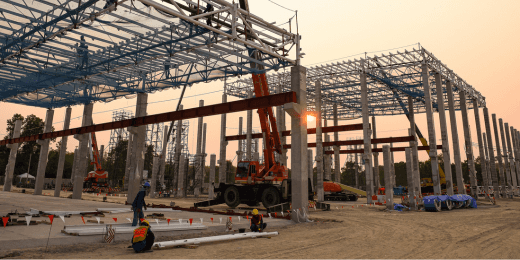
PEBs are structures made from factory-manufactured parts that are designed to fit perfectly during assembly. Structural components, such as the frames, beams, and walls, are pre-fabricated in controlled environments, eliminating delays and ensuring durability. PEBs consistently outperform conventional construction by delivering projects faster, cheaper, and with complete design flexibility.
These are the standard components of a PEB system:
Primary structural steel frames that form the building’s skeleton
Secondary framings (e.g., purlins and grits) that support roof and wall panels
Wall panels or claddings
Insulated roof panels
Bracing systems for lateral stability
Doors and windows
Foundations and anchoring systems
How Do Pre-Engineered Buildings (PEBs) Differ from Conventional Steel Buildings?
The pre-engineered buildings market has seen dramatic growth over the last decade. Its Compound Annual Growth Rate (CAGR) is strongly projected to be around 12% from now until 2030, underscoring the essential role of prefabrication in the construction industry.
Aspect | Pre-Engineered Buildings (PEB) | Conventional Steel Buildings |
Design | Developed by one company as a complete system, every part fits perfectly | Beams, columns, and frames are planned separately, requiring different teams and several adjustments. |
Manufacturing | All parts are made in a factory that accurately cuts, drills, and shapes for easy assembly when they arrive on site. | Components are made from different workshops. Welding and cutting can still happen at the construction site. |
Construction Time | The duration is shorter (weeks or months sooner) because workers bolt pieces together on site. | The building time takes longer because of additional work done on site. |
Cost Efficiency | The full project cost is cheaper because PEBs use less steel, require fewer workers, and take less time to build. | The project budget is often higher because more planning requires more resources. |
Flexibility | Adding extra space or extending the building is easier because the layout is modular. | Design customization is easier, but major changes after the structure is up will be harder. |
Material Weight | Because the structure uses less steel, PEBs are lighter. | Larger steel sections add weight and require stronger foundations, increasing total material costs. |
The Limitations and Potential Challenges of PEBs
Although pre-engineered buildings streamline on-site assembly and significantly reduce the construction timeline, project stakeholders must proactively address potential limitations and inherent constraints to uphold construction safety standards and safeguard schedules and budgets.
Here are some examples:
Dependency on accurate site preparation: The site foundation must be perfectly level and aligned . Any mistake (e.g., inaccurate anchor bolt placement) can delay construction or require costly corrections.
Transportation and handling restrictions: Large components must be safely transported from the factory to the site. Mishandling can damage precision-made parts.
Quality variations between manufacturers: Not all suppliers maintain the same standards. Choosing reputable manufacturers is essential to prevent long-term durability issues.
Limited flexibility for major mid-project adjustments: Altering dimensions, adding floors, or modifying load requirements during construction may require re-fabrication, causing schedule delays and additional expenses.
Limited architectural customization: PEBs are less suitable for projects requiring stronger architectural identity, especially those with curved forms or complex facades.
Limited suitability of certain building types: This system is the top choice for constructing commercial warehouses and industrial facilities. Multi-story buildings and highly specialized structures require complex steel fabrications, heavy concrete, and mechanical systems.
Construction safety concerns: Although components of pre-engineered metal buildings are supposedly simple to assemble, poor planning or rushing can still lead to serious safety incidents.
Streamline Your Construction Operations
Unlock the power of data-driven insights, standardized processes, and effective communication to improve efficiency and productivity across all jobsites.
What Building Codes and Design Standards Apply to Pre-Engineered Buildings?
Building codes and design standards set the rules for structural strength, fire protection, wind and seismic resistance, and material quality. Following these prevents failures that could compromise structural integrity from site preparation all the way to occupancy.
Country | Regulation | Mandate |
US | International Building Code (IBC) Minimum Design Loads Steel Construction Standard | Defines overall building safety requirements (e.g., design, fire protection, loads) and is widely adopted by states Specifies how to calculate loads (e.g., wind, snow, earthquakes) critical for framing and connection Covers design, fabrication, and erection of structural steel, including strength, stability, welding, and quality control |
UK | UK Building Regulations Steel Structures BS 5950 | Set minimum safety standards for fire resistance, structural integrity, energy efficiency, and site safety Provides rules for design, material strengths, and structural stability Still referenced despite its age, this addresses the structural use of steel in building design. |
Australia | National Construction Code (NCC) AS 41000- Steel Structures Structural Design Actions | Outlines mandatory building safety, structural performance, fire protection, and energy efficiency requirements Covers design, fabrication, and erection of steel members in PEBs Specifies load calculations and other forces acting on the building |
EU | Basis of Design Actions on Structures Eurocode 3 (EN 1993) Steel Structure Design | Defines safety principles, reliability requirements, and design combinations for structural engineering Provides load design (e.g., wind, temperature, accidental actions) rules The main standard for designing steel frames, bolts, welded joints, etc. |
Canada | National Building Code of Canada (NBCC) Design of Steel Structures Cold-Formed Steel | Specifies structural requirements (e.g., fire safety, seismic design, environmental loads) Defines rules for steel member sizing, connections, welding, bracing, etc. Applies to PEB secondary members (e.g., purlins and grits) |
Best Practices for Deploying PEB Structures
The success of any construction endeavor, even with the simplified on-site assembly of pre-engineered steel buildings, is ultimately dependent on a rigorous, integrated project management system. Here’s a step-by-step guide that can eliminate costly delays, reworks, and safety risks:
1. Assess and prepare the site.
Because PEB components are manufactured to exact measurements, the foundation and anchor bolts must match perfectly. Proper site preparation prevents the following:
Misalignment
Structural issues
Costly on-site adjustments
Create your own Construction checklist
Build from scratch or choose from our collection of free, ready-to-download, and customizable templates.
2. Conduct a detailed design review.
Reviewing drawings, load requirements, and connection details ensures the design meets local codes, environmental loads, and functional needs. Doing this early on reduces errors that could arise during ongoing assembly and construction.
3. Enforce quality control during fabrication.
The components are precisely pre-cut, pre-drilled, and pre-welded. Rigorous factory quality checks during pre-engineered buildings fabrication are crucial, ensuring items meet specifications before being shipped to the site. This significantly reduces on-site rework and enhances assembly safety protocols.
4. Plan efficient logistics and transportation.
PEB parts are large and heavy, so logistics should be planned to minimize delays, avoid component damage, and keep the project on schedule. Here are some best practices:
Schedule deliveries to match the assembly and erection sequence.
Use proper lifting plans to handle oversized steel components safely.
Inspect transport routes early to avoid congestion and accessibility issues.
5. Deploy skilled on-site assembly teams.
Employ trained personnel familiar with proper PBE bolting, lifting, bracing, and alignment. Provide targeted construction training and certification to ensure faster erection, prevent structural issues, and reduce safety risks.
6. Implement strong safety management and compliance.
Erecting steel structures involves working at height, heavy lifting, cranes, and fall risks. Reduce accidents and improve worker protection by strictly following local regulations and construction safety rules.
7. Plan for maintenance and lifecycle care.
Even well-built PEBs require periodic inspections for corrosion, fastener tightness, drainage issues, and panel condition. Being always on the lookout for issues ensures the following:
Extends the building’s lifespan
Maintains structural performance
Prevents costly repairs
Robust digital solutions are indispensable assets for any organization seeking to optimize its PEB construction processes, from factory quality checks to on-site assembly. Coffey Testing, a leading geotechnical and civil construction materials testing company, has greatly benefited from a platform that helped them accelerate workflows, increase reporting accuracy, and achieve zero lost-time injuries for four consecutive years.
Optimize PEB Project Timelines with SafetyCulture
Why use SafetyCulture?
SafetyCulture is a mobile-first operations platform adopted across industries such as manufacturing, mining, construction, retail, and hospitality. It’s designed to equip leaders and working teams with the knowledge and tools to do their best work—to the safest and highest standard.
Oversee PEB projects by streamlining inspection workflows, safety audits, and quality control checks. Track progress to mitigate risks, optimize on-site assembly accuracy and safety, and centralize documentation for review and compliance. Maintain quality and safety standards throughout the project’s lifecycle through a unified platform.
✓ Save time and reduce costs
✓ Stay on top of risks and incidents
✓ Boost productivity and efficiency
✓ Enhance communication and collaboration
✓ Discover improvement opportunities
✓ Make data-driven business decisions
FAQs About Pre-Engineered Buildings
In this article
- What are Pre-Engineered Buildings?
- How Do Pre-Engineered Buildings (PEBs) Differ from Conventional Steel Buildings?
- The Limitations and Potential Challenges of PEBs
- What Building Codes and Design Standards Apply to Pre-Engineered Buildings?
- Best Practices for Deploying PEB Structures
- Optimize PEB Project Timelines with SafetyCulture
- FAQs About Pre-Engineered Buildings
Related articles
Environmental Safety
Safety

Green Building for a Carbon-Neutral Future
Learn about green building, its components, and how it can help your business achieve its sustainability goals.
Safety
Risk Assessment

Machine Risk Assessment for Industrial Safety
Learn what machine risk assessment is, why it’s important, and the necessary steps to prevent workplace injuries and equipment failures.
Construction Safety
Safety
An Introduction to Core Drilling
Learn what core drilling is, why it’s used, and the best safety practices to during when core drilling.