Inside the World of Emergency Workers: What They Do and Why They Matter
Here’s a simple guide to emergency worker roles and duties. Know who responds first when every second counts.
Here’s a simple guide to emergency worker roles and duties. Know who responds first when every second counts.
Published 28 Apr 2026
Article by
4 min read
Emergency workers are trained professionals who protect people, property, and the environment during emergencies. Whether designated in advance or mobilized as needed, they respond to medical emergencies, natural disasters, fires, and accidents, providing the urgent help people need.
Emergency workers are often the first on the scene, saving lives, preventing further harm, and restoring safety to affected communities. As critical players in emergency management, they coordinate responses, provide essential aid, and help communities stay safe in times of crisis.
They’re also involved in all stages of disaster management, from preparedness to recovery. Their work is not only essential for immediate rescue operations; it also reduces long-term damage from disasters.
Emergencies happen without warning anytime, anywhere ranging from a medical emergency to a fire to a natural disaster— with each situation requiring different assistance with different skillsets. That's why there's different types of emergency workers, each trained with specialized skills to handle specific challenges. Here are some of the most common:
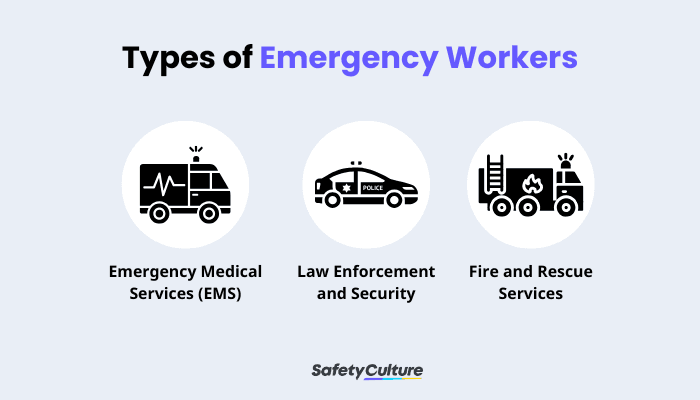
Emergency medical responders (EMR) provide basic life-saving care like cardiopulmonary resuscitation (CPR) and first aid. They often arrive at the scene first before advanced care providers. Many firefighters and police officers are certified EMRs, trained to act fast when every second counts.
Police and law enforcement personnel are the first responders at any incident sites to provide security, crowd control, and initial emergency response. Police officers keep people and properties safe and maintain order during emergencies, ensuring safety and stability during both routine operations and emergency situations.
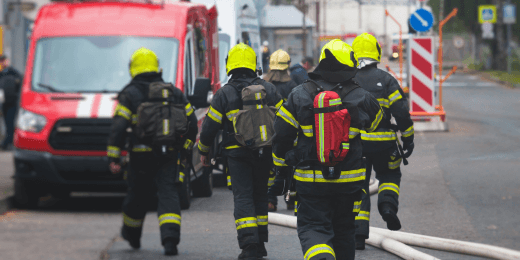
Firefighters provide immediate assistance during fires, vehicle accidents, hazardous material incidents, and rescue operations. They form part of specialized Fire and Rescue Services that handle a wide range of emergencies including emergency medical care.
Their work spans complex operations, from confined spaces to water and high-angle rescues. Hazardous Materials (HAZMAT) teams manage chemical, biological, radiological, and nuclear threats to protect both people and the environment.
The European Agency for Safety and Health At Work (EU-OSHA) stated that emergency workers face diverse risks including physical, mental, environmental, and task-specific demands, as follows:
Physical risks: Handling heavy equipment, working in smoky or chemical environments, and enduring difficult conditions can cause physical strain, injuries, or long-term health issues.
Mental risks: Exposure to fatalities, violence, time pressure, and traumatic incidents can lead to severe stress, post traumatic stress disorder (PTSD), burnout, and depression.
Environmental risks: Working in disaster zones, extreme weather, or noisy, confined spaces can result in illness, contamination, or fatigue.
Protecting the health and well-being of responders keeps emergency operations strong in the face of diverse and unpredictable hazards. The following agencies have established guidelines and laws to safeguard these essential workers:
At the international level, ILO calls on governments and employers for strong safety standards to protect emergency workers from fire, toxic exposure, or trauma. It covers preventive measures such as:
Safety training
Personal protective equipment (PPE) for each type of emergency response
Regular risk assessments for hazards such as exposure to fire, toxic substances, structural collapse, violence, and psychological trauma
Aside from that, the US (OSHA) mandates employers to provide the following:
Hazard assessment and controls: Identify potential risks early, and apply barriers, ventilation, administrative controls, safe work practices, and PPE to reduce exposure to harmful or unpredictable elements.
Engineering controls: Isolate drivers from patient areas using closed pass-throughs or dedicated ventilation to lower the spread of contaminants.
Administrative controls: Coordinate 911 centers, dispatchers, and responders to identify infection risks early, limit personnel in patient areas, and provide infection control training.
Safe work practices: Avoid unnecessary close or physical contact with injured or ill individuals unless necessary, and use extreme caution handling sharps and contaminated materials.
SafetyCulture is a mobile-first operations platform adopted across the manufacturing, mining, construction, retail, and hospitality industries. It is designed to equip leaders and working teams with the knowledge and tools to do their best work—to the safest and highest standard.
Stay connected with your team and manage lone worker risks through location sharing and discreet panic alerts that can escalate to emergency services. Foster a culture of safety and transparency by enabling constant communication with lone workers, allowing them to perform tasks with configurable durations and check-ins.
Save time and reduce costs
Stay on top of risks and incidents
Manage compliance with safety standards
Enhance communication and collaboration
Monitor worker condition
Make data-driven business decisions