Understanding Building Safety and Compliance in the Modern Workplace
Learn the essentials of building safety and how to create a compliant, strategic safety program for your organization.
Learn the essentials of building safety and how to create a compliant, strategic safety program for your organization.
Published 28 Apr 2026
Article by
6 min read
Building safety is an integrated approach encompassing policies, procedures, systems, and design principles to ensure a building’s structural integrity, habitability, and resilience throughout its life cycle. This includes risk prevention and mitigation, code compliance (local and international), occupant awareness, and emergency preparedness to protect the property, environment, and occupant health and safety.
The concept of building regulations dates back to pre-biblical times. To provide safe and comfortable spaces, these laws severely punished laborers if homes collapsed and injured the inhabitants. It has evolved significantly over time, influenced by advances in construction techniques, new materials, technology, and lessons learned from disasters. Companies that take building safety standards seriously are rewarded with the following:
Safeguards property, health, and life – Building and safety codes, such as the International Building Code (IBC), International Code Council (ICC), and the National Fire Protection Association (NFPA), set standards to ensure structures and everything within them are safe and secure. Well-constructed buildings also prevent considerable injuries, illnesses, and fatalities.
Advances business continuity and financial stability – Investing in building health and safety is a strategic business decision. Proactively mitigating risks prevents costly disruptions, lowers costs associated with accidents and insurance, and builds a stronger, resilient, and trusted organization.
Improved legal and regulatory compliance – Adhering to codes and standards for building security and safety isn’t just about avoiding immediate penalties and potential criminal charges. This is a foundation for legally operating and thriving in a highly competitive business landscape, relied on by clients, investors, and the general public.
Building safety is more than just structural integrity. It’s a coordinated system of proactive measures that work together to maintain safer environments, reduce liabilities, and foster a culture of continuous safety. Here are the components of this unified framework:
Building risk assessment systematically identifies and evaluates potential hazards and their impact. This is the foundation for all safety efforts, guiding decision-making, especially when prioritizing controls. Regular assessments should be conducted to accommodate changes in building use, occupancy, and environmental conditions.
Staying aligned with regulations, from upholding safety during construction to minimizing the impacts of building operations, is crucial in promoting best practices that protect laborers, occupants, and maintenance staff throughout the building’s life cycle. Building safety compliance also prevents legal penalties.
Routine building safety inspections and preventive maintenance ensure critical systems (e.g., electrical wiring, fire alarms, Heating, Ventilation, and Air Conditioning (HVAC), emergency exits) function as intended. This proactive approach prevents minor issues from escalating into serious and life-threatening hazards.
Effective emergency response planning ensures buildings and occupants are ready for any event, from water spills and power outages to earthquakes and fires. This involves establishing evacuation procedures, providing emergency lighting, conducting drills, offering first-aid training, and coordinating with local responders to minimize confusion and injuries during emergencies.
Effective building safety depends on clear roles, responsibilities, and smooth information flow. The Golden Thread is a reliable guide that helps stakeholders understand their part in maintaining a safe environment by easily accessing information, such as inspection schedules, building safety rules, and emergency protocols
Building safety regulations, codes, and standards vary significantly between countries and regions. The disparities are based on environmental risks, infrastructure needs, and population density, to name a few. Get to know the most consequential building safety policymakers and enforcers:
Jurisdiction | Authorities/Codes/ Standards | Basic Facts | |||
United States | Develops model-building codes to regulate construction safety | ||||
National Fire Protection Association (NFPA) | Publishes widely adopted fire and life safety codes. | ||||
Provides minimum standards for building construction and safety. | |||||
United Kingdom | Oversees national building regulations and housing policy | ||||
Local Building Control Bodies | Enforce compliance with building regulations at the municipal level | ||||
Provides legal requirements for construction, alterations, and building use | |||||
European Union | Develops EU-wide technical standards across industries, including construction | ||||
Promotes energy efficiency and safety in the built environment across the EU | |||||
Australia | Oversees the development and management of the National Construction Code | ||||
State and Territory Building Authorities | Administer and enforce local building regulations. | ||||
Unifies building code covering structural, fire, and health requirements | |||||
Canada | Develops the National Model Codes | ||||
Establishes minimum requirements for safe building design and construction nationwide |
Consistently applying building safety best practices ensures companies can efficiently adapt to changing needs and hazards. Organizational leaders, facilities managers, and EHS professionals can benefit from the following:
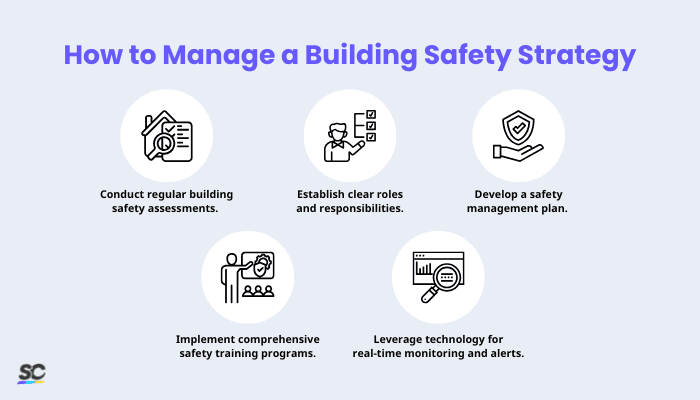
How to Manage a Building Safety Strategy
This proactive and systematic process of identifying, evaluating, and prioritizing potential hazards uncovers safety risks (e.g., structural weaknesses, electrical faults, fire hazards) before they escalate and cause real harm. While this should be done at least annually, here are factors that can affect frequency:
Building age and condition
Building use and occupancy changes
Building structure or system modifications
New hazards
Regulatory and standard adjustments
Clearly outline who’s responsible for what aspect of building safety. Everyone, from building owners and managers to occupants and contractors, should understand their job descriptions and demonstrate due diligence in protecting life and property.
These are the most common roles with their corresponding responsibilities:
Building owners allocate resources for safety.
Facility managers oversee inspections, maintenance, and daily operations.
Safety officers conduct hazard assessments and lead safety planning.
Contractors and service providers follow all safety protocols during work.
Employees and/or tenants report hazards and comply with emergency procedures.
Regulators or auditors monitor adherence to safety laws and codes.
This structured and proactive framework serves as a guide to prevent or reduce risks and manage incidents, creating a more secure and productive environment. A safety management plan must include the following:
Hazard identification and assessment methodology
Building safety and maintenance procedures
Emergency evacuation and communication plan
Trained occupants are less likely to panic in emergencies. Regular safety training for employees and comprehensive orientation for tenants and visitors should be prioritized in building management processes, as these empower everyone to contribute to safety and respond effectively to incidents.
Digital tools like building management systems, smart sensors, and mobile safety apps detect risks in real time, helping safety managers address issues and hidden threats before they escalate. Aside from modernizing building operations, this supports data-driven decision-making and provides audit trails for compliance.
SafetyCulture is a mobile-first operations platform adopted across industries, such as manufacturing, mining, construction, retail, and hospitality. It’s designed to equip leaders and working teams with the knowledge and tools to do their best work—to the safest and highest standard.
Empower employees, tenants, and other stakeholders to maintain safety and security by reporting, addressing, and documenting incidents. Build a culture of accountability to ensure compliance with regulations and standards by tracking responsibilities and corresponding actions. Simplify the entire building safety management process throughout the structure’s life cycle through a unified platform.
✓ Save time and reduce costs ✓ Stay on top of risks and incidents ✓ Boost productivity and efficiency ✓ Enhance communication and collaboration ✓ Discover improvement opportunities ✓ Make data-driven business decisions