Social Worker Safety: Responsibilities and Guidelines
Discover what social worker safety entails, including their key responsibilities, the common challenges they face, and the guidelines that govern and protect their practice.

Discover what social worker safety entails, including their key responsibilities, the common challenges they face, and the guidelines that govern and protect their practice.
Published 28 Apr 2026
Article by
6 min read
Social worker safety refers to the precautions, protocols, and policies designed to safeguard social workers from various threats and violence while performing their duties. These proactive measures aim to prevent physical, verbal, and psychological harm in both within the office and fieldwork, where social workers often encounter unpredictable and also high-risk situations.
According to the US Bureau of Labor Statistics, a social worker is someone who helps people prevent and cope with problems in their everyday lives. Some can operate in various communities to help in managing challenges like illness, abuse, and social problems, while others focus on research, advocacy, policy development, or serving specific populations. Because the nature of this job is to work independently in diverse or high-risk environments, ensuring lone worker safety is a vital aspect of ensuring their protection and well-being, while they ensure the protection and well-being of others.
According to the US National Association of Social Workers (NASW), there are three types of social work and workers, which are the following:
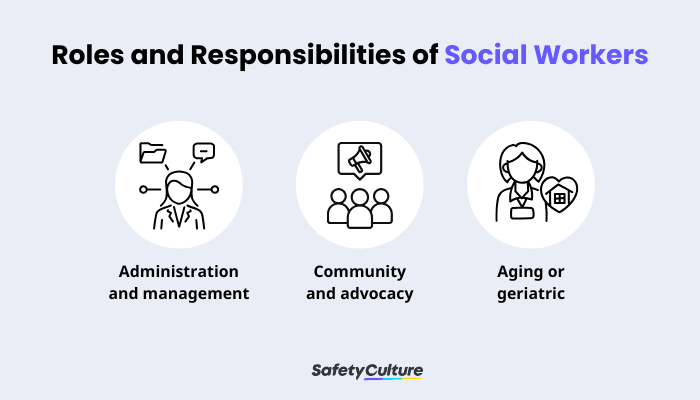
Administration and management social work: Social workers who work in administration and management typically lead and guide private and public organizations that provide social services, combining management skills with social work values. They're the ones who manage resources, planning programs, and developing policies and systems to ensure effective and ethical service delivery.
Community and advocacy organizing social work: This type of social work focuses on promoting social justice by amplifying the voices of individuals and communities. Social workers in this sector aim to unite people to take collective action, challenging systems of inequality and influencing policies that affect marginalized groups.
Aging or geriatric social work: Social workers who work with the elderly aim to connect them with the necessary resources and services that promote independence, dignity, and quality of life. In particular, social workers in this sector provide specialized guidance, advocacy, and support to help seniors live better and easier.
NASW developed 11 standard guidelines that ensure social workers can safely perform their duties, whether out in the field or in a workplace. Agencies and managers are required to follow these at all times.
The guidelines are as follows:
Standard 1 - Organizational Culture of Safety and Security: Agencies should foster a culture of psychological, emotional, and physical safety among their social workers through leadership commitment, safety committees, clear policies on hostile behavior, incident reporting, and regular protocol reviews.
Standard 2 - Prevention: Agencies should focus on proactive risk reduction by analyzing past incidents to identify policy, training, and environmental weaknesses, then address these gaps through improved staff training and updated policies.
Standard 3 - Office Safety: Agencies should ensure that their social workers’ physical workplace should be designed for safety, complete with clear emergency exits, accessible alarms, secure entry points, good lightings, effective separation of public and private areas, and clear regulations for the use or disposal of firearms in case of accidents.
Standard 4 - Use of Safety Technology: Agencies and their social workers should take advantage of technology such as panic buttons, GPS devices, and cameras in order to reduce risk.
Standard 5 - Use of Mobile Phones: Agencies should require their social workers to use agency-issued phones only when on the field to protect personal information.
Standard 6 - Risk Assessment for Field Visits: Agencies should perform risk assessments on their clients before each visit to ensure social worker safety and make changes to plans as needed to ascertain their well-being.
Standard 7 - Transporting Clients: Agencies must have transport policies in place to protect social workers and clients anytime and anywhere. .
Standard 8 - Comprehensive Reporting Practices: Agencies should establish effective and easily understood reporting procedures so social workers can easily check in with their managers and notify them of any risk or concern.
Standard 9 - Post-Incident Reporting and Response: Agencies must provide their social workers medical, legal, or counseling support after any violent or shocking encounter, as well as debrief staff and witnesses, if any.
Standard 10 - Safety Training: Agencies should provide social workers training either annually or as-needed on risk assessment procedures, de-escalation practices, nonviolent self-defense, safety technology, and managing secondary trauma.
Standard 11 - Student Safety: Schools of social work must ensure field sites have strong safety policies and prioritizes the student’ safety, as well as provide alternative placements when risks can’t be resolved.
Social workers play an important role in making individuals’ lives less challenging. However, their job often comes with its own unique challenges of their own. Here are some common challenges faced by social workers:
Heavy workload and burnout: It’s very common for social workers to experience emotional exhaustion on the job or after work hours due to the high caseloads, excessive administrative tasks, and constant exposure to trauma and crisis situations.
Limited resources: Inadequate funding, lack of community services, and staff shortages further complicate the ability of social workers to support and help clients effectively and quickly.
Bureaucratic and policy constraints: Social workers typically encounter hindrances in their work due to rigid systems, changing welfare policies, and limited influence in decision-making.
Safety concerns: Social workers often find themselves in hostile environments without sufficient institutional support when doing dangerous or risky fieldwork that may escalate quickly.
Enhance social worker safety by providing real-time visibility, proactive risk management, and reliable communication tools. Lone worker solutions, in particular, can be a great help for social workers as they often find themselves far from other safety professionals or emergency services. Providing social workers a lone worker safety tool that’s easily accessible from anywhere can help better connect them with the necessary help in times of emergency, which helps not only them, but also their clients.
One such platform that offers lone worker safety management tools for any industry is SafetyCulture. Through SafetyCulture’s Lone Worker monitoring feature, social workers can easily contact their agencies and emergency responders if a visit goes off-plan. SafetyCulture also gives agencies complete visibility over their workers at all times with real-time GPS tracking, wherever they may be.
Some lone worker monitoring features SafetyCulture offers that can help manage social worker safety are the following:
Duress activation via Bluetooth devices: Allows social workers to silently trigger assistance without drawing attention through its discreet duress or panic button
Integrations: Ensures connectivity and SOS functionality even in low or no-signal areas through satellite integration
Digital forms: Standardizes pre-visit risk assessments, incident reporting,and social worker safety protocols with digital checklists, questionnaires, and report templates.
Check-in tracking: Requires social workers to check in with their employers in set intervals, ensuring constant communication and visibility into their safety and movements
These features enable supervisors to monitor active jobs, coordinate rapid support, analyze patterns, and continuously improve safety practices, all contributing to safer, more confident fieldwork for social workers.
SafetyCulture is a mobile-first operations platform adopted across the manufacturing, mining, construction, retail, and hospitality industries. It is designed to equip leaders and working teams with the knowledge and tools to do their best work—to the safest and highest standard.
Stay connected with your team and manage lone worker risks through location sharing and discreet panic alerts that can escalate to emergency services. Foster a culture of safety and transparency by enabling constant communication with lone workers, allowing them to perform tasks with configurable durations and check-ins.
Save time and reduce costs
Stay on top of risks and incidents
Manage compliance with safety standards
Enhance communication and collaboration
Monitor worker condition
Make data-driven business decisions