Mastering Modern Service through Hospitality Training
Explore how to refine the team’s skills to elevate guest experience and build a culture of excellence in the hospitality industry.

Explore how to refine the team’s skills to elevate guest experience and build a culture of excellence in the hospitality industry.
Published 27 Apr 2026
Article by
5 min read
Hospitality training is a structured development program that equips employees with the skills and knowledge to deliver exceptional service in hotels, restaurants, and other service settings. By focusing on communication, professionalism, safety, and teamwork, this standardized training framework helps hospitality teams work better. It also ensures a consistent, high-quality guest experience.
The practice of formal hospitality training programs began only in the late 19th century. In 1893, the École hôtelière de Lausanne was established, driving professional education standards tailored to hospitality management. Many schools followed suit, offering courses designed to elevate service quality.
Providing training is a strategic move, especially in such a highly competitive industry. It shapes confident teams, reducing costly turnover and keeping operations smooth. As employees grow more engaged and adaptable, service becomes more consistent and efficient. Ultimately, it all comes down to delivering exceptional guest experiences that drive satisfaction and lasting loyalty.
With the global guest experience industry valued at $4.7 trillion, standing out in such a crowded market requires more than just good service. It requires a strategic investment in people, necessitating a structured hospitality management training curriculum. These are the critical pillars and the essential topics to master within each:
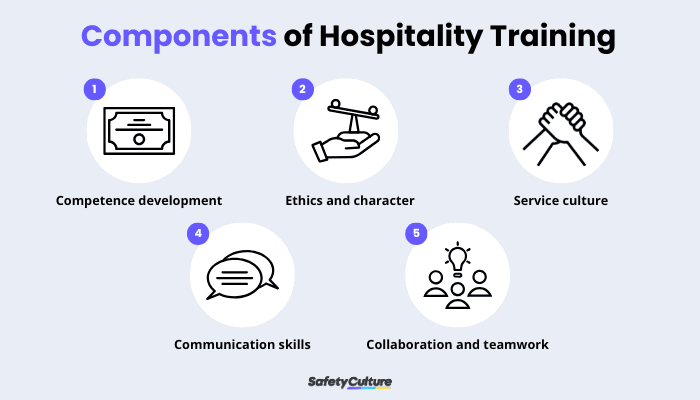
As a cornerstone of the 5Cs, this pillar focuses on the technical and practical skills required for operational efficiency. Whether in front-desk management or food safety, a well-managed hospitality facility ensures consistent, high-quality service at every touchpoint.
Standard operating procedures (SOPs)
Service workflows and quality standards
Health, safety, and compliance fundamentals
Values like integrity, empathy, and respect are vital to service excellence. By embodying these principles, employees better represent the brand and approach every guest interaction with a professional mindset.
Workplace ethics and accountability
Emotional intelligence and empathy
Brand representation and conduct
A focus on the guest builds a genuine commitment to their happiness and consistent, high-quality service. This mindset encourages employees to do more than just the bare minimum, creating memorable moments instead of just completing tasks.
Service excellence standards
Guest journey mapping
Personal responsibility for outcomes
Refining verbal, non-verbal, and intercultural communication allows staff to interpret and address guest needs with clarity. It ensures that teams can connect with diverse guests and provide courteous solutions.
Verbal and non-verbal communication
Active listening
Cross-cultural communication
Seamless departmental collaboration doesn't happen by chance, it’s built and intentionally designed. Integrating reception, housekeeping, and F&B (food and beverage) into a unified team requires constant instruction and reminders:
Interdepartmental workflows
Conflict resolution and problem-solving
Team-building and accountability
Since one size doesn't fit all, hospitality management training programsshould be flexible and made to fit the specific needs of each team. Here are some types to integrate into a comprehensive curriculum:
Orientation and onboarding - This welcome phase is for new hires, usually focused on brand values, property layout, guest demographics, and company hierarchy.
Service (soft) skills training - This focuses on how staff interact with guests. Soft skills like active listening, body language, and professional etiquette are taught here.
Technical (job-specific) training - This covers hard or technical skills required for specific roles, including the practical manual for daily operations.
Health, safety, and compliance - A non-negotiable for compliance, this ensures that the environment is safe for both guests and employees.
Conflict resolution - This training gives staff the tools to stay calm and solve problems, ensuring difficult situations are handled well.
Hospitality training is inherently challenging due to high turnover, rotating shifts, and constant service demands. Without a structured approach, teams can lose alignment, causing service quality to suffer. Adopting these strategies helps companies build a cohesive and capable workforce that can thrive under pressure.
Training should be practical and directly connected to daily work. Engaging content improves retention and motivation. Hospitality training programs should have interactive formats (e.g., simulation, role-playing, mobile microlearning modules) to help employees see the immediate relevance of the course and are more likely to apply skills consistently.
Consistency is critical, especially for brands that operate in different jurisdictions. Standardizing procedures guarantees uniform service and eliminates performance discrepancies. It also reinforces standards while allowing minor adaptations locally.
Safety and hygiene directly affect guest trust, which impacts regulatory compliance and operational continuity. Strength in this capacity builds employee confidence and minimizes accidents.
Training shouldn't stop after onboarding; it is an ongoing journey. Continuous development empowers employees to refine their skills in real-time environments, helping them adapt to evolving guest expectations while supporting long-term career growth.’
Evaluation turns training efforts into measurable results. By tracking key metrics (e.g., guest satisfaction, staff retention, and performance reviews), the impact of the programs can be validated, allowing managers to pivot strategies for continuous improvement.
Waldorf Astoria, a popular luxury hotel brand in Sydney, was able to shift from paper checklists to mobile audits, helping their teams standardize inspections, capture photos and audio, and visualize performance data in dashboards. With clear and accurate information, the company highlights areas that require skill reinforcement, supporting more consistent and elevated service delivery.
SafetyCulture is a mobile-first operations platform adopted across industries such as manufacturing, mining, construction, retail, and hospitality. It’s designed to equip leaders and working teams with the knowledge and tools to do their best work—to the safest and highest standard.
Revolutionize training by creating immersive modules deployed through interactive formats. Empower cross-departmental staff to master brand standards using mobile audits and visual verification, allowing leadership to pinpoint retraining needs instantly. Ensure consistent skill development and operational excellence across global regions through this unified platform
✓ Save time and reduce costs
✓ Stay on top of risks and incidents
✓ Boost productivity and efficiency
✓ Enhance communication and collaboration
✓ Discover improvement opportunities
✓ Make data-driven business decisions