Importance
The hospitality industry faces challenges such as high turnover rates and rising guest expectations. Effective hospitality employee onboarding is essential for smart hospitality management, helping retain staff and ensure guest satisfaction. A hospitality staff onboarding checklist can help:
Reduce turnover: Checklists provide structure to onboarding, addressing high turnover rates in the hospitality industry. They help new hires feel welcomed, supported, and prepared.
Maintain guest satisfaction: Having a checklist on hand helps new staff better understand how things are done. This allows them to understand the company’s service standards and deliver a smoother, more reliable customer experience.
Improve productivity and consistency: A checklist provides straightforward instructions to complete role-specific tasks more efficiently. It also ensures every new hire gets the tools and training they need to deliver the best performance.
Strengthen safety and compliance: With a checklist, establishments can provide consistent onboarding, reducing skill gaps that can lead to workplace accidents. Additionally, it offers proof of compliance during audits, inspections, and investigations.
What to Include in a Hospitality Staff Onboarding and Training Checklist
Hospitality staff onboarding and training checklists must cover essential areas to promote a positive work environment and exceptional guest experiences. Here are some sample checklist items to include for each stage of the onboarding and training process.
Pre-Onboarding and HR Basics
Job offer, acceptance, and start date
Legal and payroll forms (e.g., tax forms, direct deposit, eligibility to work, emergency contact)
Employee handbook and key policies (e.g., code of conduct, attendance, sexual harassment)
Uniform requirements, schedule, and where to report on day one
System access setup (e.g., door access, timeclock, email or messaging app, POS or PMS login)
Day-One Welcome and Orientation
Welcome by the manager or supervisor and team introductions
Brief story of the business (brand, history, mission, values, and guest promise)
Site tour covering entrances and exits, guest areas, kitchen or back-of-house, staff areas, lockers, and emergency exits
Review of basic rules (e.g., attendance, breaks, phone use, tipping rules, uniform and grooming standards)
First-day buddy/mentor assignment
Safety, Compliance, and House Rules
Induction training session on hazards and procedures
Emergency procedures covering evacuation routes, alarms, and shelter locations
Incident reporting for accidents, near misses, security concerns, lost-and-found, and guest injuries
Chemical safety (e.g., storage locations, labeling, PPE usage, and safe use for housekeeping and kitchen staff)
Guest privacy and data security when handling IDs, payment cards, room numbers, and other sensitive information
Service Culture and Soft Skills
Brand standards for greeting and welcoming guests (e.g., body language and tone of voice) and communication basics like non-verbal cues and polite phrasing
Anticipating guest needs and upselling (offering upgrades or special packages)
Handling complaints and managing conflict with difficult guests
Teamwork expectations (internal customer mindset and respectful communication across departments)
Role-Specific Skills and SOPs
This section breaks down the technical skills required for each role. We’ve listed some examples below:
Role | Checklist items to include for training |
Front desk/reception | Check‑in/check‑out flow, reservations, payment handling, PMS basics, room moves, guest requests, logbook use |
Housekeeping | Room cleaning sequence, public area standards, cart setup, linen handling, reporting maintenance issues, chemical safety, do‑not‑disturb rules |
Restaurant servers/hosts | Steps of service, table management, POS use, menu knowledge, allergen protocols, timing, upselling, handling complaints |
Bar staff | Responsible service of alcohol, ID checking, drink recipes, POS use, bar closing and cash handling procedures |
Maintenance | Work order process, prioritization of issues, guest‑safe repairs, documentation, communication with the front desk |
Requirements to Consider
One benefit of using a checklist for hospitality staff onboarding is that it enhances compliance by clearly outlining the steps needed to meet health and safety standards in the hospitality industry. Below are some legal considerations to keep in mind:
Core employment and paperwork requirements: Right-to-work documents, tax and payroll forms, as well as wage and pay notices
Mandatory policy acknowledgments: Anti-discrimination and harassment policies, pregnancy and family protection, and wage and scheduling ordinances
Mandatory training and certifications: Sexual harassment prevention, workplace safety, and food safety
Regional requirements: Local mandates like Illinois’ Right to Privacy in the Workplace Act and Chicago’s Fair Workweek ordinance
Documentation and audit practices: Background checks, training and payroll records, timecards, etc.
How to Use a Hospitality Staff Onboarding and Training Checklist
We’ve outlined the best practices to help you get the most out of your hospitality staff onboarding and training checklist.
Break It Into Clear Phases
A checklist for onboarding and training hospitality staff covers many areas. It’s important to divide it into different sections to make it easier for checklist users to follow. You can split it into the following phases:
Pre‑boarding: contract, paperwork, logins, welcome email, first‑week schedule, uniforms, workspace setup
Day 1: welcome, tour, safety basics, culture and values, team introductions
Week 1: core job skills, shadowing, basic SOPs, first performance expectations
First 30–90 days: advanced tasks, cross‑training, formal feedback, and sign‑off on key competencies
Assign Owners and Timelines
Hold someone accountable for completing your onboarding checklist to ensure all areas are covered from the moment your new hires start. Confirm that team members’ expertise aligns with each task to guarantee effective execution of every checklist item. Set expectations through timelines to prevent the onboarding process from going on forever.
Mix Training Formats
The hospitality industry includes various roles that can benefit from different training methods. It’s essential to strike the right balance among these formats to optimize your training program:
Formal briefings
Job shadowing
Hands‑on practice
Short e-learning or microlessons
Role‑plays (for guest complaints, service recovery, and upselling) to practice handling tricky situations
“Teach‑back” moments, where you ask the new hire to show or explain the process to validate comprehension
Tie Every Item Back to Your Brand and Guest Experience
When using the checklist to evaluate your new hire, refer to your business’s specific standards or service philosophy. Emphasize behaviors that demonstrate your values in action. Include real examples and scenarios from your establishment, such as busy check-in days, VIP arrivals, managing overbookings, and handling late-night requests.
Evaluate Feedback, Not Just Sign-Offs
Checklists are not the same as scorecards. They’re two-way feedback tools that allow both trainee and manager to share input, spot issues early, and refine the onboarding and training process over time. Here are some ways to get better insights from your checklist:
Add checkpoints (end of week 1, 30, 60, 90 days) with space for both manager and employee comments.
Ask what felt clear, what was confusing, and where they still feel uncertain, then update future checklists based on that.
Track simple metrics like time‑to‑independent‑shift, error trends, or guest feedback to see if onboarding is actually working.
Keep It Simple, Visible, and Digital
Easy-to-use, accessible checklists are more likely to produce valuable results. Use clear, straightforward actions (e.g., “Shadow senior front desk on check‑in for 2 hours”) instead of vague topics (“Front desk training”). Make it easy to access by turning it into a digital checklist, learning management system (LMS), or shared drive that updates live.
Sample Hospitality Staff Onboarding and Training Checklist Report
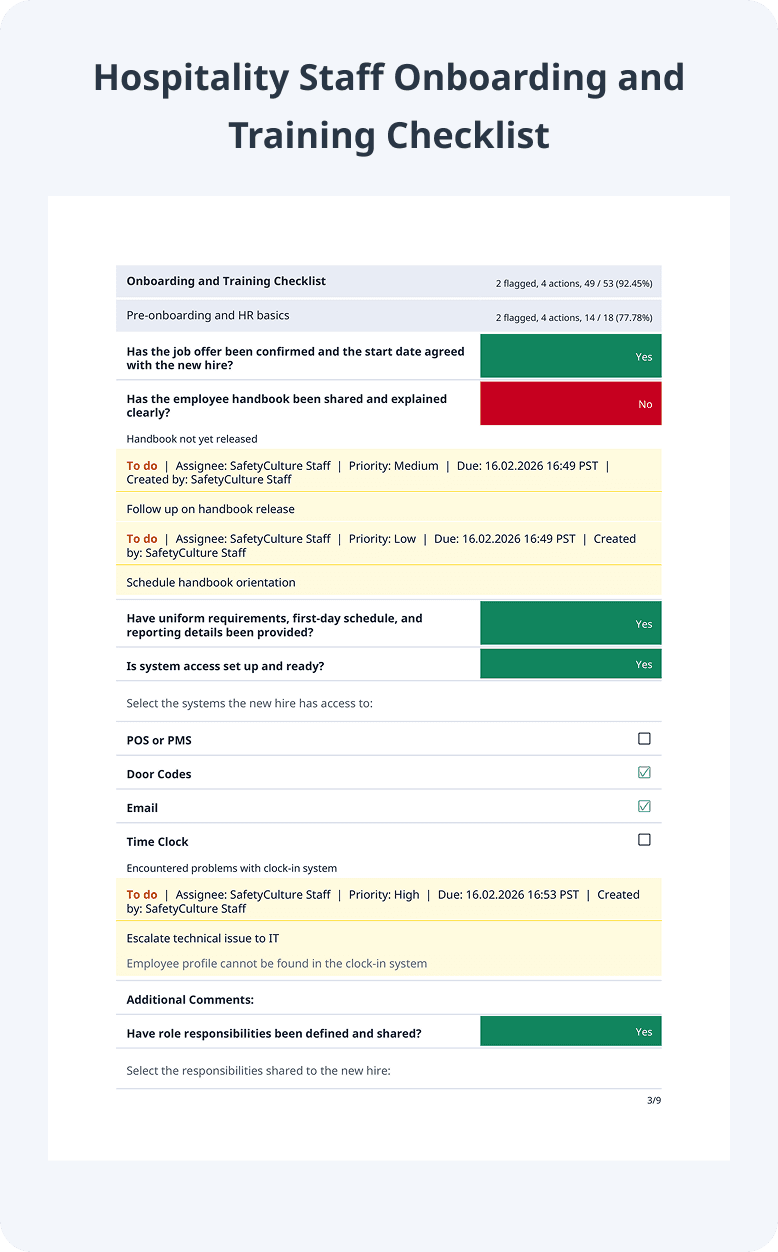
Here’s a sample report to show you what a hospitality staff onboarding and training checklist would look like:
Preview Hospitality Staff Onboarding and Training PDF Report