Learn About Oil Storage & Related Regulations
Find out about the oil storage regulations in place to protect the environment and public health.

Find out about the oil storage regulations in place to protect the environment and public health.
Published 28 Apr 2026
Article by
7 min read
Oil storage keeps petroleum products and other oils in large, specialized containers for long periods. These containers, or tanks, help to facilitate the safe, efficient, and reliable storage of crude oil and other petrochemical products.
These tanks can hold a wide variety of crude oil and refined petroleum products, from diesel and gasoline to fuel oils, all stored for long-term use to meet future energy demands.
Oil storage is an integral part of the oil transportation process as it helps to ensure the safe delivery of these essential resources. Storage capacity varies according to the type and volume of the product.
Oil storage regulations are designed to protect the environment and public health by ensuring that oil stored in tanks meets specific safety standards and Occupational Safety and Health Administration (OSHA) requirements. These regulations are intended to prevent spills and leaks from causing harm to people or the environment.
They cover both onshore and offshore operations, tank design, containment systems for tank overflows, oil spill prevention plans, and emergency protocols for onshore operations. For offshore operations, additional requirements may include double-walled containment systems and remote sensing technologies that detect oil leaks.
In addition to outlining the technical requirements of oil storage facilities, these regulations also detail the responsibilities of operators who store various petroleum products. These include properly maintaining equipment and reporting any incidents related to the storage of oil or transportation of petroleum products.
Some benefits for following oil storage requirements include the following:
Avoiding accidents that could be costly and put human lives at risk
Proper measurements when storing hazardous materials safely and securely
Lower rates and insurance premiums from insurers
Protection from hefty fines or market bans for code violations
Both the US OSHA and Environmental Protection Agency (EPA) have established regulations for oil storage tanks, which include requirements for tank design, containment systems, and emergency response plans.
In general, oil storage compliance regulations address the following issues:
Types of containers for storing oil
Storage capacity of a container based on its size
Inspection of oil storage containers and equipment
Qualifications required for oil storage workers
Below are the regulations for different storage tanks:
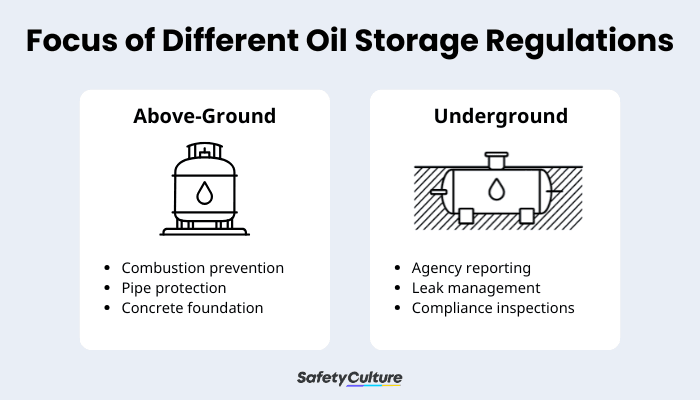
Focus of Different Oil Storage Regulations
OSHA’s standards for above-ground storage tanks are comprehensive. Key things to be mindful of include the following:
There should be no combustion in above-ground tanks, regardless of whether they are stored indoors or outdoors.
Above-ground and indoor storage tanks require the painting of pipes to guard against corrosion.
It is crucial to construct above-ground oil storage tanks on concrete islands to minimize the chance that out-of-control vehicles will strike them.
OSHA has extensive regulations to be followed when storing fuel tanks above ground. For example, the government specifies the minimum distance a tank must be away from any structure.
Regulations for underground fuel storage tanks include the following requirements:
When installing underground storage tanks, owners must notify the state agency, and sellers must explain this notification process to purchasers.
Tanks used underground must meet specific performance standards, especially since these are most commonly used in gas stations.
If a qualified state official believes the owner of an underground storage tank will be able and willing to address a tank leak (or the possibility of one), that official may require that owner to do so.
Routine inspections are required if underground storage tanks are within 1,000 feet of a drinking well or community water system.
The safety and security of oil storage tanks rely on strict design standards. Each type of tank follows specific guidelines to prevent spills, protect against corrosion, and reduce environmental risks.
Oil drums used to store hazardous materials must meet the United Nations (UN) Recommendations on the Transport of Dangerous Goods. These standards include strict testing for portable storage containers, such as drop, leakproof, hydrostatic pressure, stacking, and vibration tests. Once approved, drums display the “UN” marking to show they’re safe for transport. Only oil drum storage used to move hazardous materials, including petroleum products, need to meet these requirements.
IBCs are larger and cubed shaped compared to an oil drum. They are designed for handling large quantities, with reduced handling costs involved and increased durability. Since IBCs are portable, they are required to meet UN standards, but must also comply with additional flammable liquid regulations such as 49 CFR Part 178 Subpart N, DOT/UN certifications, and NFPA 30 for safety.
Fixed tanks or fixed roof storage tanks are large, cylindrical structures permanently installed at a site. They are most often used for products with low vapor pressure to reduce evaporation and vapor emissions. The UN standards don’t apply to these tanks, instead they follow standards set by the American Petroleum Institute (API) and the Oil Firing Technical Association (OFTEC), such as OST T100 for plastic containers, OFS T200, or British Standard 799-5 for metal containers.
Bunded fixed tanks are storage tanks with an outer layer or “bund” that fully encloses the inner tank, essentially serving as a tank within a tank. The bund must have a capacity equal to 110% of the largest tank, or 25% of the total combined volume of all tanks within the bund, whichever is greater. These tanks must also meet local and national standards, such as British Standard 5410 and OFTEC guidelines in the UK.
Some fixed tanks use underground piping to save space and reduce impact risks. While installation and maintenance are more complex, this setup improves safety and keeps above-ground areas clear. Warning tape is buried above the pipes to prevent accidental digging, and plastic-coated pipe with compacted sand helps protect against corrosion or leaks. These tanks follow the same design standards as fixed tanks, with additional requirements for the piping set out in codes such as the International Residential Code (IRC) and International Fuel Gas Code (IFGC).
An underground oil tank is designed to resist corrosion since it’s buried below ground. Being underground helps save space and reduces fire hazards. These tanks are typically reinforced with fiberglass plastic or use cathodic protection to prevent rust and leaks. Because they’re installed below ground, their design must follow common oil storage standards such as those set by Underwriters Laboratories (UL), specifically UL 58 for steel tanks and UL 1316 for fiberglass tanks.
Here is an example of oil storage tank maintenance, specifically for bunded fixed tanks. Tank Technicians, inspectors, and cleaners must do scheduled and preventive maintenance on the following:
Sight Gauges - Secure the sight gauge tube to the tank using brackets so it doesn’t get knocked over. Make sure it includes an automatic closing valve for safety.
Piping - Place fill, draw-off, and overflow pipes away from driveways or forklift paths. Protect exposed sections with barriers and support above-ground pipes using wall brackets.
Delivery Pipes - If a fixed tank has a flexible dispensing pipe, store it in a locked cabinet with a drip tray inside the bund. Make sure exit valves are lockable and kept locked when not in use.
Pumps - Install a valve on the feed line to stop the tank from emptying if the pump or line gets damaged. Keep pumps away from high-traffic areas and lock or disable them when not in use.
Vent Pipes, Taps, and Valves - Keep all pipes, taps, and valves within the bund and ensure oil drains vertically into it. Only taps and valves should have locks and be locked shut when not in use.
Overfill Prevention - Make sure the vent pipe and tank are visible when installing an automatic overfill prevention device. These systems stop oil flow or alert you when the tank is full.
Screw Fittings or Fixed Couplings - Use screw fittings or fixed couplings when filling a fixed tank. Check them regularly to ensure they aren’t corroded or blocked.
SafetyCulture is a mobile-first operations platform adopted across industries such as manufacturing, mining, construction, retail, and hospitality. It’s designed to equip leaders and working teams with the knowledge and tools to do their best work—to the safest and highest standard.
Promote a culture of accountability and transparency within your organization where every member takes ownership of their actions. Align governance practices, enhance risk management protocols, and ensure compliance with legal requirements and internal policies by streamlining and standardizing workflows through a unified platform.
Save time and reduce costs
Stay on top of risks and incidents
Boost productivity and efficiency
Enhance communication and collaboration
Discover improvement opportunities
Make data-driven business decisions