
Industrial Maintenance: Guarantee Uptime Through Asset Reliability
Learn how industrial maintenance supports safe and efficient production through preventive strategies, skilled teams, and modern technology.
Published 7 Nov 2025
Article by
7 min read
What is Industrial Maintenance?
Industrial maintenance is the strategic management of industrial-grade equipment, tools, and systems through preventive, predictive, and corrective practices. Its core purpose is to maximize asset reliability, ensure operational efficiency, and support continuous improvement by conducting regular inspections, calibrations, lubrications, repairs, and technology-driven optimization.
Importance
Compared to general maintenance tasks, managing industrial assets involves a high degree of complexity, primarily due to the scale and criticality of massive and interconnected equipment and systems. Here are other reasons why this is vital across sectors, from manufacturing to healthcare:
Improves equipment reliability - Industrial manufacturers lose billions of dollars annually due to downtimes caused by malfunctioning equipment. The failure of one, seemingly minor component can shut down an entire production line, resulting in catastrophic downtimes.
Extends asset lifespan - Aging equipment is expected to be the leading cause of unscheduled production stoppages. Proactive strategies replace failure-driven repairs, maximizing the equipment’s useful life and lowering the high cost of equipment replacement.
Increases safety - The US Federal Motor Carrier Safety Administration found that vehicle failures contribute to truck crashes in the country. Maintaining critical components prevents the risk of explosive, electrical, and mechanical hazards that put workers in danger.
Achieve operational excellence
Cultivate a culture of excellence with our digital solutions that enhance efficiency, agility, and continuous improvement across all operations.
Application of Key Maintenance Methodologies
Industrial maintenance relies on several methodologies to keep systems, equipment, and facilities running smoothly. Because each approach has a unique purpose, understanding the distinction helps industrial maintenance technicians tailor the most appropriate intervention for any given scenario.
Type of Maintenance | Purpose and Importance | Example |
Preventive | Regular inspections, cleaning, and part replacements to address wear and tear early | Hospitals conduct PM on MRI machines and ventilators at fixed intervals to ensure accurate performance and patient safety |
Predictive | Data from sensors, Internet of Things (IoT) devices, and analytics help predict when equipment might fail, facilitating just-in-time maintenance | Car manufacturing plants use vibration and temperature sensors on conveyor motors to detect early signs of failure and schedule timely repairs |
Corrective | Equipment restoration is done after an unexpected fault or minor failure is detected to minimize potential delays and immediately resume operations | Power plants perform industrial gearbox maintenance when abnormal pressure levels are detected on malfunctioning turbine valves, preventing subsequent energy loss. |
Condition-Based | Monitoring equipment performance parameters (e.g., temperature, vibration, oil quality) and conducting maintenance tasks when indicators show deterioration | Airlines use condition-based maintenance techniques to analyze engine oil debris and vibration readings and to determine if the aircraft engine requires servicing |
Planned | Scheduling maintenance activities based on production schedules, equipment history, or known failure patterns | Property managers conduct industrial Heating, Ventilation, and Air Conditioning (HVAC) maintenance during spring and fall, ensuring tenant comfort and preventing unexpected failures during summer and winter seasons |
Overcoming Challenges
Managing the reliability of industrial systems and heavy equipment is a daunting, complex endeavor, especially when maintenance for both new and legacy assets is still handled manually. Organizations must proactively recognize and address these pressing challenges:
High failure costs - Two-thirds of industrial businesses experience unplanned outages at least once a month, draining hundreds of thousands of dollars per month. Manual oversight cannot match the speed of real-time data when flagging defects and potential failures.
Disconnected equipment and systems - Facilities that still operate with older machinery will struggle to integrate new systems. Overcoming this critical bottleneck requires modernization, if funding allows.
Skills gaps - The shortage of skilled labor also contributes to more breakdowns and safety risks. Implementing comprehensive industrial maintenance training (e.g., on-the-job training, mentorship programs) is crucial.
Inventory, spare parts, and supply chain delays - The inability to forecast issues can also lead to stock-outs, higher costs for emergency procurement, and extended downtimes . Critical spares can be optimally stocked by carefully monitoring inventory.
Heavy compliance burden - Industrial facilities are required to uphold numerous safety, environmental, and operational regulations. Careful record-keeping minimizes the risk of non-compliance and subsequent consequences.
Must-Have Solutions for Industrial Maintenance
Outdated processes and limited automation are the underlying issues behind the challenges mentioned above. These problems can be overcome by adopting digital, data-driven tools, such as the following:
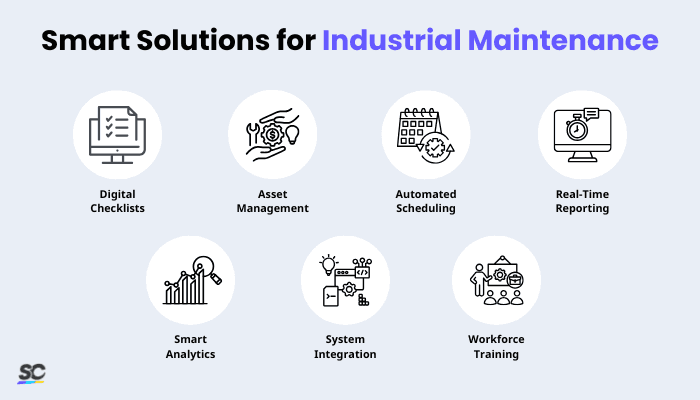
Smart Solutions for Industrial Maintenance
Digital Checklists
A digital system replaces paper-based inspections, helping standardize procedures across multiple industrial sites and ensuring inspections follow the same safety and quality standards. These digital checklists often come with the following capabilities:
Photo and video attachments for accurate, on-site information
Offline functionality to complete inspections even without internet access
Customization options to tailor forms to specific assets, locations, and maintenance tasks
Centralized Asset Register and Management Systems
Utilize a centralized digital record to track each asset’s life cycle, from installation to decommissioning. Understanding the equipment's condition history and performance data optimizes industrial asset utilization. It also supports data-driven repair or replacement decisions.
The register can also be used for industrial property maintenance, ensuring the upkeep of common areas (e.g., parking lots), utilities, and security systems.
Automated Maintenance Scheduling and Work Orders
Automatically plan and assign maintenance tasks based on time intervals, usage data, or condition indicators. Generating and prioritizing work orders in an industrial setting ensures maintenance activities are completed before issues escalate, significantly reducing unplanned downtime and costly disruptions.
Simplify maintenance scheduling for your business with SafetyCulture
Streamline your operations with usage-based maintenance using our intuitive management software.
Real-Time Issue Reporting Tools
Streamline interdepartmental communication with a digital reporting tool that empowers employees to instantly record, categorize, and escalate maintenance or safety issues. This ensures prompt documentation, tracking, and resolution, simultaneously cultivating a strong culture of accountability.
Smart Analytics Dashboard
Automatically record inspection data by integrating a reporting system with robust analytics into industrial maintenance workflows. On top of driving improvements, this feature generates compliance documentation, such as:
Lockout/tagout procedures for industrial electrical maintenance
Safety data sheets for handling hazardous materials
Inspection certificates
Permit to work forms
Preventive maintenance records
System Inoperability
Connecting all tasks and needs into one platform helps enhance workflows. Seamlessly connect industrial maintenance software with other business systems, such as inventory, Enterprise Resource Planning (ERP), and IoT platforms. This allows predictive insights that drive smarter maintenance planning and increase operational efficiency.
Workforce Development Platform
Build technician competency in using modern maintenance tools, automation systems, and data analytics by structuring programs that combine digital learning tools, on-the-job training, and certification tracking. Using a platform that has mobile support is best, as it allows industrial maintenance workers to learn anytime and anywhere, all at their own pace.
A Simple Rollout Plan
Digitizing complex industrial maintenance workflows cannot happen overnight. A strong foundation and a strategic, phased approach are paramount. This structured maintenance plan outlines the necessary steps:
Identify critical assets - Pinpoint the industrial equipment or system that has the greatest impact on safety, production, and cost if it fails. Focusing on where failures hurt most helps prioritize maintenance resources efficiently.
Develop standardized checklists - Convert existing preventive maintenance forms and safety inspections into digital templates. This ensures uniformity across sites and enables quick data capture and real-time issue reporting.
Configure asset records - Build comprehensive digital profiles for every asset, including details such as maintenance history, manuals, warranty documents, and related media. Assign QR codes or NFC tags so technicians can instantly access records in the field.
Automate schedules and assign responsibilities - Industrial maintenance programs should be automated based on time intervals, equipment usage, or condition data. Include protocols for emergency maintenance so teams can respond to unexpected breakdowns or safety incidents immediately.
Integrate selectively - Once the maintenance foundation is solid, start integrating systems that add clear value. For example, link the maintenance platform with business intelligence tools, telematics, or document repositories to enhance visibility and data flow.
Train and empower the team - Invest in the workforce by launching targeted micro learning sessions. Consider utilizing in-app updates as well to keep teams informed about new tools, workflows, and safety reminders.
Optimize Asset Reliability Through Industrial Maintenance with SafetyCulture
Why Use SafetyCulture?
SafetyCulture is a mobile-first operations platform adopted across industries such as manufacturing, mining, construction, retail, and hospitality. It’s designed to equip leaders and working teams with the knowledge and tools to do their best work—to the safest and highest standard.
Streamline processes, eliminate bottlenecks, enhance resource utilization, and build an agile and scalable infrastructure with SafetyCulture. Strive for operational excellence to boost competitive advantage, foster sustainable growth, and deliver long-term value.
Save time and reduce costs
Stay on top of risks and incidents
Boost productivity and efficiency
Enhance communication and collaboration
Discover improvement opportunities
Make data-driven business decisions
FAQs About Industrial Maintenance
Related articles
Facility Management
Maintenance

The Ultimate Guide to Warehouse Layout Optimization
Learn effective strategies in warehouse layout optimization to maximize space, streamline flow, and support efficient production operations.
Facility Management
Maintenance

Workplace Management: The Ultimate Guide
Learn how workplace management drives safe, efficient operations through frontline visibility, consistency, and continuous improvement.
Facility Management
Maintenance

A Guide to Retail Facility Management
Improve store performance with effective retail facility management, and learn its key components, challenges, and top solutions for success.