Autonomous Vehicle Maintenance for Safety and Asset Performance
Explore how disciplined maintenance practices and technician readiness keep autonomous systems safe, reliable, and operational.
Explore how disciplined maintenance practices and technician readiness keep autonomous systems safe, reliable, and operational.
Published 5 May 2026
Article by
5 min read
Autonomous Vehicle (AV) maintenance involves using Artificial Intelligence (AI), sensors, and data to self-diagnose, predict, and even perform minor upkeep for workplace vehicles. It transformshuman-led tasks into automated systems that alert users or technicians to issues, improving uptime and safety and reducing reliance on manual checks. This is particularly important for routine care like cleaning, lubrication, and early problem detection, especially in fleet management.
As vehicle technology advances, maintaining autonomous vehicle safety requires a shift from routine mechanical checks to predictive, software-driven monitoring. Below is how autonomous vehicle maintenance differs from other maintenance types.
Prioritizes predictive diagnostics using onboard sensors, telematics, and software analytics.
Involves regular inspection, cleaning, and calibration of Light Detection and Ranging (LiDAR), radars, cameras, and other perception hardware.
Depends heavily on software updates, AI model validation, and system integrity checks.
Shifts cost drivers from mechanical wear to technology calibration, sensor accuracy, and system reliability
Centers on frequent mechanical servicing due to combustion-related wear and heat.
Requires regular oil changes, typically every 3,000 miles (4,828 kilometers), along with spark plug and air filter replacements.
Includes transmission servicing, exhaust inspections, and fuel system checks that increase service frequency and cost.
Relies on fixed service intervals rather than real-time condition monitoring.
Eliminates engine oil changes and most combustion-related service tasks.
Focuses on tire rotations, battery coolant checks, and cabin air filter replacements.
Experiences reduced brake wear due to regenerative braking systems.
Benefits from longer service intervals and lower overall maintenance costs compared to ICE vehicles.
Combines internal combustion engine servicing with electric system monitoring.
Still requires oil changes and engine-related checks, but at reduced frequency.
Includes battery health monitoring and inspections of the regenerative braking system.
Maintains predictable maintenance schedules with total costs comparable to or lower than ICE vehicles.
Maintenance on AVs is shifting from a traditional, reactive, time-based model to a proactive, data-driven, and predictive approach. The following shows how autonomous vehicles are maintained to ensure reliable performance.
Internet of Things (IoT) sensors collect real-time data on braking, steering, and sensor health.
AI and machine learning algorithms analyze this data to detect anomalies and forecast potential failures.
Maintenance shifts from fault code responses to proactive alerts, reducing downtime and optimizing service schedules.
LiDAR, radar, and camera sensors are cleaned using fluid-based methods (telescopic or ring nozzles) or mechanical techniques (rotating covers or wipers).
Sensors trigger cleaning when it detects 15-30% dirt coverage.
Image processing software differentiates between rain and debris for targeted cleaning.
Over-the-air (OTA) updates deliver bug fixes, performance enhancements, and cybersecurity patches remotely.
Engineers perform continuous self-diagnostics, often using digital twin technology for simulation and predictive testing.
Vehicles can self-navigate to service depots for routine inspections.
Operators conduct daily CIL (clean, inspect, lubricate) checks, 5S audits, and abnormality reporting.
Technicians perform more in-depth calibrations and maintenance of tires, brakes, and batteries in accordance with manufacturer schedules.
Maintaining and repairing autonomous vehicles comes with challenges that go far beyond traditional car maintenance. Technicians need to have skills to diagnose and repair software and hardware issues.
Here are some of the challenges in repairing autonomous vehicles:
The complexity of AV systems requires a holistic understanding of how software, sensors, and hardware interact to maintain safe operation.
A single malfunctioning sensor or camera can disrupt multiple systems, making diagnosis more complicated than with traditional vehicles.
The connected nature of these vehicles increases the risk of cyberattacks on both the car and its maintenance systems.
Even fully autonomous vehicles may still require human intervention in the event of on-road failures or unexpected malfunctions.
Faulty or dirty sensors can provide misleading data, affecting vehicle performance and safety.
Predictive diagnostics can alert technicians before failures occur, but human oversight remains essential for proper repairs.
As autonomous vehicle technology continues to advance, so too does the need for effective maintenance practices. Here are some best practices to consider when maintaining AVs:
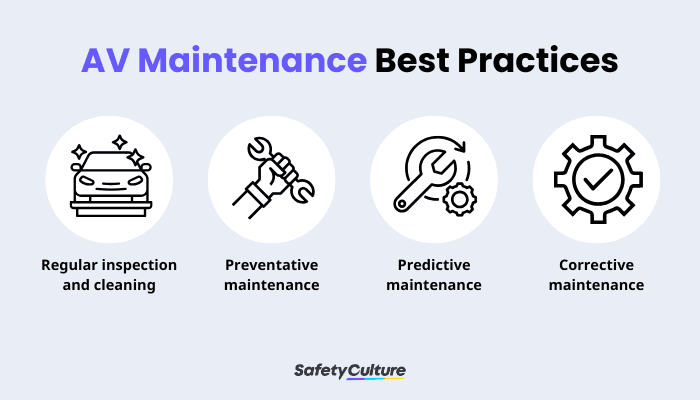
Regular inspection and cleaning: Periodically clean the vehicles to remove dust, dirt, and debris that can interfere with sensors and mechanical components. Additionally, visually inspect for leaks, cracks, or misalignments during this process.
Preventative maintenance: Conduct component calibration, lubrication, and part replacement to prevent future failures. Perform this maintenance every six months for better reliability.
Predictive maintenance: Catch potential problems early by implementing sensors and AI to monitor vehicle performance in real time. This enables timely repairs and reduces the risk of unexpected breakdowns.
Corrective maintenance: When a failure occurs, corrective maintenance is necessary to restore the vehicle to proper functioning. It can range from minor repairs, such as replacing a broken part, to more extensive repairs, such as an engine overhaul.
SafetyCulture is a mobile-first operations platform adopted across industries such as manufacturing, mining, construction, retail, and hospitality. It’s designed to equip leaders and working teams with the knowledge and tools to do their best work—to the safest and highest standard.
Streamline processes, eliminate bottlenecks, enhance resource utilization, and build an agile and scalable infrastructure with SafetyCulture. Strive for operational excellence to boost competitive advantage, foster sustainable growth, and deliver long-term value.
✓ Save time and reduce costs
✓ Stay on top of risks and incidents
✓ Boost productivity and efficiency
✓ Enhance communication and collaboration
✓ Discover improvement opportunities
✓ Make data-driven business decisions
In this article