
Autonomous Vehicle Safety: The Future of Driving and its Risks
Learn everything you need to know about self-driving vehicles, its risks, and what they mean for the future of driving.

Published 17 Oct 2025
Article by
5 min read
What is Autonomous Vehicle Safety?
Autonomous vehicle safety is a set of safety protocols, procedures, and guidelines for self-driving cars. These safety measures aim to ensure that autonomous vehicles are safe for users, passengers, and pedestrians by using sensors and other technologies to guide a vehicle autonomously through roadways while avoiding obstacles or potential traffic dangers.
5 Levels of Vehicle Autonomy
According to the Society of Automotive Engineers (SAE), fully autonomous vehicles are still in development, however, many car and truck brands have incorporated semi-autonomous driving features in their new vehicles.
A vehicle’s autonomy can be divided into 5 stages:
Level 1 automation: Provides basic driver assistance like cruise control, acceleration, and lane-keeping.
Level 2 automation: Performs advanced cruise control and emergency braking while requiring constant driver supervision.
Level 3 automation: Handles some safety-critical functions in specific situations, but relies on the driver to take control when needed.
Level 4 automation: Operates autonomously in most conditions, except in unmapped locations and unfavorable weather conditions.
Level 5 automation: Functions fully autonomously under all conditions without human input.
Safety Risks of Autonomous Vehicles
While beneficial for many reasons, the use of self-driving vehicles is not without risks. Autonomous vehicles present unique safety challenges due to their heavy reliance on sensors, software, and connectivity. While these technologies are designed to reduce human error, several safety risks still persist. Some of the dangers include:
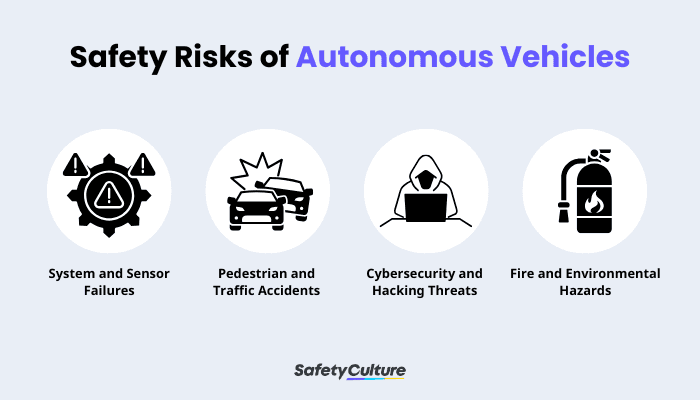
System and Sensor Failures
An autonomous system poses a risk when its sensors misinterpret its environment. It's not uncommon for self-driving cars to struggle to recognize obstacles or lane markings, especially in poor weather or low-visibility conditions. Moreover, these errors can lead to major road incidents because most existing road infrastructure is not yet equipped to detect or compensate for the mistakes, errors, or deficiencies of autonomous vehicles.
Pedestrian and Traffic Accidents
Because human or driver behavior can be unpredictable, self-driving cars often struggle to respond appropriately to pedestrians, cyclists, or erratic drivers. This unpredictability—especially during left turns, merges, or sudden lane changes— can make it difficult for autonomous systems to react quickly and safely. At the same time, too much trust is put in these vehicles’ abilities to predict these behaviors, leading to drivers becoming overly confident and slower to intervene when something goes wrong. Combined with unpredictable changes on the road, this can further increase the risk of accidents in critical moments.
Cybersecurity and Hacking Threats
Self-driving cars are especially vulnerable to cyberattacks because they rely heavily on constant connectivity. Specifically, these cars are at risk of being hacked, which could lead to stolen vehicles, property, or personal information, and possibly be used in acts of terror. Hackers might take control of crucial systems like steering or braking, disrupt traffic, or exploit autonomous vehicles for malicious purposes, highlighting the serious security challenges that come with connected technology.
Fire and Environmental Hazards
Autonomous vehicles rely on lithium-ion batteries to power their systems, but these batteries come with significant safety concerns. When overcharged, damaged, or even exposed to extreme temperature, they are prone to overheating and catching fire, leading to an incident known as a "thermal runaway." These fires are notoriously hard to extinguish, often reigniting even after being put out. Inside a vehicle, these fires and fumes can spread quickly, presenting greater risks to passengers, first responders and even the surrounding environment.
Autonomous Vehicle Regulations
There are several major regulations and frameworks currently governing autonomous vehicle safety worldwide. These efforts aim to modernize old vehicle safety laws to address the unique risks of vehicles equipped with Automated Driving Systems.
For example, in the US, the Department of Transportation (DOT) and the National Highway Traffic Safety Administration (NHTSA) have announced a new initiative called the Automated Vehicle Framework, which aims to guide the safe and responsible growth of automated vehicle technology. One of its guiding principles is to ensure automated vehicle operations on public roads remain safe by maintaining and improving crash and incident reporting. The goal is to focus on collecting critical safety data while removing unnecessary or duplicate reporting requirements.
Improve your EHS Management
Cultivate a safe working environment and streamline compliance with our EHS solutions.
How Technology Keeps Autonomous Vehicles Safe
Technology plays a crucial role in helping fleets stay competitive by enhancing safety, efficiency, and compliance through features such as real-time driver tracking and behavior assessment. Fleet managers can monitor driver activities to detect risky behaviors, enabling timely disposal of assistance when needed.
Some additional ways digital tools can enhance safety include the following:
Provides digital mobile-ready inspection templates for vehicle and equipment checks
Schedules autonomous vehicle maintenance and preventive repairs automatically with recurring task assignments
Offers custom dashboards and smart analytics tools for insights into autonomous vehicle usage patterns and safety compliance
Enables drivers to report hazards and vehicle issues instantly with documented evidence online and offline
Streamlines incident reporting and analysis through fleet accident management software capabilities
Ensure Autonomous Vehicle Safety with SafetyCulture
Why Use SafetyCulture?
Like conventional cars; autonomous vehicles will undergo safety inspections to meet all standards. SafetyCulture (formerly iAuditor), a multi-platform safety inspection solution, can help with this.
With SafetyCulture, users can perform the following:
Create a safety checklist from scratch or customize existing templates for autonomous vehicle inspections
Schedule fleet audits and driver assessments to identify any potential risks
Store audit results in the cloud for easy access and record-keeping
Receive automated notifications when safety issues are detected
Capture photos and videos with geo-tagging to identify problem areas quickly
FAQs About Autonomous Vehicle Safety
Related articles
Maritime
Transportation

Inside The World Of Shipyard Management
Learn about the shipyard management process, from planning and construction to commissioning and operation.
Transportation
Automotive
A Comprehensive Guide to Delivery Driver Training
Learn how delivery driver training improves safety, consistency, and frontline readiness across fleets while reducing operational risk.
Automotive
Transportation
Driver Training: How to Improve Safety
Discover driver training programs, understand safety requirements, and learn which certifications are needed for specific industrial roles.