Safe Team Lifting in the Workplace
Discover essential team lifting techniques for safer material handling.
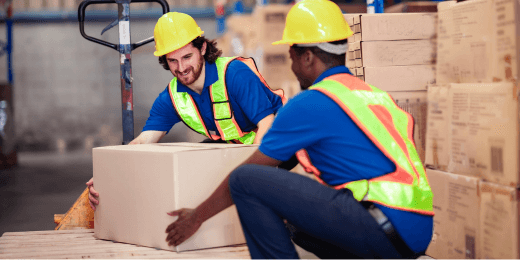
Discover essential team lifting techniques for safer material handling.
Published 15 Dec 2025
Article by
7 min read
Team lifting is a manual handling strategy where two or more people work together to safely move heavy or awkward objects. It requires careful planning and coordinated movement, ensuring everyone lifts at the same time, keeps their back straight, and has a secure footing. With clear instructions from a designated leader, the team minimizes physical strain, significantly reducing the chance of injury while completing the task efficiently.
Musculoskeletal Disorders (MSDs) affect hundreds of thousands of workers across industries. A significant occupational health concern, MSDs’ chronic symptoms can be prevented when workers consistently apply safe lifting practices. Here are other specific benefits of utilizing team lifting manual handling procedures:
Reduced risk of injury: Distributing weight between workers lowers one’s biochemical load, reducing strain on the spine and limbs.
Less lost time and workers’ compensation claims: A structured lift team reduces lost-time injuries and associated hospitalization costs. A study found a 95% reduction in lifting injuries when trained professionals do the work.
Improved efficiency and productivity: Operations become smoother by coordinating movement and clarifying roles before this task. It reduces unnecessary effort and time wasted on corrections.
Enhanced worker satisfaction and morale: Workers who know that a teammate will help with heavy loads feel less anxiety. This also reinforces safe practices.
Higher recruitment and retention: The simple act of implementing team lifting safety programs signals commitment to worker health. This helps employers attract and retain staff.
Team lifting is just one of several manual handling strategies. Assessing the following points helps safety managers determine if it’s the safest and most efficient method for a task:
Coordinated lifting is the optimal choice when two or more workers can share the physical demand and maintain ergonomic posture better together than alone. Team lifting should be used when a load:
exceeds safe single-person lifting;
is awkwardly shaped;
is unstable; and
requires coordinated placement.
Several details determine the number of lifters required and the safest way to maneuver the load. Here are some of the most consequential, aside from the weight, size, and shape:
Center of gravity
Stability of the load
Presence of sharp edges
Shifting contents
Fragility
People with recent injuries, limited mobility, or who are fatigued shouldn’t take part because a mismatch in strength or timing can increase risk. These factors must be prioritized:
Physical capability
Ability to follow synchronized instructions
There should also be a designated leader who cues the lift. This worker should have good communication skills.
A clear, hazard-free path is one of the most important principles of team lifting, supporting coordinated movement and reducing accidents. Inspect the surroundings for the following before the lift starts:
Slip and trip hazards, such as uneven flooring and obstructions
Poor lighting
Tight spaces
Noise levels that could disrupt communication
Environmental conditions (e.g., heat, cold, rain) that could affect lifting safety
Eliminate manual exertion by prioritizing trolleys, hoists, pallet jacks, or vacuum lifters. Sometimes, mechanical aids are unavailable, impractical, or riskier to use. Team lifting becomes the more appropriate choice for these:
Short distances
Tight spaces
Non-repetitive lifts
Regulations on manual handling exist to protect workers from preventable injuries. Understanding and following these rules, from basic ergonomics safety to detailed lifting guidelines, is crucial in creating safer environments.
Region | Regulation | Mandate |
US | Requires safe handling, storage, and movement of materials, including preventing hazards from improper lifting and carrying Obligates employers to protect workers from recognized risks; Team lifting is required when single-person lifting presents clear hazards. | |
UK | Requires employers to avoid hazardous manual handling where possible. Emphasis is on load assessment, worker capability, and selecting the safest handling method. | |
Australia | Safe Work Australia Code of Practice - | Outlines the identification of hazardous manual tasks, assesses biomechanical risks, and implements controls, especially when mechanical aids aren’t feasible |
Canada | Canadian Centre for Occupational Health and Safety (CCOHS) Guidelines and Provincial OHS Regulations | Requires hazard assessments and controls for manual handling; Team lifting is recommended when loads exceed safe individual capacity. |
EU | Manual Handling Directive 90/269/EEC | Obligates employers to minimize manual handling risks, evaluate load characteristics, and ensure workers are trained in safe techniques |
Team lifting safety depends on several core protocols. These protect workers from strains, reduce handling errors, and ensure every stage of the lift, from planning to placement, is controlled, stable, and ergonomically sound.
Conducting a pre-lift toolbox talk helps workers review the load, path, hazards, and lifting plan. Everyone should understand the risks, roles, and sequence to reduce confusion and minimize unsafe movements during the lift.
Lifts should be synchronized and stable. Assign a lead lifter to ensure team call commands and the workers involved lift, walk, and lower loads together. Clear verbal cues prevent sudden shifts, mistimed movements, and uneven load distribution.
Proper lifting posture is key to injury prevention during manual handling. The load should be managed by the body’s strongest muscle groups, not the lower back. Take note of the following to ensure this:
Stance: Position the feet about shoulder-width apart to maximize stability.
Spine: Maintain a neutral (straight) back throughout the entire lift.
Knees and hips: Bend at the hips and knees, not the waist, to lower the body.
Grip: Secure a firm, balanced, non-slip grip on the load.
Power: Drive upward with the leg muscles to initiate the lift.
Begin the movement in sync to prevent twisting and jerking. This reduces imbalances, which might strain the muscles. Follow these team lifting techniques:
Lift on signal.
Rise smoothly using leg power.
Keep the load close to the body.
Safe carrying minimizes awkward postures, potential collisions, and
imbalance when navigating tight or uneven spaces. Walk slowly, avoid turning the torso, and keep communication active to stay aligned with the team.
Controlled lowering protects the back. It also prevents sudden drops, ensuring the load is set down exactly where intended. Follow these instructions:
Lower the object on the signal.
Bend at the knees.
Maintain a neutral spine.
As soon as the load is lowered, check for discomfort. Report any early strain symptoms to prevent cumulative injuries. Assess what went well and discuss improvements to prepare the team for safer lifts in the future.
A reality TV production that operates in a dynamic construction site, The Block was able to streamline its hectic operations with digital templates for daily inductions and random inspections. Collaborative tools have kept their staff safe from workplace hazards, ensuring clear communication and proactive risk mitigation for everyone.
“At the end of the day, we’re a very busy site. There are lots of dangers but we keep them to a minimum — there’s lots of cranes, lots of lifting. It’s paramount we keep everyone safe.”
SafetyCulture is a mobile-first operations platform adopted across industries such as manufacturing, mining, construction, retail, and hospitality. It’s designed to equip leaders and working teams with the knowledge and tools to do their best work—to the safest and highest standard.
Facilitate pre-lift risk assessments, define safe team lifting procedures, and enable incident reporting to identify unsafe practices. Streamline documentation, from audits to issues, and ensure consistent training to uphold compliance with internal policies and regulations. Build and enforce manual lifting safety, empowering teams to follow best practices and continuously improve safety protocols through a unified platform.
✓ Save time and reduce costs
✓ Stay on top of risks and incidents
✓ Boost productivity and efficiency
✓ Enhance communication and collaboration
✓ Discover improvement opportunities
✓ Make data-driven business decisions