Working Alone in a Laboratory: Risks and Regulations
Gain insight into the responsibilities and regulatory requirements of working alone in laboratory environments.

Gain insight into the responsibilities and regulatory requirements of working alone in laboratory environments.
Published 13 Oct 2025
Article by
5 min read
Working alone in a laboratory refers to instances in which a researcher, lab technician, scientist, or chemical engineer conducts research or procedures without supervision or immediate assistance nearby. Doing so can be dangerous, which increases the chances of emergencies escalating from a simple incident to a fatality. For this reason, most organizations require a thorough risk assessment, supervisor authorization, and detailed written procedures before approving any lone work activities in laboratory settings.
Working in a laboratory already involves unique risks, which become even more pronounced when employees work alone. This is why prioritizing lab safety is essential, as the potential hazards can include the following:
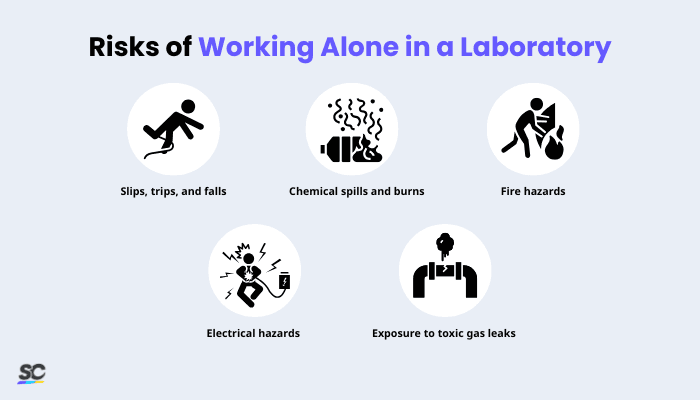
Slips, trips, and falls
Chemical spills and burns
Fire hazards
Electrical hazards and high-voltage equipment risks
Exposure to toxic gas leaks
Ideally, workers should not be left alone in a laboratory unless necessary. In cases where lab personnel need to work alone, these risks can escalate quickly due to the lack of medical assistance, making adherence to safety protocols and guidelines critical.
The US Occupational Safety and Health Administration (OSHA) states that laboratory personnel are exposed to various risks that range from chemical, biological, physical and radioactive hazards, as well as musculoskeletal stresses. Lab workers are also often unaware of such hazards when in the workplace—which makes lone working in a laboratory even more dangerous.
With that said, OSHA has provided extensive laboratory safety recommendations to ensure these hazards are not only mitigated, but, if possible, avoided. Here are some of these guidelines:
Laboratories must have a Chemical Hygiene Plan (CHP), a program that outlines procedures and policies that protect lab workers from chemical health hazards.
Workers must receive training on how to recognize harmful chemicals and exposure symptoms, safe work practices, and emergency procedures.
Medical attention must be offered when exposure incidents occur in any capacity.
Employers must provide adequate Personal Protective Equipment (PPE) suited to the chemical hazards accordingly.
Records of exposures, medical evaluations, and training should be kept on file for traceability.
To supplement these, the OSHA Hazard Communication Standard (HCS) provides additional guidelines to ensure these risks are mitigated by providing clear, accessible and understandable information about chemical hazards. It mandates that hazards and supply are properly assessed and labelled, and that Safety Data Sheets (SDSs) are given to the employers, who must make them accessible to workers and provide proper training.
Additionally, updates in 2025 aligned the HCS with the Globally Harmonized System (GHS), introducing:
standardized hazard classification criteria;
uniform labels with signal words, pictograms, and precautionary statements;
a consistent 16-section SDS format; and
training on new label elements and SDS use.
While these guidelines are meant for lab workers of all types, they are especially important to those working alone. Lone laboratory workers need extra protection, and it’s their employers’ duty to ensure that safeguards are provided to them at all times to ascertain their safety. This is supported by OSHA Standard 1915.84: Working Alone, which emphasizes the need for employers to maintain reliable communication and conduct regular checks with their lone working employees to guarantee immediate help is available if an incident happens.
Similarly, in the UK, the Health and Safety Executive (HSE) requires organizations to conduct risk assessments and ensure that lone workers—especially those in laboratories— have access to emergency communication tools and training. This ascertains lone lab workers always have access to assistance in case of emergency.
The same standard is also applied in Canada. According to the Canadian Centre for Occupational Health and Safety (CCOHS), organizations must implement a safety protocol that includes a reliable check-in system and dependable access to emergency resources. These protocols are an integral part of keeping lone workers safe, especially in environments such as laboratories, where a single vial of chemicals handled incorrectly can pose risks that can easily escalate.
From chemical exposure to delayed emergency response, working alone in laboratories poses unique risks that, if without immediate assistance, can lead to incidents escalating quickly. Technology is helping close this gap, making laboratories safer places for lone workers. In particular, advancements in the field of AI and robotics have been a great help to ensuring lone worker safety in laboratories.
The creation of various digital tools have also improved how lone worker safety is monitored and ensured in laboratories. One such platform is SafetyCulture, an operations and safety improvement platform that helps organizations monitor their lone workers anytime and anywhere.
With SafetyCulture, employers and laboratory managers can streamline risk identification and response time through real-time analytics, automated reporting, and digital checklists that promote faster data-driven actions. It also supports integrations with wearable safety devices and provides in-app panic buttons usable in any situation, helping employers keep an eye on their lone or remote lab workers at all times. SafetyCulture also allows for automated check-ins and real-time employee tracking on any mobile device, transforming lone worker protection by allowing supervisors to respond instantly to emergencies, even in isolated lab environments.
By integrating these technologies into one platform, workers in laboratories can remain connected, protected, and supported at all times, even if they're working alone.
SafetyCulture is a mobile-first operations platform adopted across the manufacturing, mining, construction, retail, and hospitality industries. It is designed to equip leaders and working teams with the knowledge and tools to do their best work—to the safest and highest standard.
Stay connected with your team and manage lone worker risks through location sharing and discreet panic alerts that can escalate to emergency services. Foster a culture of safety and transparency by enabling constant communication with lone workers, allowing them to perform tasks with configurable durations and check-ins.
Save time and reduce costs
Stay on top of risks and incidents
Manage compliance with safety standards
Enhance communication and collaboration
Monitor worker condition
Make data-driven business decisions