Hand And Power Tools: Which One Should You Use?
Decide between hand and power tools by understanding their uses and which works best for your next project.

Decide between hand and power tools by understanding their uses and which works best for your next project.
Published 28 Apr 2026
Article by
5 min read
Hand and power tools are two types of equipment used for different purposes in construction projects. Hand tools are operated manually, and examples include hammers, screwdrivers, wrenches, and more. Power tools, on the other hand, are electrically-powered equipment such as drills, saws, and sanders.
When it comes to hand tools vs power tools, both come with strengths and weaknesses as follows:
Hand tools: Easy to maintain, versatile, and affordable, making it them ideal for a wide range of everyday tasks.
Power tools: Delivers more force and speed, making them perfect for heavy-duty or repetitive work.
Choosing the right tool comes down to the type of job. For quick, simple tasks, hand tools can get it done. When the work demands more precision, power tools make it faster and easier. Together, they help reduce risk, work efficiently, and deliver better results.
There are a variety of hand tools and power tools available on the market, and each has its own advantages and disadvantages.
Hand tools are manually-operated tools that do not require any power source. They are often smaller and lighter than power tools, which makes them easier to maneuver and use for extended periods. Hand tools are also usually less expensive than power tools. On the downside, hand tools can be slower and more labor-intensive than power tools.
Power tools are mechanical or electrical devices powered by a motor or battery. They are typically faster and more powerful than hand tools, making them ideal for larger projects. However, power tools can be more difficult to control than hand tools and can also be more expensive.
To better understand the difference between hand tools and power tools, here’s a table breaking them down according to precision speed, length of use, energy source, and safety:
Hand Tools | Power Tools | |
Precision | Become more precise when it comes to the level of control | Offer great precision for repetitive tasks such as drilling and cutting |
Speed | Slow | Fast |
Length of Use | Depends on the frequency of usage | Depends on the usage |
Energy Source | Human power | Electricity, gas, or battery |
Safety | Safe to use with proper handling | Safe to use with proper knowledge and safety equipment |
There are many different types of hand and power tools available on the market today. Selecting the right tool for the job is important, as using the wrong tool can often lead to poor results or even accidents.
Here is a list of some common hand and power tools you can use as a reference:
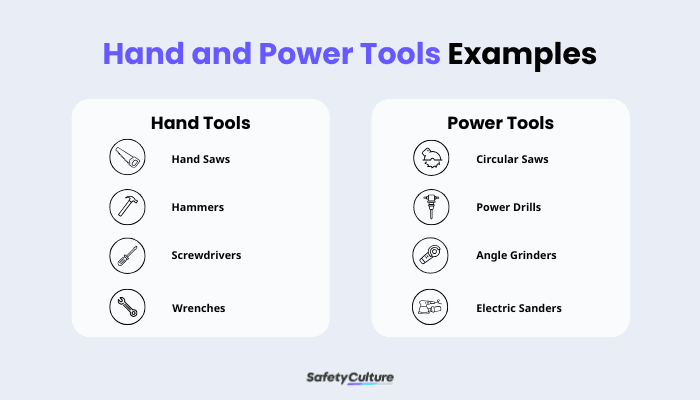
Hand and Power Tools Examples
Hand saws: Used for cutting wood, metal, or other materials.
Hammers: Used for driving nails or other fasteners into wood or other materials.
Screwdrivers: Used for driving screws into wood or other materials.
Wrenches: Used for tightening or loosening nuts and bolts.
Power tools are another type of tool that can be used for a variety of tasks. Common examples of power tools include:
Circular saws: Used for quickly cutting wood, metal, or other materials.
Power drills: Used for making holes in wood, metal, or other materials.
Angle grinders: Used for grinding, polishing, and deburring.
Electric sanders: Used for smoothing and finishing.
There are a variety of injuries that can be associated with hand and power tools. In fact, according to the Consumer Product Safety Commission, about 400,000 people are sent to the emergency room due to hand and power tool injuries.
Some of the most common injuries include the following:
Cuts
Lacerations
Punctures
Abrasions
Contusions
In more severe cases, hand and power tools can lead to injuries such as:
Fractures
Amputations
Electric shocks
Burns
Most of these injuries can be prevented by using the proper safety gear and following proper safety procedures. However, even with the best precautions, accidents can still happen. If you suffer an injury from a hand or power tool, it’s important to seek medical attention as soon as possible.
Build from scratch or choose from our collection of free, ready-to-download, and customizable templates.
Since hand and power tools are often used in construction and similar operations, it’s important to be aware of the potential workplace hazards before using them. Here are some safety tips to keep in mind when using these tools:
Because hand tools don’t rely on mechanical power, it’s easy to accidentally injure yourself or others if they’re not used correctly. Always use proper form and handling when working with sharp tools. Below are some other key safety tips:
Inspect your tools before each use to make sure they are in good condition.
Be sure to use the proper tool for the job at hand.
Use Personal Protective Equipment (PPE) as needed.
Always be alert and focus on the task at hand.
Keep your work area clean and tidy to avoid trip hazards.
Discard any worn out-tools such as hammers, saws, etc.
While power tools are mechanically operated, that doesn’t mean they’re less risky to handle. Their complex design and use of electricity can increase the chance of accidents if not used correctly. Below are some key safety tips:
Read and follow the operator’s manual before using.
Always unplug tools when not in use or before adjusting or cleaning them.
Use proper PPE as needed.
Avoid wearing loose clothing or jewelry that could get caught in moving parts.
Maintain a clean, dry, and well-ventilated work area to prevent dust buildup, electrical hazards, and exposure to fumes.
Check for any loose screws, damaged parts, or worn cords before operating tools.
When it comes to ensuring consistent workplace safety and proper equipment handling procedures, SafetyCulture is your one-stop hub. With sensors that detect when equipment is worn out or overheating to scheduled maintenance reminders, mobile-ready report forms, and asset management and tracking tools, you can easily identify potential downtime or accidents before they happen.
Optimize your organization's operations and workflow with SafetyCulture. Our digital platform enables you to:
Simplify processes by automating manual and repetitive tasks
Maintain safety, quality, and compliance standards with digital checklists
Create powerful workflows by integrating your existing systems and software
Gain greater visibility and transparency with real-time reporting
Take advantage of our comprehensive features to transform your organization’s capabilities towards operations excellence.