A Comprehensive Guide to General Food Law
This guide breaks down the General Food Law into legal standards and responsibilities to ensure you're informed and compliant.

This guide breaks down the General Food Law into legal standards and responsibilities to ensure you're informed and compliant.
Published 28 Apr 2026
Article by
6 min read
The General Food Law regulation represents a foundational piece of legislation within the European Union aimed at ensuring food safety from production to consumption. Officially known as Regulation (EC) No. 178/2002, it establishes the European Food Safety Authority (EFSA) and lays down fundamental principles, requirements, and food and feed safety procedures.
This law establishes mechanisms that enable authorities and businesses to trace foodstuffs in all stages of production, processing, and distribution. Additionally, it promotes transparent communication with the public regarding food safety concerns, risks, and regulations to maintain consumer trust and protect public health across the European Union (EU).
The EU food regulation functions as a comprehensive framework that oversees the entire food supply chain, from primary production to the point of consumption. It ensures food is safe, traceable, and produced under standardized conditions.
Regulators, industry participants, and scientific experts collaborate to build the system and uphold food safety and public health.
Components of how the general food law regulation works include:
Traceability: Create a system to track food products during the production, processing, and distribution stages.
Risk Assessment: Applies scientific evaluation to identify and analyze potential food hazards.
Control Measures: Implements procedures to prevent, eliminate, or reduce food safety risks to acceptable levels.
Monitoring and Enforcement: Involves regular inspections, testing, and compliance checks by authorities.
Use of Technology: Enhances efficiency in tracking, reporting, and managing food safety practices across the supply chain.
These mechanisms collectively create a structured and reliable approach to maintaining food safety from farm to table.
Enhance operational efficiency with monitoring sensors. Track real-time data and insights to never miss another food safety incident.
The EU General Food Law protects human health and consumer interests in food safety. Various principles underpin the General Food Law, including:
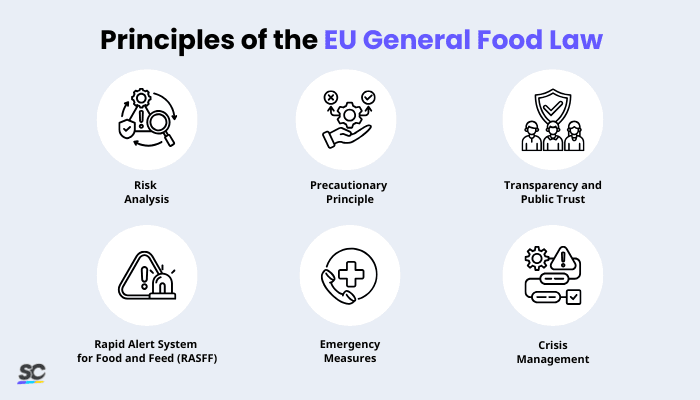
Principles of the EU General Food Law
The EU General Food Law protects human health and consumer interests in food safety. Various principles underpin the General Food Law, including:
EU food law follows a structured approach to risk analysis, where authorities assess, manage, and communicate risks effectively. It ensures that all food safety decisions are informed, science-based, and systematically executed.
Risk assessment is conducted independently and must rely on sound scientific data to evaluate potential food-related hazards. Risk management considers these assessments, EFSA opinions, and other relevant factors to determine the best protective actions.
Authorities may take action under the precautionary principle even when scientific uncertainty exists, especially if they identify potential health risks. They may apply temporary risk management measures to protect public health in such cases.
The European Commission's Communication on the Precautionary Principle provides guidelines for its consistent and transparent use. Stakeholder engagement and public consultation are essential unless immediate risks necessitate urgent action without delay.
Transparency is essential to maintaining public confidence in food law and ensuring informed decision-making inside the EU. This principle addresses the concerns of consumers, organizations, and international partners regarding food safety.
Mechanisms such as public consultations are built into the regulation to support openness. Authorities must also inform the public when food or feed poses a potential health risk.
RASFF is vital to the EU's high food safety standards by enabling fast, coordinated responses to food and feed risks. It ensures the timely sharing of health-related information among member states.
The system operates 24/7 to handle urgent notifications and prevent harmful products from reaching consumers. Through the RASFF Window, the public can access non-confidential summaries of alerts for improved transparency.
The European Commission can intervene with emergency actions if it identifies a serious food or feed risk that national authorities can’t manage. These may include suspending marketing or imposing specific conditions on use.
Such measures are adopted either on the Commission's initiative or at a member state's request, following the procedures set by EU regulations. The objective is to promptly contain and minimize threats to health or the environment.
The Commission is required to develop a comprehensive crisis management plan in collaboration with EFSA and EU Member States. This plan ensures effective coordination during significant food safety incidents.
Established under Decision (EU) 2019/300, the plan outlines coordination and emergency response procedures. It also includes a clear communication strategy to uphold transparency during food-related crises.
All businesses operating within the EU food industry are subject to strict legal obligations related to food safety. These obligations are in place to protect both consumers and businesses from potential risks or harm caused by unsafe food products.
Some legal obligations for enterprises include:
Responsibility for Food Safety: Food business operators are primarily responsible for ensuring that the food they produce, process, or distribute is safe for consumption. This obligation applies at every stage of the food supply chain.
Traceability Requirements: Businesses must implement systems to trace food, feed, and ingredients both one step backward and one step forward in the supply chain. It enables quick identification and management of potential risks.
Withdrawal and Recall Duties: If a product is found unsafe, businesses are legally required to withdraw it from the market and, if necessary, recall it from consumers. They must also inform the relevant authorities and provide full risk details.
Accurate and Non-Misleading Labeling: Food labels must provide truthful and clear information that does not mislead consumers about the product's characteristics, composition, or origin. Misrepresentation can lead to enforcement actions and damage to public trust.
Collaboration with Regulatory Authorities: Businesses must cooperate fully with food safety authorities by providing requested information and facilitating inspections. This cooperation ensures transparency and supports the effectiveness of food law enforcement.
HACCP Plan: The EU's General Food Law Regulation mandates that food business operators implement procedures based on Hazard Analysis and Critical Control Points (HACCP) principles for food safety.
SafetyCulture is a mobile-first operations platform adopted across industries such as manufacturing, mining, construction, retail, and hospitality. It’s designed to equip leaders and working teams with the knowledge and tools to do their best work—to the safest and highest standard.
Promote a culture of accountability and transparency within your organization where every member takes ownership of their actions. Align governance practices, enhance risk management protocols, and ensure compliance with legal requirements and internal policies by streamlining and standardizing workflows through a unified platform.
Save time and reduce costs
Stay on top of risks and incidents
Boost productivity and efficiency
Enhance communication and collaboration
Discover improvement opportunities
Make data-driven business decisions